Rose-breasted Grosbeak Identification Guide
A stocky black-and-white finch of eastern woodlands, the male Rose-breasted Grosbeak is unmistakable with its triangular rose-red breast patch and massive pale bill.
Read the full Rose-breasted Grosbeak encyclopedia entry →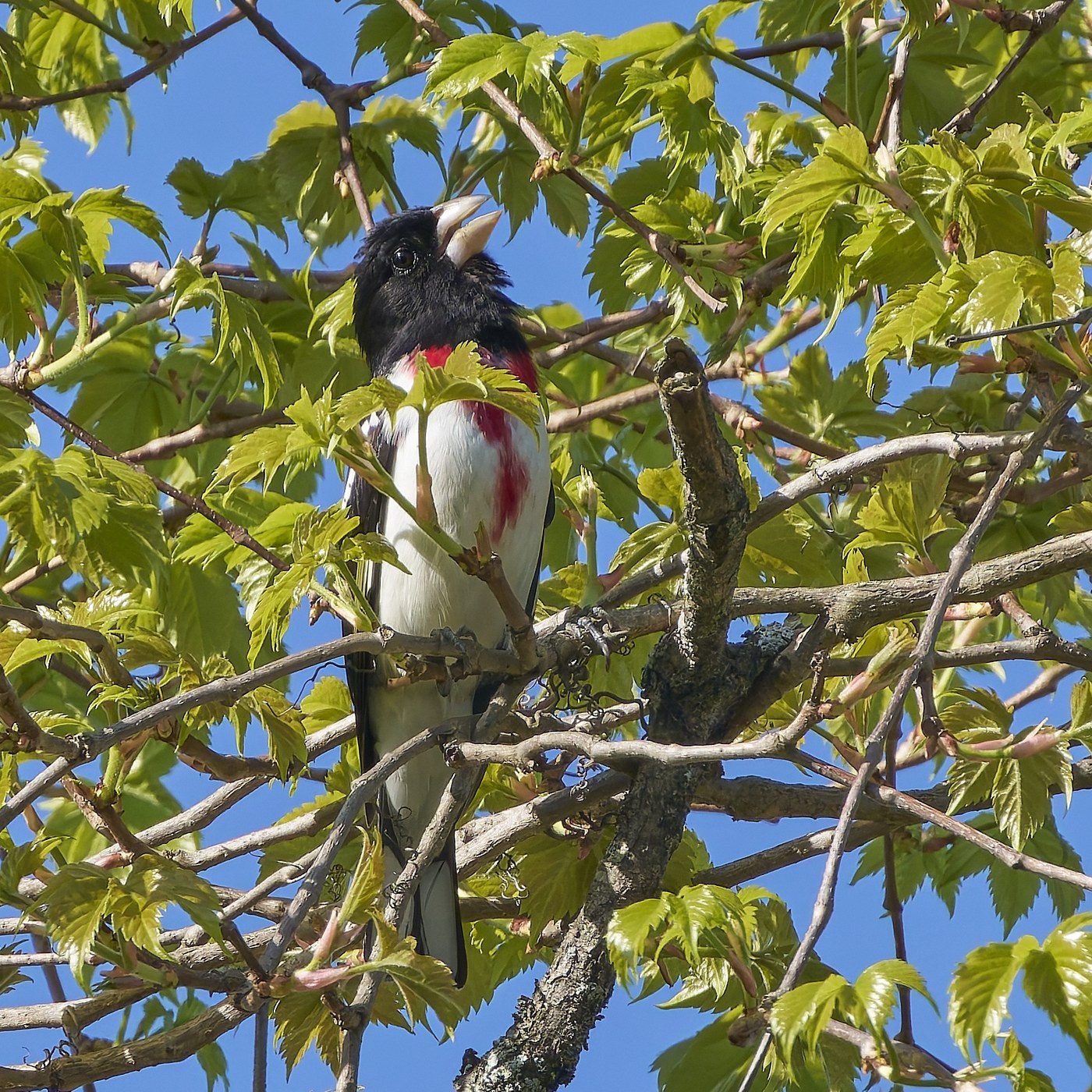
Key Field Marks
- Size & shape: A chunky, robin-sized songbird (about 19–21 cm) with a very large, conical, pale pinkish-white bill — proportionally one of the biggest bills of any North American songbird its size.
- Adult male: Bold black head, back, wings, and tail contrasting sharply with a white belly; a triangular rose-red or raspberry-pink patch splashed across the upper breast; white wing patches flash in flight; white rump.
- Adult female and immature male: Brown and heavily streaked above and below, with a bold white eyebrow stripe (supercilium) and a pale central crown stripe, giving a strong sparrow-like face pattern. The oversized pale bill is the giveaway that it's a grosbeak, not a sparrow or finch.
- In flight: Both sexes show bright wing linings — rosy-pink in males, lemon-yellow in females and immatures — visible from below as the bird flies overhead.
Separating It From Similar Species
- Black-headed Grosbeak (mostly western, overlaps in the Great Plains): males have warm cinnamon-orange underparts and face rather than white-and-rose; females are very similar to female Rose-breasted but average buffier below. Where ranges meet, hybrids occur and can show intermediate breast color.
- Female/immature vs. large sparrows or Purple Finch: the grosbeak's much heavier, pale (not dark) bill and bold facial stripes are the quickest separators.
- Female vs. female Black-headed Grosbeak: underwing color (yellow in Rose-breasted vs. yellow-orange, more saturated in Black-headed) and voice are the most reliable clues; ranges rarely overlap except in a narrow contact zone.
Where and When to Find One
- Habitat: Deciduous and mixed woodland edges, second-growth forest, orchards, parks, and shrubby streamsides.
- Range and season: Breeds across southern Canada and the northeastern and north-central United States. A long-distance migrant, it winters from Mexico through Central America into northern South America, so it is absent from its breeding range outside roughly May–September; look for it at feeders (especially sunflower seed) during spring and fall migration.
- Behavior: Forages methodically in the mid-story and canopy for insects, seeds, and berries; readily visits backyard feeders during migration.
Voice
- Song: A rich, rapid, sweetly warbled series often described as sounding like "a robin who took voice lessons" — smoother and more melodic than an American Robin's song.
- Call: A sharp, distinctive squeaky note likened to a sneaker squeaking on a gym floor — a useful clue even when the bird is hidden in foliage.
Frequently asked questions
What does a female Rose-breasted Grosbeak look like?
She is streaky brown above and below with a bold white eyebrow stripe and pale crown stripe, resembling an oversized sparrow. Her very large, pale conical bill and yellowish underwing in flight distinguish her from true sparrows and finches.
How can I tell a Rose-breasted Grosbeak from a Black-headed Grosbeak?
Male Rose-breasted has a rose-red triangle on an otherwise white breast, while male Black-headed has warm cinnamon-orange underparts. Females are very similar; range is the best clue, since Rose-breasted is an eastern bird and Black-headed a western one.
Where do Rose-breasted Grosbeaks go in winter?
They migrate to Central America and northern South America, so they are not present in their North American breeding range from roughly October through April.
What sound does a Rose-breasted Grosbeak make?
Its song is a fast, rich, warbling melody often compared to a robin's song but smoother and more musical; its call note is a sharp, squeaky "eek" like a sneaker on a gym floor.
Rose-breasted Grosbeak identified by the community
Recent Rose-breasted Grosbeak sightings identified with Bird Identifier.