
Rook Identification Guide
A social Eurasian crow with a bare, pale grayish face patch, a peaked crown, and shaggy "trouser" feathering on the thighs, almost always seen in noisy flocks.
Read the full Rook encyclopedia entry →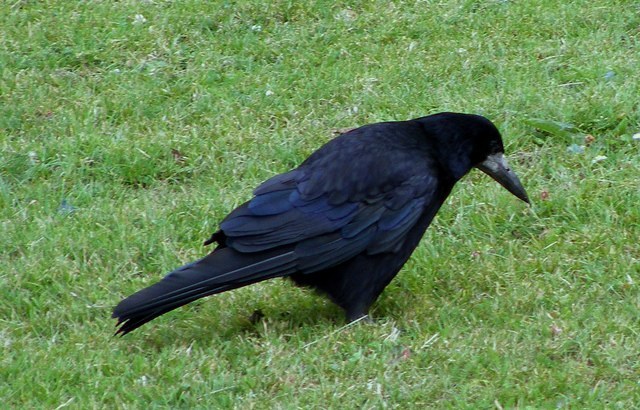
Key Field Marks
- Size & shape: About 44–46 cm, similar in size to a Carrion Crow but with a distinctly peaked, angular crown and a longer, more slender, pointed bill.
- Plumage: Entirely black with a purplish-blue iridescent sheen in good light; the thigh feathers are loose and shaggy, forming a baggy "trousers" look unique among common corvids.
- Bare parts: Adults show a distinctive area of bare, grayish-white skin at the base of the bill and around the face, exposed as feathers wear away with age — a feature Carrion Crow never shows.
- Behavior: Intensely social at every season, feeding, flying, and roosting in large, often noisy flocks, and nesting colonially in treetop "rookeries" of stick nests, sometimes with dozens of nests in a single stand of trees. Walks with a purposeful, strutting gait while foraging on open ground.
Separating It From Similar Species
- Carrion Crow: Fully feathered face (no bare skin patch), a smoother, more rounded crown, a thicker-based bill, and a solitary or loosely social habit rather than Rook's dense colonial flocking — Carrion Crow is rarely seen in the large, tight flocks typical of Rooks.
- Jackdaw: Much smaller, with a pale gray nape and hindneck and a pale (whitish) eye, quite different from the all-black Rook with its dark eye; Jackdaws often flock together with Rooks, offering a useful size comparison.
- Juvenile Rook: Lacks the bare face patch of adults (it is fully feathered like a crow) until the feathers wear away in the first year or so, which can cause confusion with Carrion Crow until the flocking behavior and shaggy thigh feathers are noted.
Habitat, Range & Season
Rooks are birds of open farmland, pasture, and lowland countryside with stands of tall trees for nesting, found across most of Europe and temperate Asia, and introduced to New Zealand. They are largely resident across much of their range, though some northern and eastern populations move south or west in winter, sometimes forming enormous mixed roosts with Jackdaws. They forage in flocks in open fields, probing the ground for invertebrates, grain, and other food.
Voice
A harsh, nasal "kaah" or "caw," generally higher-pitched and more variable than the deeper, more monotone call of Carrion Crow; rookeries produce a constant, varied chorus of guttural caws, clicks, and softer sounds, especially during the breeding season.
Frequently asked questions
What is the single best field mark for an adult Rook?
The patch of bare, pale grayish-white skin at the base of the bill and around the face, which Carrion Crow and other similar black corvids never show.
How do young Rooks differ from adults?
Juvenile Rooks have a fully feathered face like a Carrion Crow and only develop the bare facial skin patch as they mature, so behavior (flocking, colonial nesting) and shape are better clues at that age.
Why are Rooks often seen in large groups?
They are highly social year-round, feeding, roosting, and nesting communally; their colonial tree nest sites, called rookeries, can hold dozens of nests.
How is a Rook different from a Jackdaw?
Rook is larger and entirely black except for its bare face patch, while Jackdaw is smaller with a pale gray nape and a pale eye; the two species often flock together, which helps with direct size comparison.