
Rockhopper Penguin Identification Guide
A small, spiky-crested penguin of sub-Antarctic islands, known for its bright red eyes and yellow head-plumes and for hopping rather than waddling over rocks.
Read the full Rockhopper Penguin encyclopedia entry →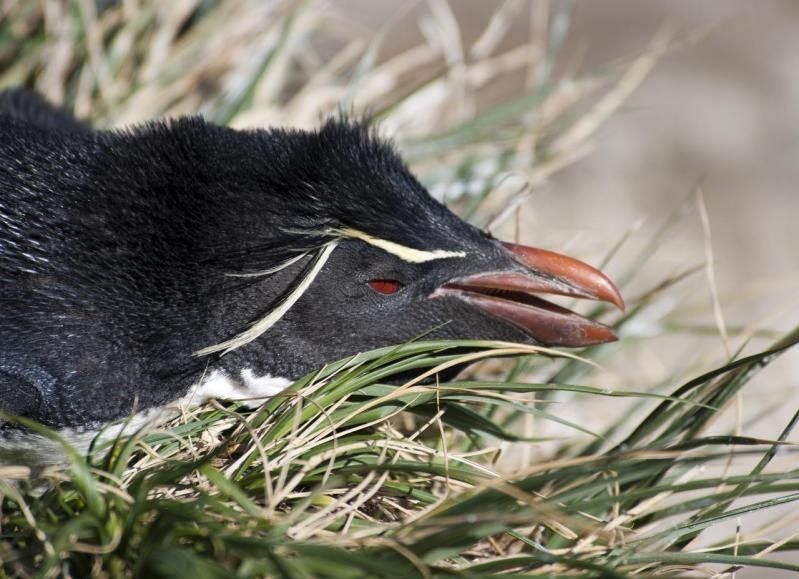
Key Field Marks
- Size & shape: One of the smallest penguin species, about 45–58 cm tall, with a compact, upright build.
- Plumage: Glossy black upperparts and head contrast sharply with clean white underparts, in typical penguin countershading pattern.
- Head ornaments: A bright yellow eyebrow stripe runs from the base of the bill back over the eye and explodes into a spray of long, drooping yellow (and black) plumes that stick out to the sides of the head, giving a spiky, punk-like crest.
- Bare parts: Striking red eyes, a stout orange-red bill, and pinkish skin visible at the base of the bill.
- Behavior: True to its name, moves over rocky terrain by hopping with both feet together rather than waddling, and is highly agile climbing steep, rocky colony sites; nests in dense, noisy colonies.
Separating It From Similar Species
- Macaroni Penguin: Larger, with orange (not yellow) plumes that originate close together on the forehead and join in a single crest, rather than the Rockhopper's separated yellow eyebrow stripes that flare out to the sides.
- Fiordland and Snares Penguins: Both lack the Rockhopper's fully separated, spiky plume tufts and have broader, less spiky yellow eyebrow stripes without the same explosive "hairdo" appearance; both also have more limited ranges around New Zealand.
- Erect-crested Penguin: Plumes stand more stiffly upright rather than drooping/flaring to the side, and the species is restricted to a small number of subantarctic New Zealand islands.
Habitat, Range & Season
Rockhopper Penguins breed in dense colonies on rocky, often steep and boulder-strewn coastlines of sub-Antarctic islands, including the Falkland Islands, islands off southern South America, and various sub-Antarctic islands in the South Atlantic and Indian Oceans (with Northern, Southern, and Eastern forms recognized across this range by many authorities). They come ashore to breed in spring and summer (austral spring/summer, roughly October–March in the south) and spend the rest of the year at sea, ranging widely over the Southern Ocean.
Voice
Loud, harsh, braying and trumpeting calls given at breeding colonies, used in mate recognition and territorial disputes; colonies are notably loud and constant during the breeding season.
Frequently asked questions
Why is it called the Rockhopper Penguin?
Because it moves over rocky, uneven terrain by hopping with both feet together, rather than the waddling walk typical of most other penguin species.
How can I tell a Rockhopper Penguin from a Macaroni Penguin?
Rockhopper has separated yellow eyebrow plumes that flare out to the sides of the head, while Macaroni Penguin's orange plumes originate close together on the forehead and join into a single crest; Macaroni is also larger.
Where do Rockhopper Penguins live?
On rocky, sub-Antarctic islands, including the Falkland Islands and various islands in the South Atlantic and Indian Oceans, coming ashore to breed in spring and summer and otherwise living at sea.
What color are a Rockhopper Penguin's eyes?
Bright red, one of the species' most distinctive features along with its orange-red bill and yellow head plumes.