
Rock Dove Identification Guide
The wild ancestral pigeon of Eurasian sea cliffs — blue-gray with two black wingbars, a white rump, and an iridescent neck sheen.
Read the full Rock Dove encyclopedia entry →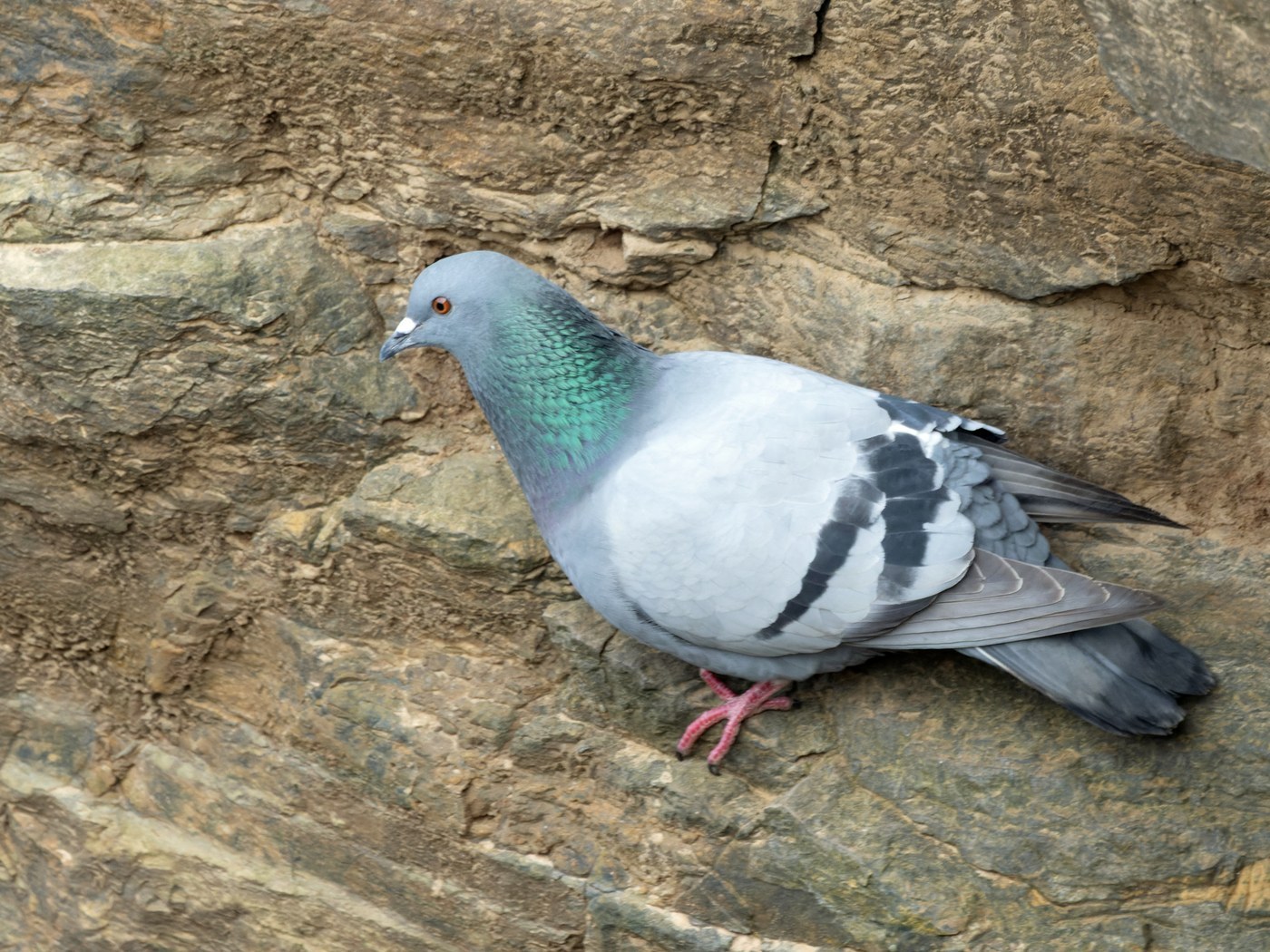
Key Field Marks
- Size & shape: A medium-sized, plump-bodied pigeon about 31–35 cm long, with a small head, short neck, and pointed wings typical of the genus Columba.
- Plumage: In its pure wild form, blue-gray overall with a paler gray back, two bold black bars across each closed wing, and a black band at the tip of the tail. The rump is white or pale gray, contrasting with the rest of the upperparts and visible well in flight.
- Head & neck: The neck and upper breast show an iridescent green and purple sheen, brightest in good light.
- Bare parts: Dark eyes, a dark bill with a pale, fleshy cere (bulge) at the base, and reddish-pink legs.
- Behavior: Highly gregarious, flying in tight, fast, wheeling flocks; nests colonially on ledges and in caves and crevices on sea cliffs and rock faces.
Separating It From Similar Species
- Stock Dove: Smaller, lacks the white rump, and shows shorter, less complete double wingbars restricted to the closed wing, plus dark eyes without the pale cere.
- Woodpigeon: Larger and bulkier with a conspicuous white neck patch and white wing bar visible in flight, quite different from the clean gray-and-white pattern of a wild Rock Dove.
- Feral pigeons: Descended from domesticated Rock Doves, feral birds show enormous plumage variation — checkered, pied, all-dark, or white-blotched — unlike the uniform pattern of genuinely wild Rock Doves found on remote cliffs.
Habitat, Range & Season
The native, wild Rock Dove breeds on sea cliffs, rocky coastlines, and inland crags and gorges across western and southern Europe, North Africa, and the Middle East into central and southern Asia. Truly wild, unmixed populations are now scarce and localized — found mainly on remote coasts of northwestern Scotland, Ireland, and parts of the Mediterranean and Central Asia — because feral and domestic pigeons have interbred with wild birds through much of the historical range. Rock Doves are non-migratory, remaining near their cliff colonies year-round.
Voice
A soft, rolling, repeated cooing, often rendered "coo-roo-c'coo," given from ledges and during display flights.
Frequently asked questions
Is the Rock Dove the same species as the city pigeon?
Yes — the feral pigeons common in cities are descended from domesticated Rock Doves, but genuinely wild Rock Doves are the ancestral cliff-nesting form and look much more uniform in plumage.
Where can I still see truly wild Rock Doves?
On remote sea cliffs and coastlines, such as parts of northwestern Scotland and Ireland, and rocky coasts around the Mediterranean and into Central Asia, away from areas with heavy feral pigeon populations.
How do I tell a wild Rock Dove from a feral pigeon?
Wild Rock Doves show a consistent blue-gray body, two clean black wingbars, and a white rump, while feral pigeons show highly variable plumage — checkered, pied, dark, or white patches — from generations of mixed domestic breeding.
What is the best field mark for a Rock Dove in flight?
The contrasting white rump against the gray body and the two black wingbars on the closed or partly open wing.