
Ring-necked Pheasant Identification Guide
A large, long-tailed introduced game bird whose iridescent copper-and-green male is unmistakable, while the camouflaged brown female is best told from grouse by her long pointed tail.
Read the full Ring-necked Pheasant encyclopedia entry →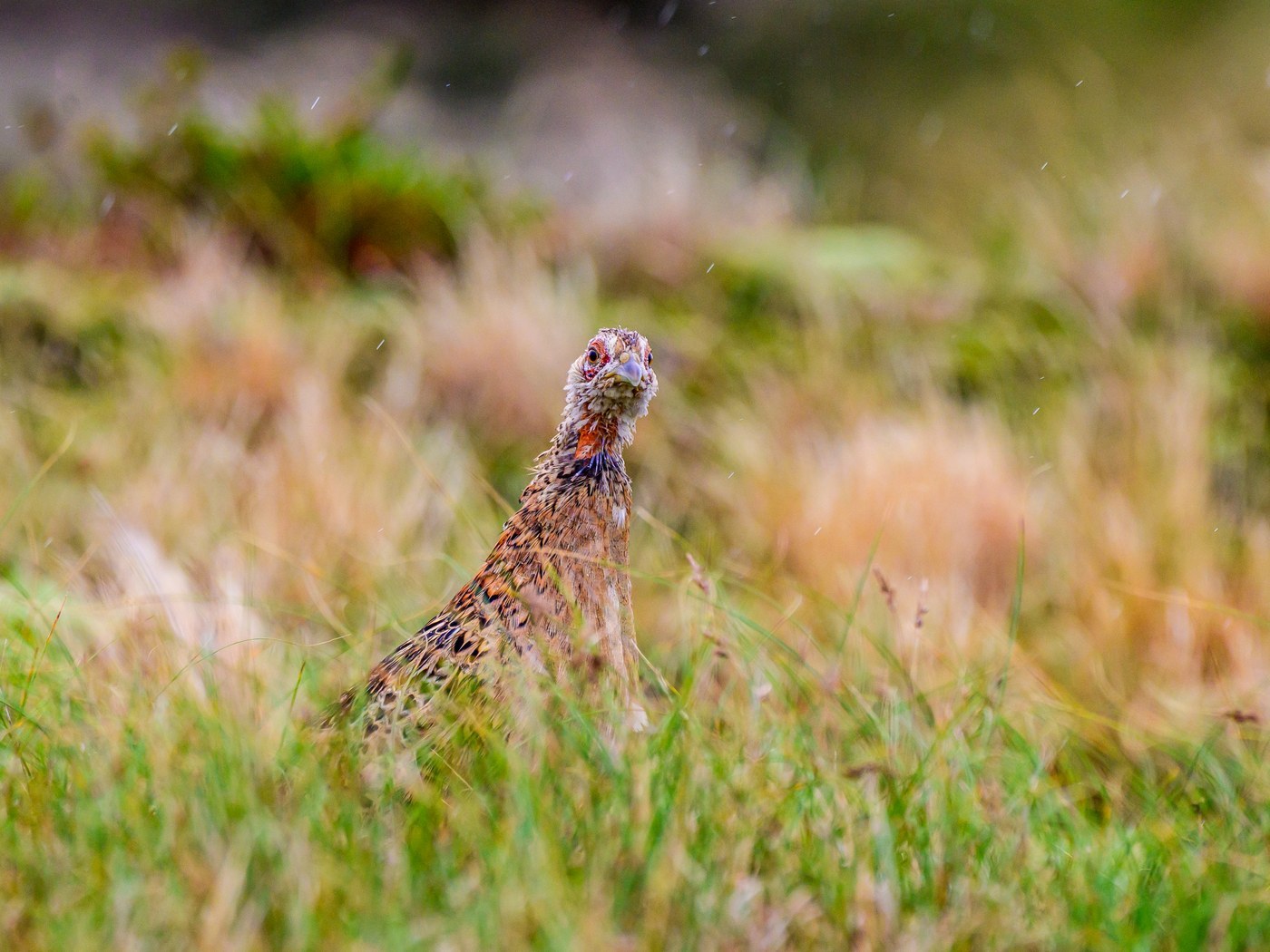
Key Field Marks
- Large, long-tailed ground bird; males can reach 75-90 cm including the tail, females are noticeably smaller and shorter-tailed but still substantial
- Male: iridescent copper and gold body plumage, dark glossy green head, bright red bare facial wattles, and (in most populations) a bold white ring around the neck; very long, pointed, barred tail
- Female: mottled buff and brown overall with fine dark barring and streaking for camouflage, and a shorter but still fairly long pointed tail compared to other ground birds
- Both sexes have relatively short, rounded wings suited to explosive, powerful flushes rather than sustained flight
Separating Ring-necked Pheasant from Similar Species
- Adult males are essentially unmistakable due to their bold coloration, red facial wattles, and long tail; no confusion species share this combination across most of the introduced range.
- Female pheasants vs. grouse: female pheasants have a notably longer, pointed tail compared to the shorter, more fan-shaped or squared tails of native grouse species, which is the most reliable mark when only a brown ground bird is glimpsed.
- Female pheasants vs. partridges: partridges are smaller and rounder-bodied with much shorter tails, lacking the pheasant's elongated tail profile.
Habitat, Range & Season
- Native to Asia, but has been extensively introduced and is now well established in farmland, grassland, and hedgerow habitats across North America, Europe, and New Zealand
- Favors agricultural edges, weedy field margins, grassy cover, and hedgerows adjacent to open cropland
- Largely resident year-round wherever established, without major migratory movements
Behavior Notes
- Primarily ground-dwelling, foraging by walking and scratching through vegetation and stubble for seeds, grain, and insects
- Roosts off the ground in trees or dense shrubby cover at night
- Flushes explosively when disturbed, with a loud burst of wingbeats followed by a fast, low glide
- Males are territorial during the breeding season, performing wing-whirring displays paired with their crowing call
Voice
- Male gives a loud, harsh, two-note crowing call, often rendered as "kork-kok," typically followed immediately by a brief burst of whirring wingbeats
- Females are generally much quieter, with soft clucking notes
Similar-Species Checklist
- Confirm the male's copper-gold body, green head, red wattles, and white neck ring
- For females, compare tail length and shape against local grouse and partridge species
- Note habitat — farmland and grassy edges rather than dense forest
Frequently asked questions
How do I tell a female Ring-necked Pheasant from a grouse?
Female pheasants have a much longer, pointed tail than native grouse, which typically have shorter, more fan-shaped or squared tails.
Do all Ring-necked Pheasant males have a white neck ring?
Most populations show the characteristic white neck ring, though it can be incomplete or reduced in some individuals and subspecies.
Where did Ring-necked Pheasants originally come from?
They are native to Asia but have been widely introduced and are now established in farmland habitats across North America, Europe, and New Zealand.
What does a Ring-necked Pheasant sound like?
The male gives a loud, harsh two-note crow, often described as 'kork-kok,' immediately followed by a short burst of whirring wingbeats.
What habitat do Ring-necked Pheasants prefer?
Farmland edges, grassy cover, hedgerows, and weedy field margins adjacent to open agricultural land.