
Ring-necked Duck Identification Guide
A peaked-headed North American diving duck best identified by the white ring near the bill tip and a white spur on the flank, rather than the subtle chestnut neck ring that gives it its name.
Read the full Ring-necked Duck encyclopedia entry →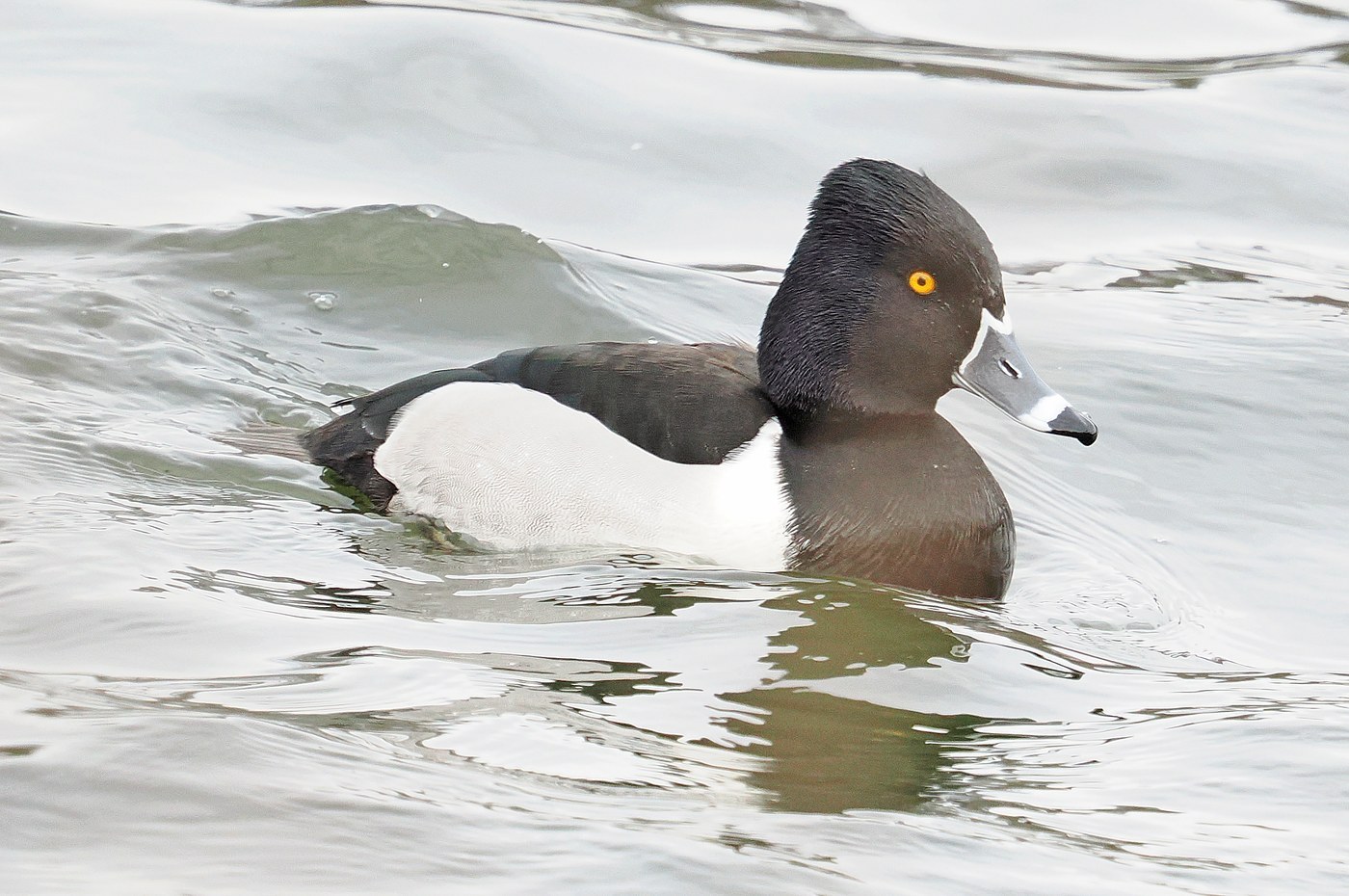
Key Field Marks
- Medium-sized diving duck with a distinctly peaked, angular crown that comes to a slight point at the back of the head
- Male: glossy black head with purple sheen, black back and breast, gray flanks with a bold white vertical spur in front of the folded wing, and a gray bill with a white ring near the black tip plus a thin white ring at the base
- Female: brown overall with the same peaked head shape, a distinct white eye-ring, a paler grayish face patch around the base of the bill, and a duller version of the male's bill pattern
- The chestnut neck ring that gives the species its name is subtle and often very hard to see in the field, even at close range
Separating Ring-necked Duck from Similar Species
- Scaup (Lesser and Greater): have a rounder, less peaked head shape, plain gray bills without a white ring, and lack the bold white flank spur; scaup also tend to favor larger, more open water bodies.
- Tufted Duck: shows a drooping head tuft and is mostly a Eurasian species, with different range and a more contrasting white-flanked pattern without the bill ring.
- The peaked head shape combined with the white-ringed bill and flank spur is the most reliable combination for separating Ring-necked Duck from all scaup species.
Habitat, Range & Season
- Breeds on freshwater ponds, bogs, and marshes across the boreal forest zone of Canada and the northern United States
- Winters on lakes, ponds, flooded timber, and slow rivers across the southern United States, Mexico, and Central America, often favoring smaller, more vegetated wetlands than scaup
- Migrates broadly across the interior of North America in spring and fall
Behavior Notes
- A diving duck that feeds on aquatic vegetation, seeds, and invertebrates in relatively shallow water
- Often found in smaller, quieter ponds and wooded wetlands compared to the more open-water habits of scaup
- Typically seen in small to moderate flocks rather than the huge rafts sometimes formed by scaup
Voice
- Generally quiet; males give soft whistled notes, while females utter a harsh, growling "churr," mainly during courtship or when flushed
Similar-Species Checklist
- Check head shape — peaked/angular in Ring-necked Duck versus rounded in scaup
- Look for the white ring near the bill tip and the white flank spur
- Note habitat preference for smaller, vegetated ponds rather than large open lakes
Frequently asked questions
Why is it called Ring-necked Duck if the neck ring is hard to see?
The chestnut ring around the neck that gives the species its name is subtle and often nearly invisible in the field; birders instead rely on the more visible white ring near the bill tip and the white flank spur for identification.
How do I tell a Ring-necked Duck from a scaup?
Ring-necked Duck has a peaked, angular head shape, a white ring near the bill tip, and a bold white flank spur, while scaup have rounder heads, plain gray bills, and lack the white flank marking.
What does a female Ring-necked Duck look like?
Brown overall with the same peaked head shape as the male, a distinct white eye-ring, a pale face patch near the bill base, and a duller version of the male's ringed bill pattern.
Where do Ring-necked Ducks live?
They breed on boreal ponds and bogs in Canada and the northern U.S., and winter on lakes, ponds, and flooded timber across the southern U.S., Mexico, and Central America.
What habitat do Ring-necked Ducks prefer compared to scaup?
Ring-necked Ducks tend to favor smaller, more vegetated ponds and wooded wetlands, while scaup are more associated with larger open-water lakes and bays.