
Rhinoceros Hornbill Identification Guide
A huge Southeast Asian rainforest hornbill instantly recognizable by its massive upturned yellow-orange casque, black-and-white plumage, and audible wingbeats.
Read the full Rhinoceros Hornbill encyclopedia entry →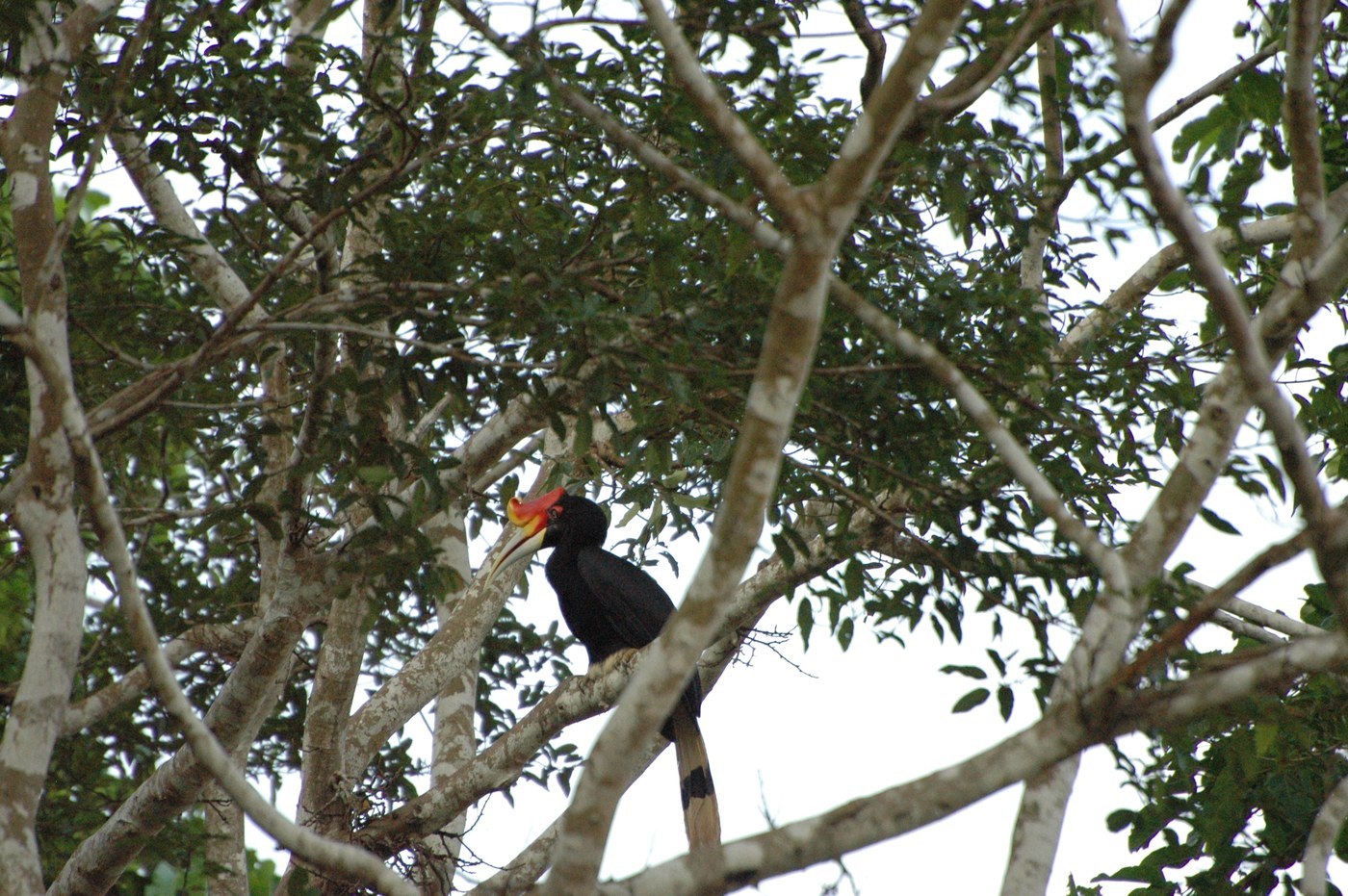
Key Field Marks
- Very large hornbill, up to about 110-127 cm including the tail, among the largest hornbills in Southeast Asia
- Predominantly black body with a white belly, thighs, and lower back, and a white tail crossed by a bold black band
- Massive bill topped with a large, upturned, yellow-to-orange casque shaped somewhat like a rhinoceros horn, giving the species its name
- Eye color differs by sex: adult males have red eyes with a black outer ring, while females have whitish or pale eyes
Separating Rhinoceros Hornbill from Similar Species
- Great Hornbill: has a flatter, more rectangular yellow-and-black casque rather than the Rhinoceros Hornbill's tall, upcurved horn shape, and their ranges only marginally overlap (Great Hornbill favors mainland South/Southeast Asia).
- Helmeted Hornbill: has a solid, heavy casque (used for head-butting) rather than a hollow upturned horn, and shows a bare reddish throat patch not present in the Rhinoceros Hornbill.
- Wreathed Hornbill and other Southeast Asian hornbills: generally smaller casques without the tall upturned horn shape and different plumage patterning.
Habitat, Range & Season
- Resident in primary and mature secondary lowland and hill rainforest of Borneo, Sumatra, and the Malay Peninsula
- Requires large tracts of tall forest with big trees for nesting and fruiting resources, making it sensitive to deforestation
Behavior Notes
- Female seals herself inside a tree cavity nest using mud, droppings, and food remains, leaving only a narrow slit through which the male passes food during incubation and early chick-rearing
- Diet is dominated by figs and other rainforest fruit, supplemented with small animals such as insects, small reptiles, and rodents
- Flight produces loud, distinctive "whooshing" wingbeats audible from a considerable distance, a useful clue to the bird's presence even before it's seen
Voice
- Loud, far-carrying barking or honking calls, often given in a repeated "kok-kok-kok" series
- Calls and wingbeats together are often the first sign of a hornbill's presence in dense forest canopy
Similar-Species Checklist
- Confirm the tall, upturned yellow-orange casque shape versus the flatter casque of Great Hornbill
- Check eye color to help sex the bird (red-eyed male vs. pale-eyed female)
- Note white tail with a single black band and white belly/lower back
Frequently asked questions
How do I tell a Rhinoceros Hornbill from a Great Hornbill?
Rhinoceros Hornbill has a tall, upturned, horn-shaped casque, while Great Hornbill's casque is flatter and more rectangular. Their ranges also differ, with Great Hornbill mainly on mainland South and Southeast Asia.
How can I tell a male from a female Rhinoceros Hornbill?
Males have red eyes with a black outer ring, while females have paler, whitish eyes.
Where do Rhinoceros Hornbills live?
They inhabit primary and mature secondary rainforest on Borneo, Sumatra, and the Malay Peninsula.
Why does the female Rhinoceros Hornbill seal herself into the nest?
Sealing the tree cavity entrance with mud and droppings, leaving only a narrow slit, protects the female and eggs from predators while the male delivers food.
What do Rhinoceros Hornbills eat?
Mostly figs and other rainforest fruit, plus occasional insects, small reptiles, and rodents.