
Rhinoceros Auklet Identification Guide
A stocky North Pacific seabird named for the small upright horn that grows on breeding adults' bills, best distinguished from smaller auklets by its size, bill horn, and pale facial plumes.
Read the full Rhinoceros Auklet encyclopedia entry →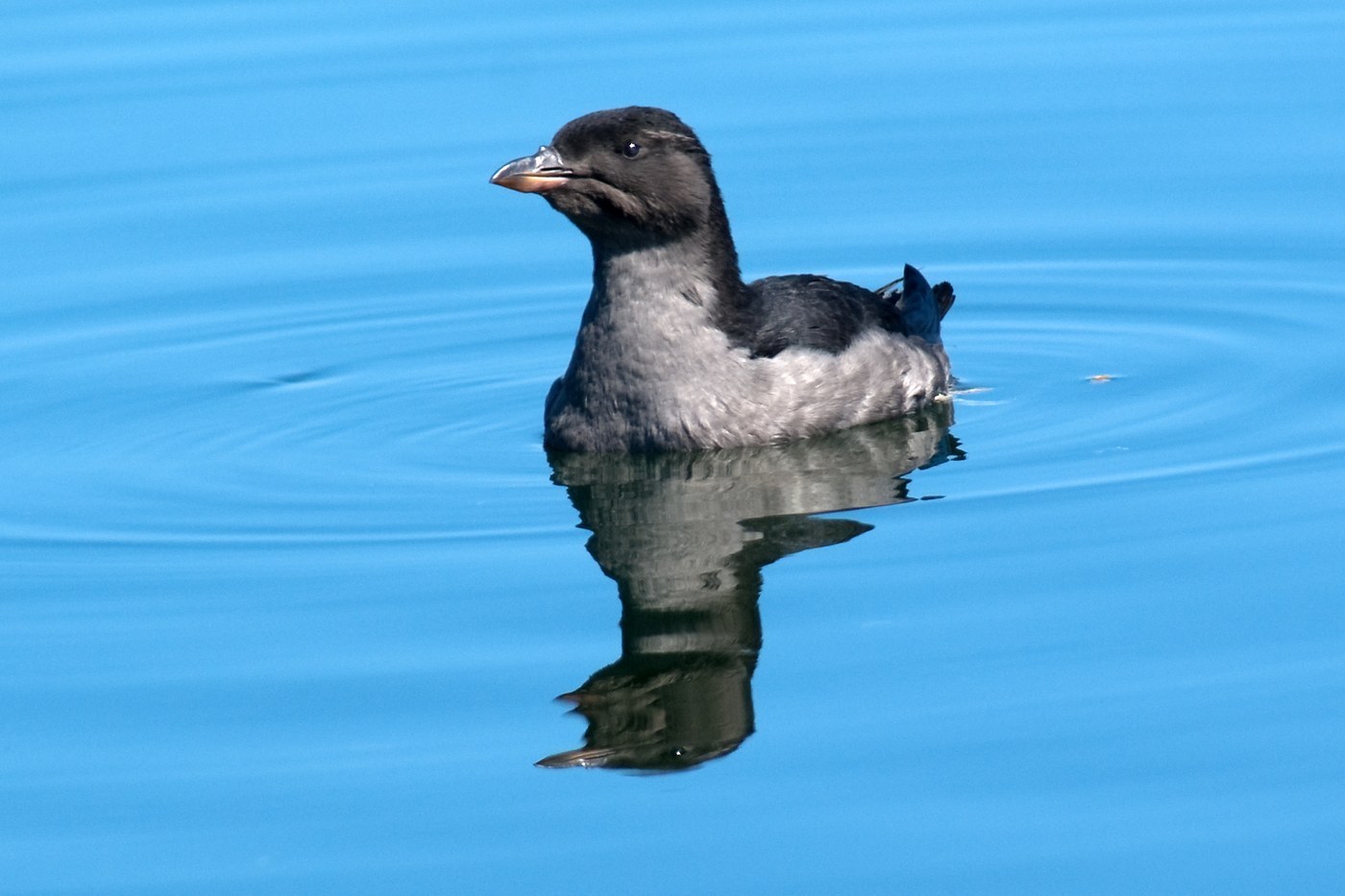
Key Field Marks
- Stocky, medium-sized alcid (auk family), around 35-39 cm, larger and bulkier than most other auklets
- Breeding adult: dark grayish-brown upperparts and paler grayish-brown underparts, with a stout orange-yellow bill bearing a distinctive pale, upright horn-like projection near the base — the feature giving the species its name
- Two thin white plume stripes on the face, one running above the eye and one below, present only in breeding plumage
- Non-breeding adult: bill horn and facial plumes are lost or reduced, and the bill becomes duller, making identification less obvious
Separating Rhinoceros Auklet from Similar Species
- Cassin's Auklet: notably smaller and plainer, with a stubby dark bill and no horn or facial plumes at any season.
- Crested Auklet: found mainly in the Bering Sea/Alaska region, with a distinctive forward-curling head crest rather than a bill horn, and different, more limited range overlap.
- Tufted Puffin: much larger with a massive, brightly colored triangular bill and (in breeding plumage) long yellow head tufts, easily separated by bill shape and size.
Habitat, Range & Season
- Breeds in burrows dug into soil on offshore and coastal islands around the North Pacific, from California north through British Columbia and Alaska, and west to Japan and Russia
- Forages at sea, sometimes well offshore, over continental shelf waters rich in small schooling fish
- Present at breeding colonies spring through late summer; disperses more broadly across open ocean in winter
Behavior Notes
- Nocturnal at breeding colonies, coming ashore only after dark to avoid predation by gulls and other aerial predators
- Adults carry several small fish held crosswise in the bill back to chicks in burrow nests, similar to puffins
- Mostly silent and inconspicuous at sea, making colony visits or dedicated pelagic trips the best way to observe them
Voice
- Low, growling or moaning calls given at night around breeding colonies, rarely heard away from nesting islands
- Generally silent while foraging at sea
Similar-Species Checklist
- Look for the bill horn and facial plumes to confirm breeding adult
- Compare overall bulk and bill shape against smaller Cassin's Auklet
- Note range and habitat — burrow-nesting colonies on North Pacific islands, foraging over shelf waters
Frequently asked questions
Why is it called a Rhinoceros Auklet?
Breeding adults grow a small, pale, upright horn-like projection near the base of the bill, resembling a rhinoceros horn, which is lost outside the breeding season.
How do I tell a Rhinoceros Auklet from Cassin's Auklet?
Rhinoceros Auklet is noticeably larger and bulkier with an orange-yellow bill, versus Cassin's Auklet's smaller size and plain dark, stubby bill.
Where do Rhinoceros Auklets live?
They breed in burrows on islands around the North Pacific, from California to Alaska and across to Japan, foraging at sea over continental shelf waters.
Why is it hard to see Rhinoceros Auklets at their colonies?
They only come ashore at night to avoid predators, so colony visits typically require after-dark observation or listening for their calls.
What do Rhinoceros Auklets eat?
Small schooling fish, which adults carry crosswise in the bill, several at a time, back to their chicks.