
Regent Parrot Identification Guide
A slender, long-tailed yellow-green parrot of Australian mallee and river red gum woodlands, distinguished from the similar Superb Parrot by its red wing patches and different range.
Read the full Regent Parrot encyclopedia entry →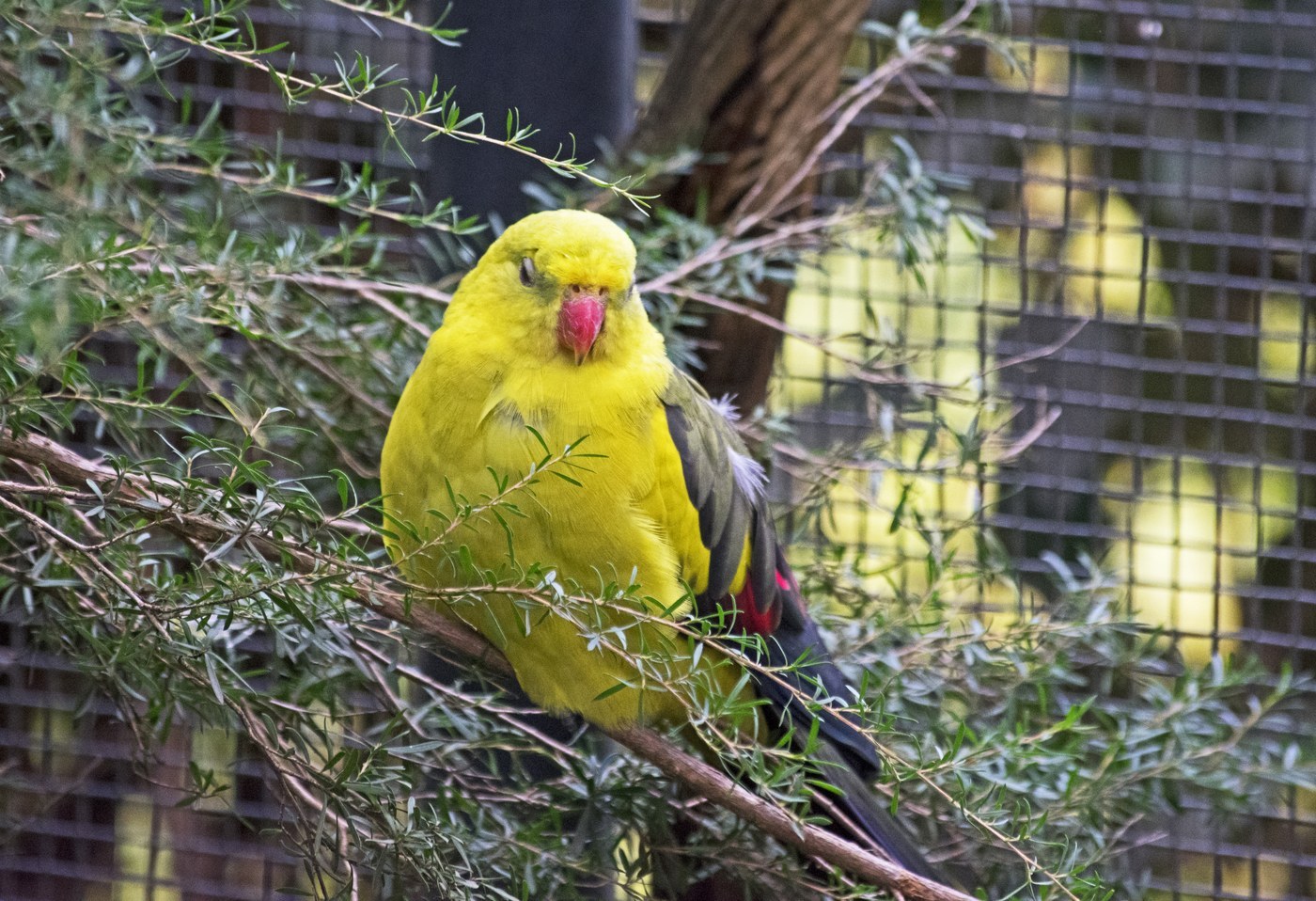
Key Field Marks
- Slender, long-tailed parrot around 37-42 cm, much of the length made up by a long, tapering tail
- Male: bright yellow-green overall plumage with a red band on the wing coverts (visible as a red patch on the folded wing) and red on the flight feathers, pale pinkish-red bill
- Female: duller olive-green with much less red on the wing, a longer and slightly more pointed tail than the male, and overall more subdued coloring
- Flight is fast, direct, and slightly undulating, with flocks giving a distinctive rolling call
Separating Regent Parrot from Similar Species
- Superb Parrot: male Superb Parrot has a bright red band across the throat/upper breast and more restricted range in NSW/Victoria river red gum forests further east; Regent Parrot lacks the red throat band and instead shows red on the wing.
- Rosellas: rosellas are shorter-tailed, more boldly patterned with distinct cheek patches and scalloped back markings, unlike the Regent Parrot's more uniform yellow-green body.
- Two disjunct subspecies exist — one in southwestern Australia's wheatbelt woodlands, one along the Murray-Darling river system in the southeast — so range helps narrow down which population you're seeing.
Habitat, Range & Season
- Favors mallee woodland, River Red Gum forest along major rivers (especially the Murray River), and semi-arid eucalypt woodland
- Two separated populations: southwestern Australia (wheatbelt and adjacent woodlands) and southeastern Australia (along the Murray River and tributaries in Victoria, New South Wales, and South Australia)
- Largely sedentary but can be locally nomadic, following seed and blossom availability
Behavior Notes
- Feeds both on the ground and in trees, taking seeds of eucalypts, saltbush, and other native and introduced plants, as well as blossom and some fruit
- Often seen in pairs or small flocks, perching high in eucalypts or flying fast overhead between feeding areas
- Nests in large tree hollows, typically in mature River Red Gums or other large eucalypts near water
Voice
- Loud, rolling flight call, often rendered as "currak-currak" or a similar rolling, metallic note, characteristic of the genus Polytelis
- Generally quieter when perched and feeding
Similar-Species Checklist
- Check for red throat band (Superb Parrot) versus red wing patch (Regent Parrot)
- Note the long, slender tail shared by both species in this genus, distinguishing them from shorter-tailed rosellas
- Confirm habitat — mallee/river red gum woodland rather than open farmland edges typical of some rosellas
Frequently asked questions
How do I tell a Regent Parrot from a Superb Parrot?
Male Regent Parrots show a red patch on the wing rather than a red throat band; Superb Parrot males have a bright red band across the throat and upper breast instead. Ranges also differ, with Superb Parrot centered further east.
What does a female Regent Parrot look like?
Females are duller olive-green with much less red on the wing than males, and have a slightly longer, more pointed tail.
Where do Regent Parrots live?
They occur in two separate populations: mallee and wheatbelt woodlands of southwestern Australia, and River Red Gum forest along the Murray River system in the southeast.
What is the Regent Parrot's call?
A loud, rolling 'currak-currak' flight call typical of the long-tailed Polytelis parrot group.
What do Regent Parrots eat?
Mainly seeds of eucalypts and other native plants, along with blossom, gathered both on the ground and in the tree canopy.