
Redwing Identification Guide
Europe's smallest true thrush, told from Song Thrush by its bold cream eyebrow stripe and rusty-red flanks, best known for its thin nocturnal flight calls during autumn migration.
Read the full Redwing encyclopedia entry →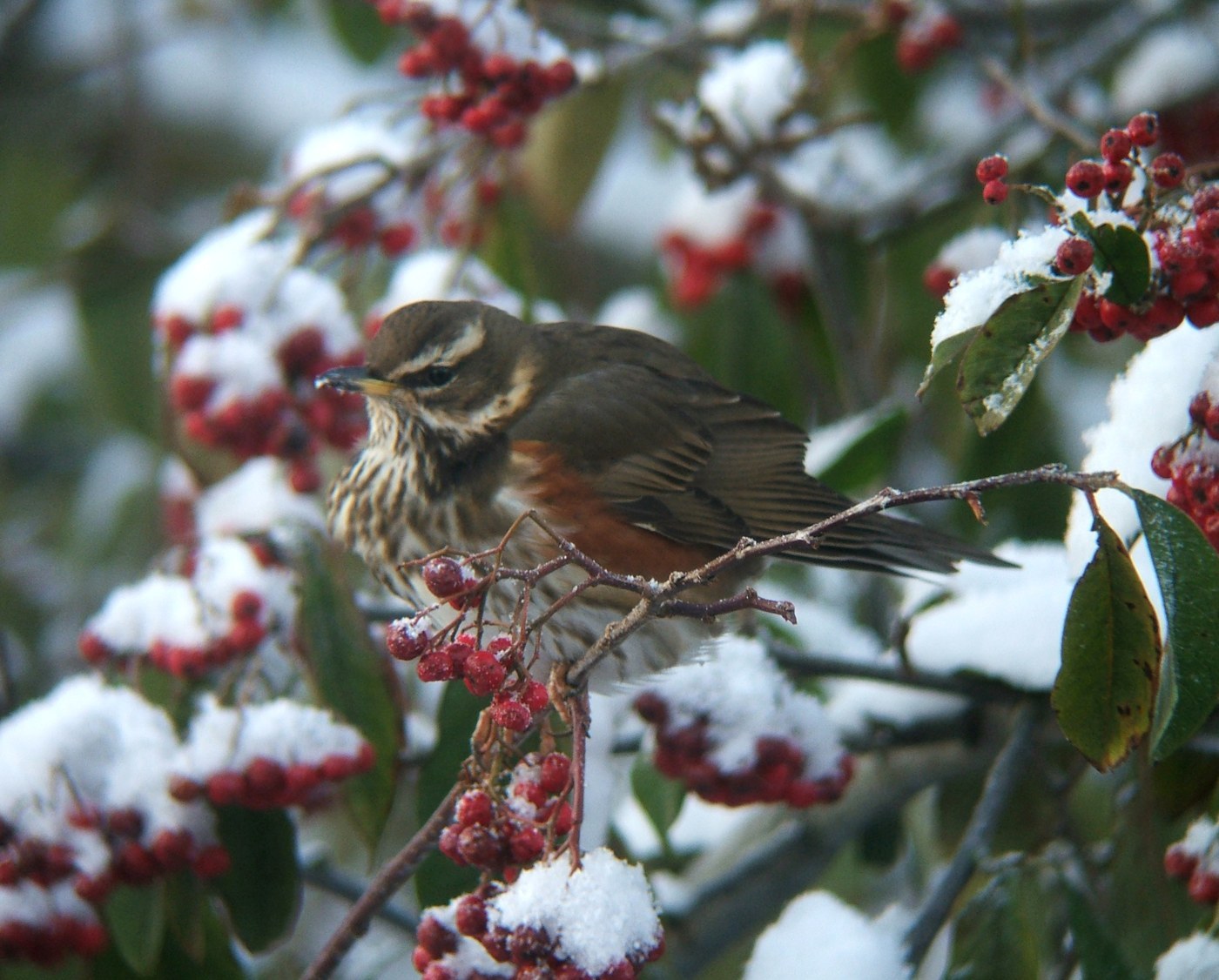
Key Field Marks
- Small thrush, noticeably smaller and more compact than a Song Thrush, about 21 cm long
- Bold creamy-white supercilium (eyebrow stripe) bordered below by a dark cheek patch, giving a striking head pattern
- Rusty-orange to brick-red flanks and underwing coverts (visible on the flanks at rest and flashing in flight — the source of the name)
- Upperparts warm olive-brown; underparts whitish with dense dark streaking, heavier than a Song Thrush's spotting
- Short tail and fairly upright thrush posture
Separating Redwing from Similar Species
- Song Thrush: lacks the bold supercilium and has no red on the flanks; Song Thrush spotting is more rounded/spade-shaped rather than streaked, and it lacks the contrasting face pattern.
- Fieldfare: much larger, with a contrasting gray head and rump, chestnut back, and no supercilium; often flocks with Redwings in winter but is easy to pick out by size and color pattern.
- Mistle Thrush: larger and grayer, with bold white tail corners and no red flank color.
Habitat, Range & Season
- Breeds across northern Europe and Siberia, including Scandinavia, Iceland, and the Russian taiga, in birch woodland, willow scrub, and open conifer forest, often near tundra edges
- A strongly migratory species; winters in flocks across western, central, and southern Europe, favoring hedgerows, farmland, orchards, and berry-laden bushes such as hawthorn
- Arrives in wintering areas in large numbers in October–November, often moving at night
Behavior Notes
- Highly social outside the breeding season, forming large mixed flocks with Fieldfares to feed on fallen fruit, berries, and worms in open fields
- A classic nocturnal migrant; birders often detect large overnight movements purely by ear
- Feeds on the ground in an upright stance, hopping and pausing to look and listen, thrush-style
Voice
- The diagnostic flight call is a thin, high "seeh" or "tseep," frequently heard overhead on autumn nights as flocks migrate
- Song is a simple, fluty phrase repeated several times, often with a scratchy warbling finish, delivered from an exposed perch on the breeding grounds
Similar-Species Checklist
- Look for the cream supercilium and red flanks to confirm Redwing over Song Thrush
- Listen for the thin "seeep" flight call, especially at night in migration season
- Check flock composition — Redwings often travel with Fieldfares in winter
Frequently asked questions
How do I tell a Redwing from a Song Thrush?
Redwing has a bold cream eyebrow stripe and rusty-red flanks/underwing that Song Thrush lacks; Song Thrush also has rounder spots rather than the Redwing's streakier breast pattern.
Why do I hear Redwings at night?
Redwings migrate mainly at night in large numbers, and their thin 'seeep' flight call is often the only clue overhead flocks are passing, especially in autumn.
Do Redwings and Fieldfares flock together?
Yes, in winter Redwings commonly join mixed flocks with Fieldfares to feed on berries and open farmland, though the two are easy to separate by size and plumage.
Where do Redwings breed?
They breed across northern Europe and Siberia, including Iceland and Scandinavia, in birch and willow scrub or open conifer woodland near tundra.
When is the best time to see Redwings in western Europe?
Redwings arrive as winter visitors from October through early spring, feeding in flocks on hedgerow berries and open fields.