
Redhead Identification Guide
A mid-sized North American diving duck with a rounded rusty-red head, gray body, and black breast, easily confused with the Canvasback until you compare head shape.
Read the full Redhead encyclopedia entry →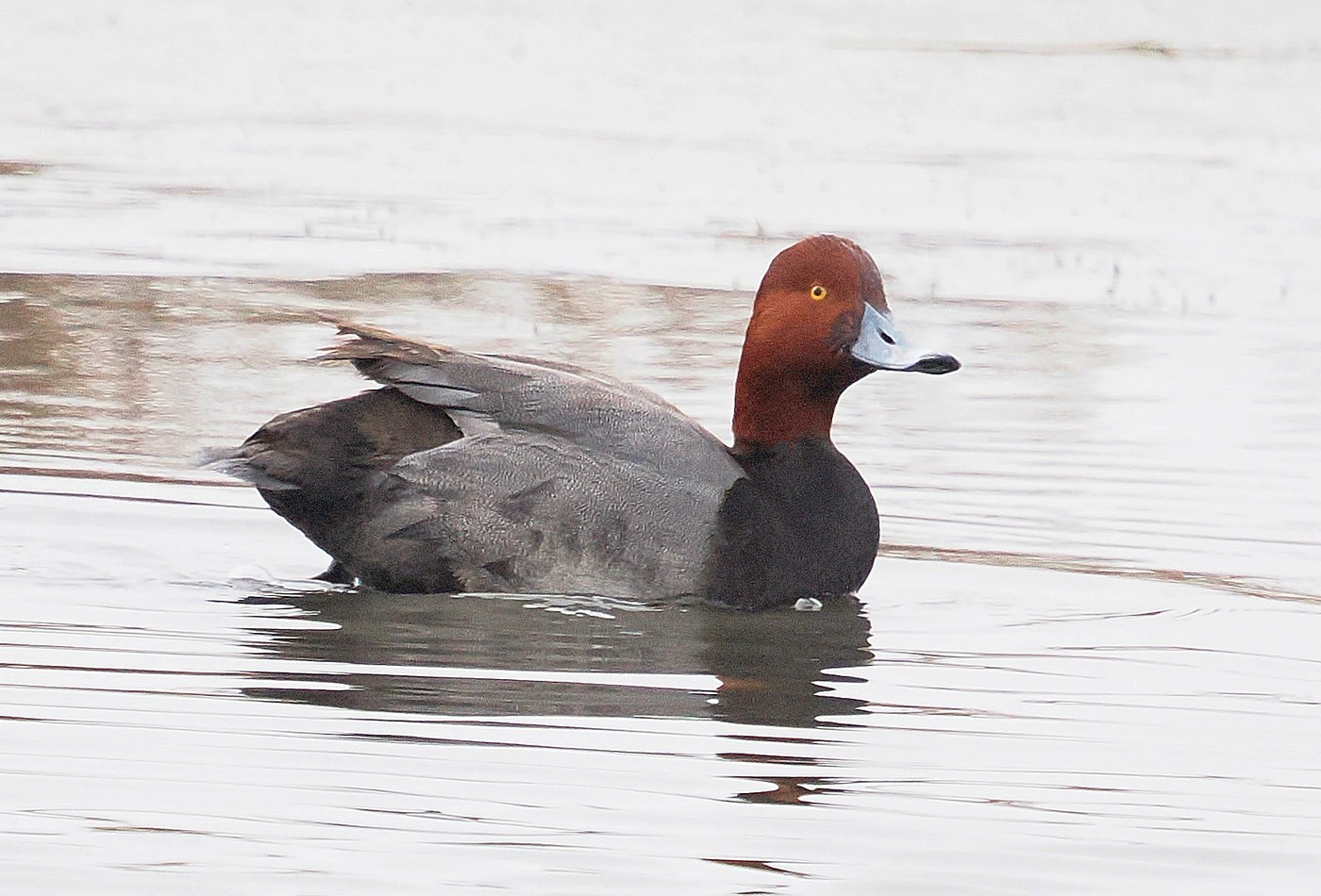
Key Field Marks
- Medium-sized diving duck, roughly 19-22 inches long, with a rounded, high-domed head profile
- Breeding male: rich chestnut-red head, black breast and rear end, pale gray body, bright golden-yellow eye
- Bill: blue-gray with a black tip and a thin whitish ring just behind the tip
- Female: uniform warm brown body, slightly paler face and throat, dark eye, same gray bill pattern with black tip
- In flight, shows a plain gray wing stripe (no bold white wing patch like scaup)
Separating Redhead from Similar Species
- Canvasback: Canvasback has a long, sloping forehead that runs straight into the bill, giving a wedge-shaped head; Redhead's head is rounded and peaked, with a shorter bill that meets the forehead at a distinct angle. Canvasback's back is much paler, almost white, versus the Redhead's medium gray back.
- Ring-necked Duck: Ring-necked has a more angular, peaked crown and a white ring near the bill tip plus a white ring at the bill base; overall body is darker with a white flank spur, and it favors smaller wooded ponds rather than open water.
- Canvasback vs. Redhead females: both are brown, but Canvasback's sloped forehead profile is the most reliable mark in any light.
Habitat, Range & Season
- Breeds on prairie pothole marshes and shallow wetlands of the northern Great Plains and Intermountain West, with a smaller breeding population in the eastern Canadian prairies
- Winters on large lakes, reservoirs, coastal bays, and estuaries across the southern United States and Mexico, often in large rafts mixed with scaup and canvasbacks
- Migrates through the interior United States in spring and fall, stopping on large open water bodies
Behavior Notes
- A diving duck that feeds by submerging to reach aquatic plants, seeds, and some invertebrates
- Forms large, tightly packed rafts on open water outside the breeding season
- Females frequently lay eggs in the nests of other Redheads and other duck species (brood parasitism), so nest counts can be misleading
Voice
- Breeding male gives a distinctive cat-like "meow" during courtship displays
- Females give a low, harsh "squak" or growling note, especially when flushed
Similar-Species Checklist
- Check head shape first (rounded vs. sloped forehead)
- Check bill pattern (ring position, amount of black)
- Check back color (medium gray vs. pale whitish)
Frequently asked questions
How do I tell a Redhead from a Canvasback?
Look at the forehead: Canvasback has a long sloping forehead that blends smoothly into the bill, while Redhead has a rounded head with a distinct break between forehead and bill. Canvasback's back is also much paler than the Redhead's medium gray back.
What does a female Redhead look like?
Female Redheads are plain warm brown overall with a slightly paler face, dark eye, and the same gray bill with a black tip as the male, though duller.
Where can I see Redheads?
Look for them breeding on prairie marshes of the northern Great Plains and wintering in large rafts on coastal bays, big lakes, and reservoirs across the southern U.S. and Mexico.
Why do Redheads lay eggs in other ducks' nests?
Redheads are known brood parasites; females often lay some or all of their eggs in the nests of other Redheads or other duck species, which can make it hard to judge true breeding success from nest counts alone.
What sound does a Redhead make?
The male's courtship call is a distinctive cat-like 'meow,' quite different from the deeper grunts of most other diving ducks.