
Reddish Egret Identification Guide
A coastal heron known for its frenetic, staggering foraging dance, with dark and white color morphs and a distinctive pink-and-black bill.
Read the full Reddish Egret encyclopedia entry →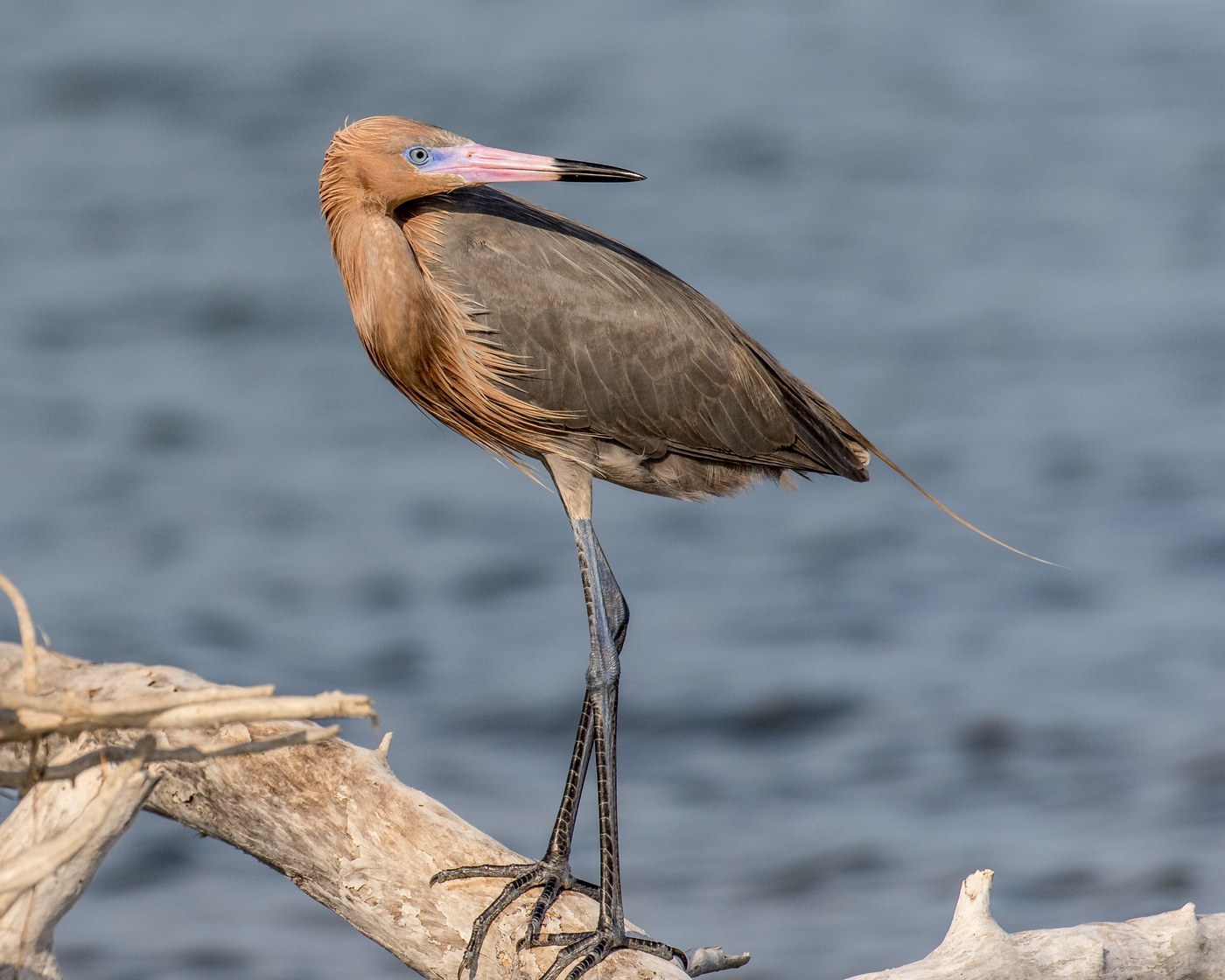
Key Field Marks
- Medium-large heron, about 76 cm tall, with a slender build and shaggy plumage on the head and neck.
- Occurs in two color morphs: the dark morph has a slate-gray body with a shaggy rufous (reddish) head and neck, while the white morph is entirely white.
- Bill is bicolored — pink at the base and black at the tip — especially vivid in breeding condition, with blue-gray legs.
- Actively forages by running, staggering, spinning, and flashing its wings open to startle fish into the open — far more animated than the slow stalking typical of most herons.
Separating It From Similar Species
- Dark morph vs. Little Blue Heron: Little Blue Heron is a more uniform slaty blue overall (without the shaggy rufous head/neck) and forages with slow, deliberate movements rather than the Reddish Egret's frantic dashing.
- White morph vs. Snowy Egret/Great Egret: white morph Reddish Egret has a bicolored pink-and-black bill and blue-gray (not black or yellow) legs, along with its distinctive shaggy neck plumes and hyperactive foraging style.
- Tricolored Heron: shows a contrasting white belly against a dark body, which the dark morph Reddish Egret lacks (its body is uniformly dark).
- The erratic "canopy feeding" and dashing behavior is often the single best clue, visible at a distance even before plumage details are clear.
Habitat, Range & Season
- A coastal specialist, found in shallow saltwater lagoons, tidal flats, and mangrove-edged estuaries along the Gulf Coast, Florida, the Caribbean, and Mexico.
- One of the rarest and most range-restricted herons in the United States, with a localized and patchy distribution tied closely to healthy coastal wetlands.
- Generally non-migratory within its range, though some post-breeding dispersal occurs.
Voice
- Generally quiet; utters low, guttural croaking calls, mainly around the nest or when disturbed.
Frequently asked questions
What is the most distinctive behavior of the Reddish Egret?
Its frenetic foraging style — running, staggering, spinning, and flashing open its wings to startle fish — is much more active than the slow stalking of most other herons and egrets.
What are the two color morphs of the Reddish Egret?
There is a dark morph with a slate-gray body and shaggy rufous head and neck, and a white morph that is entirely white; both share the same bicolored pink-and-black bill.
How do I tell a dark morph Reddish Egret from a Little Blue Heron?
Reddish Egret shows a shaggy rufous head and neck contrasting with a slaty body and forages very actively, while Little Blue Heron is a more uniform slate-blue and moves slowly and deliberately.
Where is the best place to find a Reddish Egret?
Look in shallow coastal lagoons, tidal flats, and mangrove-lined estuaries along the Gulf Coast, Florida, the Caribbean, and Mexico, as it rarely strays far from saltwater habitats.