
Red-shouldered Hawk Identification Guide
A slim, vocal North American buteo with checkered wings, a boldly banded tail, and rusty barred underparts, often heard before it's seen.
Read the full Red-shouldered Hawk encyclopedia entry →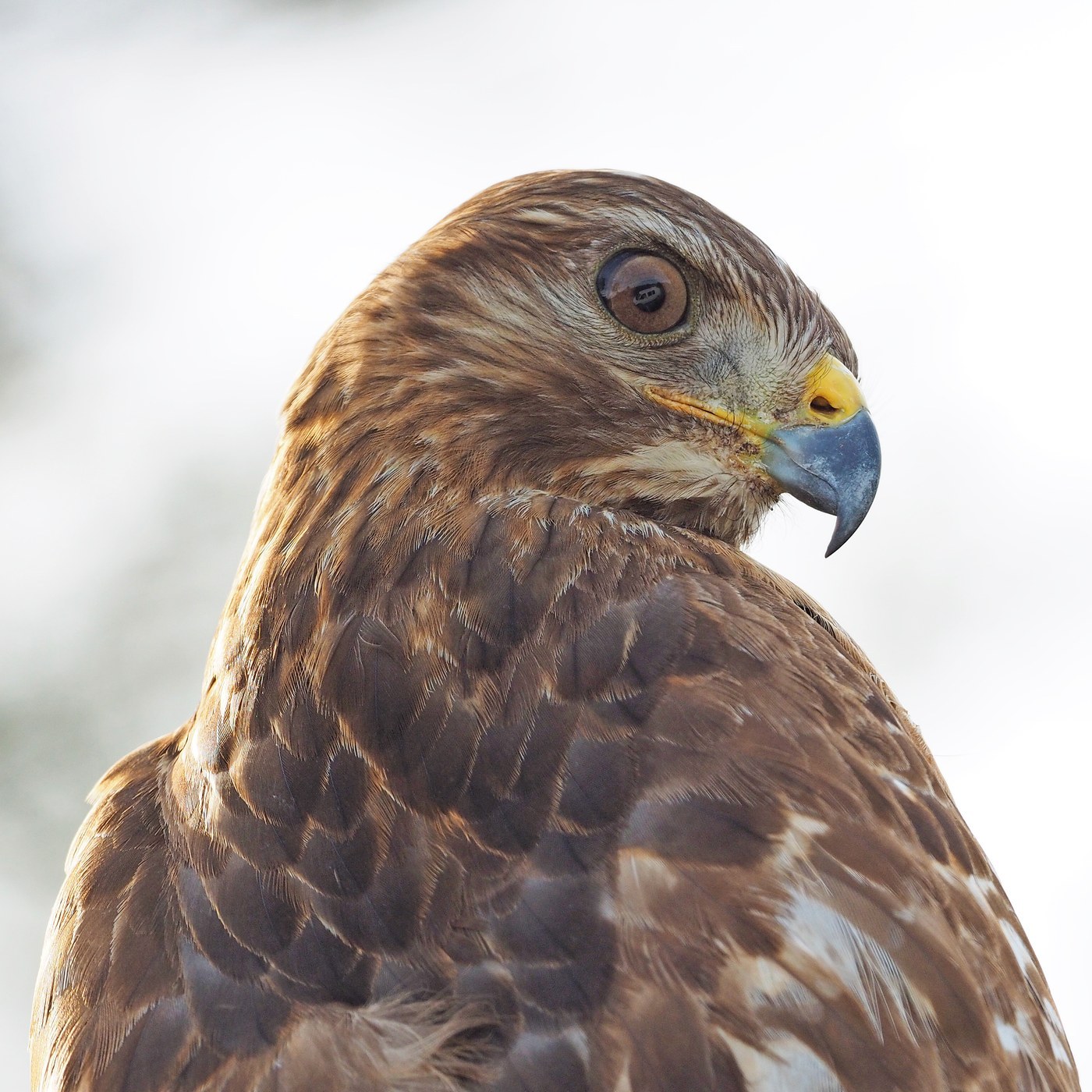
Key Field Marks
- Medium-sized hawk, slimmer and more slender-winged than a Red-tailed Hawk.
- Adult: warm reddish-barred underparts, a black-and-white checkered pattern on the upperwing coverts, and a strongly banded black-and-white tail.
- A rusty "red shoulder" patch (lesser wing coverts) is visible when perched, giving the species its name.
- In flight, look for pale, translucent crescent-shaped "windows" near the wingtips, especially visible when backlit.
- Juveniles are streaked brown below rather than barred, and can be trickier to separate from other juvenile buteos.
Separating It From Similar Species
- Red-tailed Hawk: bulkier, broader-winged, with a plain rusty (not banded) tail in adults and a streaked belly band rather than barred underparts.
- Broad-winged Hawk: smaller and stockier, with a tail showing broad, fewer white bands, and lacks the checkered wing pattern.
- Cooper's Hawk/accipiters: shorter rounded wings and a long tail, entirely different flight silhouette and habitat use.
- The reddish shoulder patch, checkered wings, and narrow tail bands together are diagnostic for adult Red-shouldered Hawk.
Habitat, Range & Season
- Prefers bottomland and riparian woodlands, swamps, and mixed forests, often near water.
- Increasingly common in leafy suburban neighborhoods with tall trees, especially in the eastern U.S. and coastal California.
- Largely non-migratory in the southeast and California; northern and interior populations move south for winter.
- Pairs are often faithful to the same territory year after year.
Voice
- A loud, distinctive, repeated "kee-yer" scream, frequently given in a series; this call is commonly imitated by Blue Jays, so confirm with a visual sighting when possible.
Frequently asked questions
How do I tell a Red-shouldered Hawk from a Red-tailed Hawk?
Red-shouldered Hawks are slimmer with checkered wings, a strongly banded tail, and barred (not streaked-band) underparts, while Red-tailed Hawks are bulkier with a plain rusty tail and a dark belly band.
Why do I keep hearing a Red-shouldered Hawk call but see a Blue Jay instead?
Blue Jays are well known for mimicking the Red-shouldered Hawk's loud "kee-yer" scream, so always confirm the sound with a visual look at the bird.
What habitat should I search for Red-shouldered Hawks?
Look near riparian woodlands, swamps, and wooded wetlands, as well as tree-lined suburban neighborhoods within its range.
Are Red-shouldered Hawks migratory?
Populations in the southeastern U.S. and California are largely year-round residents, while northern and interior birds migrate south for the winter.