
Red-rumped Parrot Identification Guide
A slender Australian parrot with a strikingly turquoise male and a drab olive-gray female, often seen feeding on the ground in pairs.
Read the full Red-rumped Parrot encyclopedia entry →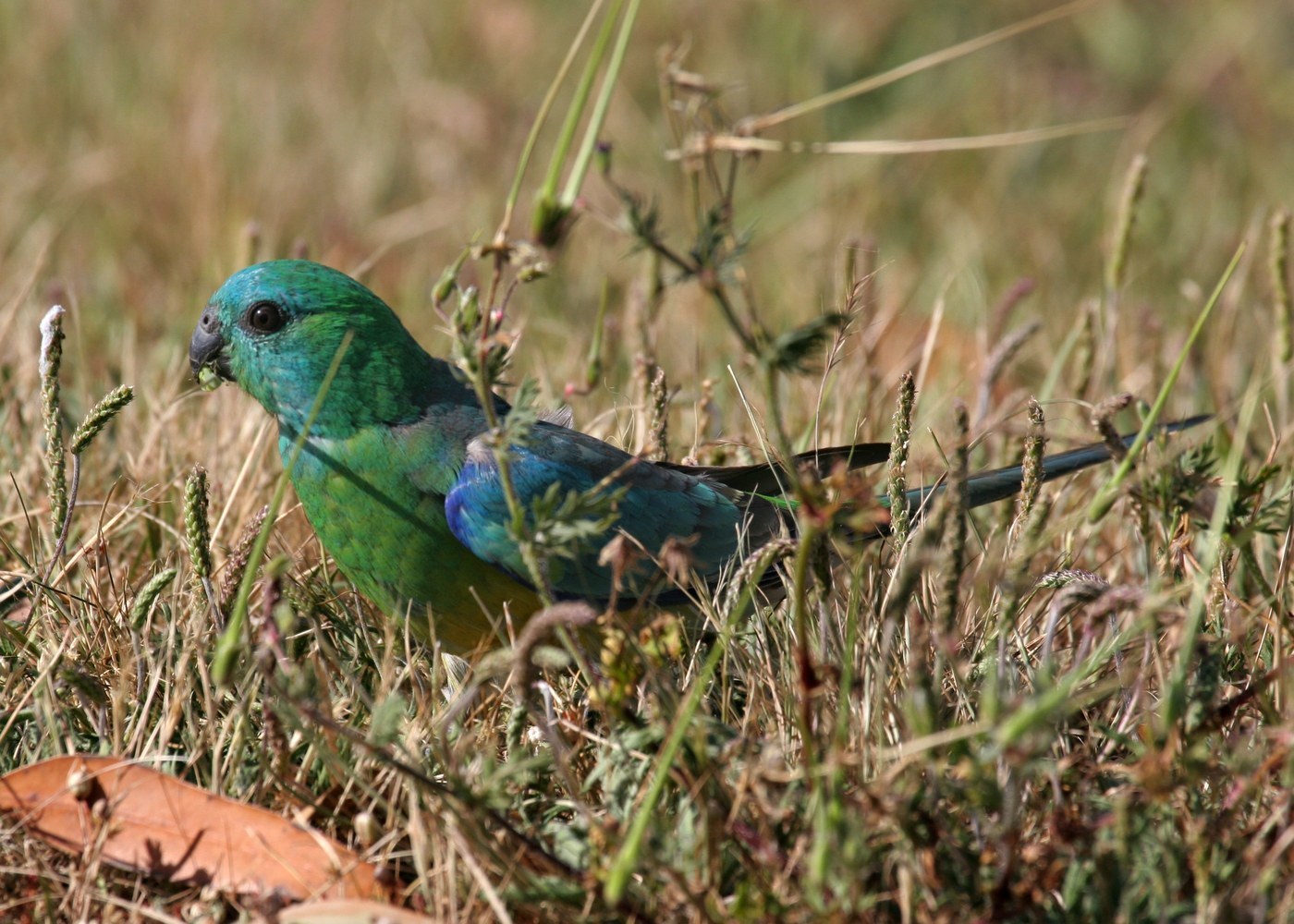
Key Field Marks
- Slim, long-tailed parrot around 26-28 cm.
- Male: bright turquoise-blue face, throat, and underparts, grass-green back and wings, a small but distinctive red patch on the rump, and a yellow lower belly.
- Female: much duller olive-gray-green overall, with only a faint or absent rump patch and a pale eye-ring; easily overlooked as a nondescript parrot.
- Long, tapered tail typical of the broad-tailed parrot group.
- Often forages on the ground, walking with a distinctive gait while picking at seeds.
Separating It From Similar Species
- Female/immature Mulga Parrot: shows more yellow in the wing and a different face pattern; male Mulga Parrot has a yellow forehead band the Red-rumped lacks.
- Blue Bonnet: larger, with a blue face mask and different body coloration, lacking the male Red-rumped's clean turquoise-and-green combination.
- The male's red rump patch combined with turquoise underparts is diagnostic; females require close attention to subtle gray-green tones and habitat/behavior context.
Habitat, Range & Season
- Common and widespread across inland southeastern Australia, including New South Wales, Victoria, and South Australia.
- Favors open woodland, grassland, farmland, parks, and roadside verges, often near water.
- Non-migratory but locally nomadic in response to food and water availability; present year-round in its range.
- Frequently seen in pairs or small flocks feeding on fallen seed on the ground, flying up to nearby trees or wires when disturbed.
Voice
- A soft, musical twittering or chirrupy contact call, often given in flight; less harsh than many other parrot calls.
Frequently asked questions
How do I tell a male from a female Red-rumped Parrot?
Males are bright turquoise-blue below with a green back and a red rump patch, while females are plain olive-gray-green with little or no red on the rump.
Where do Red-rumped Parrots live?
They are found in open woodland, grassland, and farmland across inland southeastern Australia, often seen feeding on the ground near roads and paddocks.
What is the easiest field mark for a male Red-rumped Parrot?
The combination of turquoise-blue underparts and a small red rump patch, visible when perched or in flight, is the quickest way to confirm a male.
Are Red-rumped Parrots social birds?
Yes, they are typically seen in pairs or small flocks, often foraging together on the ground for fallen grass and weed seeds.