
Red Phalarope Identification Guide
The bulkiest and most oceanic of the phalaropes, with brick-red breeding females and a thick, dark-tipped yellow bill.
Read the full Red Phalarope encyclopedia entry →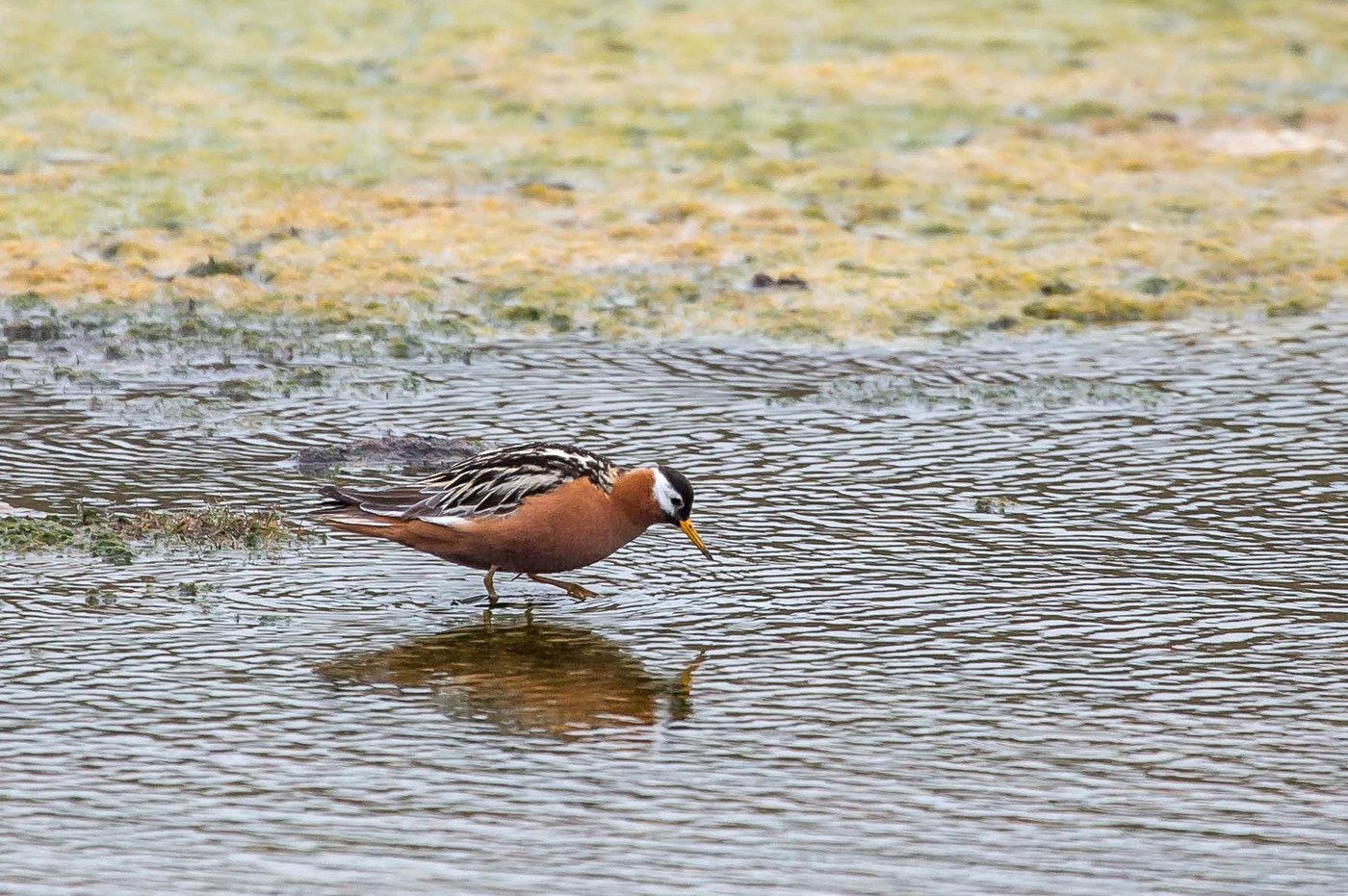
Key Field Marks
- Stocky, robust phalarope, about 20-22 cm, noticeably heavier-bodied than the Red-necked Phalarope.
- Bill is thicker and shorter than other phalaropes; in breeding female it is yellow with a black tip.
- Breeding female: brick-red to rufous underparts and neck, black cap, bold white cheek patch — the most colorful phalarope plumage.
- Breeding male: similar pattern, but duller, more mottled brown and buff.
- Nonbreeding/winter: pale gray, essentially unmarked back (no streaking), white below, black patch through and behind the eye, dark bill.
- Known in the UK and parts of Europe as the Gray Phalarope, reflecting its plain winter look.
Separating It From Similar Species
- Red-necked Phalarope: smaller and slimmer with a thin needle-like bill and a streaked (not plain) gray back in winter.
- Wilson's Phalarope: larger, longer-necked, thinner bill, lacks a dark eye patch in winter, and is far less pelagic.
- The heavy build, thick bill, and unstreaked winter back are the most reliable clues for Red Phalarope.
Habitat, Range & Season
- Breeds on High Arctic tundra, often on wetter, more barren ground than Red-necked Phalarope.
- The most pelagic of all phalaropes in the nonbreeding season, wintering far offshore over cold, productive ocean waters (e.g., off West Africa, Peru/Chile, and other upwelling zones).
- Storms can push exhausted birds onshore or inland ("phalarope wrecks"), which is when many inland birders get their best looks.
- Passage migrant well offshore; land sightings are irregular and often storm-driven.
Voice
- A sharp, high "clink" or "whit" call; mostly silent away from breeding grounds.
Frequently asked questions
How can I tell a Red Phalarope from a Red-necked Phalarope?
Red Phalarope is bulkier with a noticeably thicker bill, and its winter back is plain gray without streaking, unlike the streaked back of Red-necked Phalarope.
Why do Red Phalaropes sometimes appear inland far from the ocean?
They are highly pelagic and normally stay far offshore, but strong storms can force exhausted birds onto land or inland waters, an event birders call a phalarope wreck.
Do male and female Red Phalaropes look different?
Yes — the female is more brightly colored in breeding plumage, with richer red underparts, while the male is duller and more mottled, a reversal of typical bird coloration roles.
What does a Red Phalarope eat and how does it feed?
It eats small aquatic invertebrates and plankton, often spinning in tight circles on the water to stir prey toward the surface before picking it off with its bill.