
Red-necked Phalarope Identification Guide
A tiny, needle-billed shorebird best known for spinning in circles on the water and, unusually, having brighter-plumaged females than males.
Read the full Red-necked Phalarope encyclopedia entry →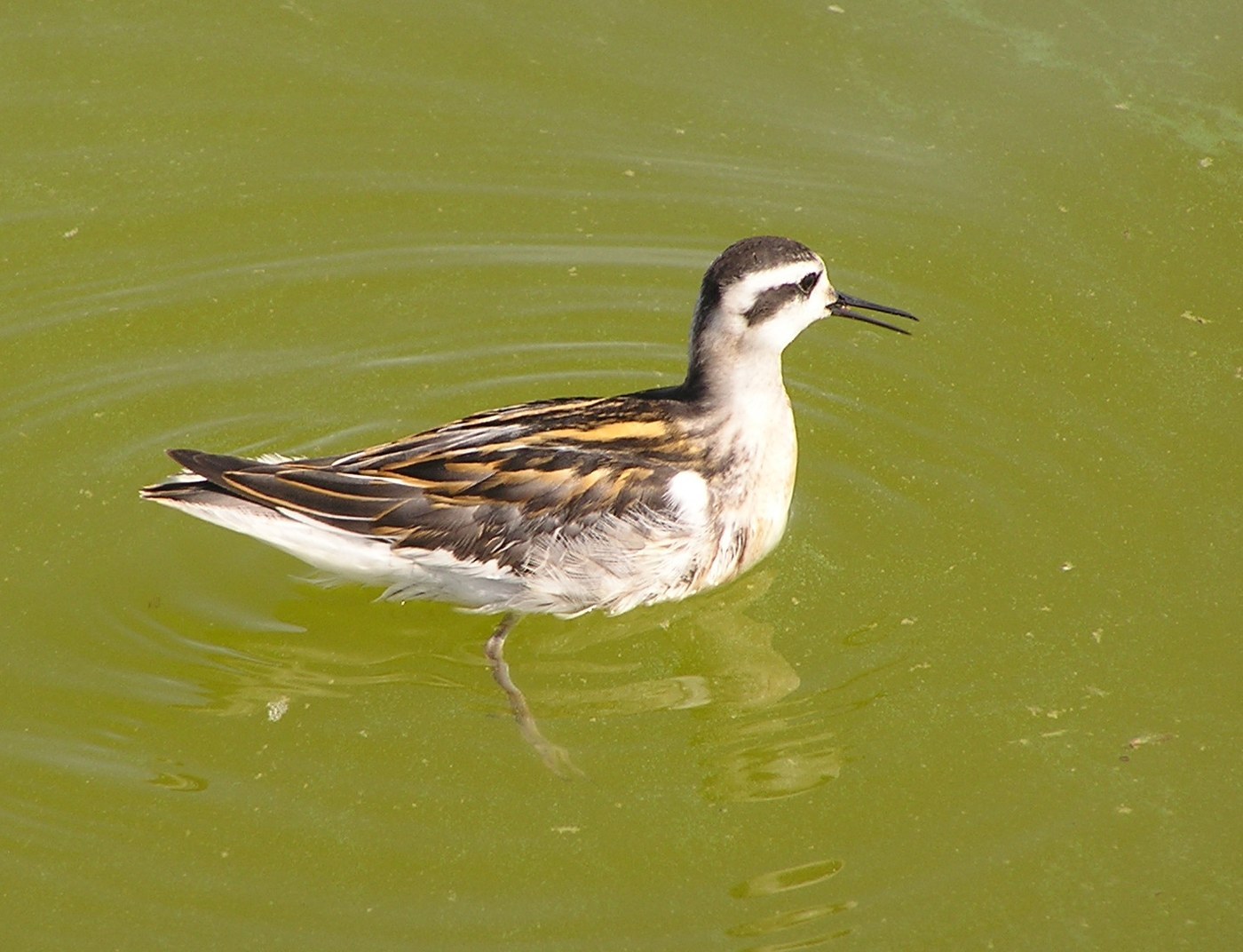
Key Field Marks
- Sparrow-sized shorebird, roughly 18 cm long, with a very thin, needle-like black bill.
- Lobed toes (not webbed like a duck) that aid swimming; dark legs.
- Breeding female (brighter than the male, reversed sex roles): slate-gray head and back, white throat, and a bold orange-red band down the sides of the neck.
- Breeding male: similar pattern but duller and browner overall.
- Nonbreeding/winter: pale gray above with a streaked back, white below, black "bandit mask" through the eye, white forehead.
- Frequently seen swimming buoyantly and spinning in tight circles to stir up small invertebrates from the water surface — a very distinctive foraging behavior.
Separating It From Similar Species
- Red Phalarope: bulkier, with a noticeably thicker bill; nonbreeding Red Phalarope has a plain, unstreaked gray back, while Red-necked shows pale streaking on the back.
- Wilson's Phalarope: larger, longer-necked, longer thin bill, and lacks the bold dark eye patch in winter plumage; rarely spins as persistently.
- Overall, the combination of tiny size, needle-thin bill, and streaked back separates it from both relatives.
Habitat, Range & Season
- Breeds on Arctic and subarctic tundra pools and marshy wetlands across the far north of North America, Europe, and Asia.
- Extremely pelagic outside the breeding season — most of the population winters far offshore in tropical and subtropical seas (e.g., Arabian Sea).
- On migration it can turn up on inland lakes, sewage ponds, and flooded fields, often in loose flocks, spinning as they feed.
- Passage is typically brief; look for it in mid-to-late spring and again in fall.
Voice
- A short, sharp "kip" or "whit" call, often given in flight; generally quiet on the water.
Frequently asked questions
Why do Red-necked Phalaropes spin in circles?
Spinning creates a small upwelling current that draws tiny invertebrates up toward the surface, making them easier for the phalarope to snatch with its thin bill.
Which sex is more colorful in Red-necked Phalaropes?
The female is more brightly colored than the male, an unusual reversal from most birds — she also takes the lead in courtship and leaves incubation to the male.
How do I tell a Red-necked Phalarope from a Red Phalarope in winter plumage?
Look at the bill and back: Red-necked has a thinner bill and a streaked gray back, while Red Phalarope has a thicker bill and a plain, unstreaked back.
Where is the best place to see Red-necked Phalaropes?
Inland lakes and flooded fields during migration are reliable, since they are otherwise highly pelagic and winter far out at sea.