
Red-legged Partridge Identification Guide
A plump European gamebird identified by its red bill and legs, bold black-and-white barred flanks, and black necklace-like gorget.
Read the full Red-legged Partridge encyclopedia entry →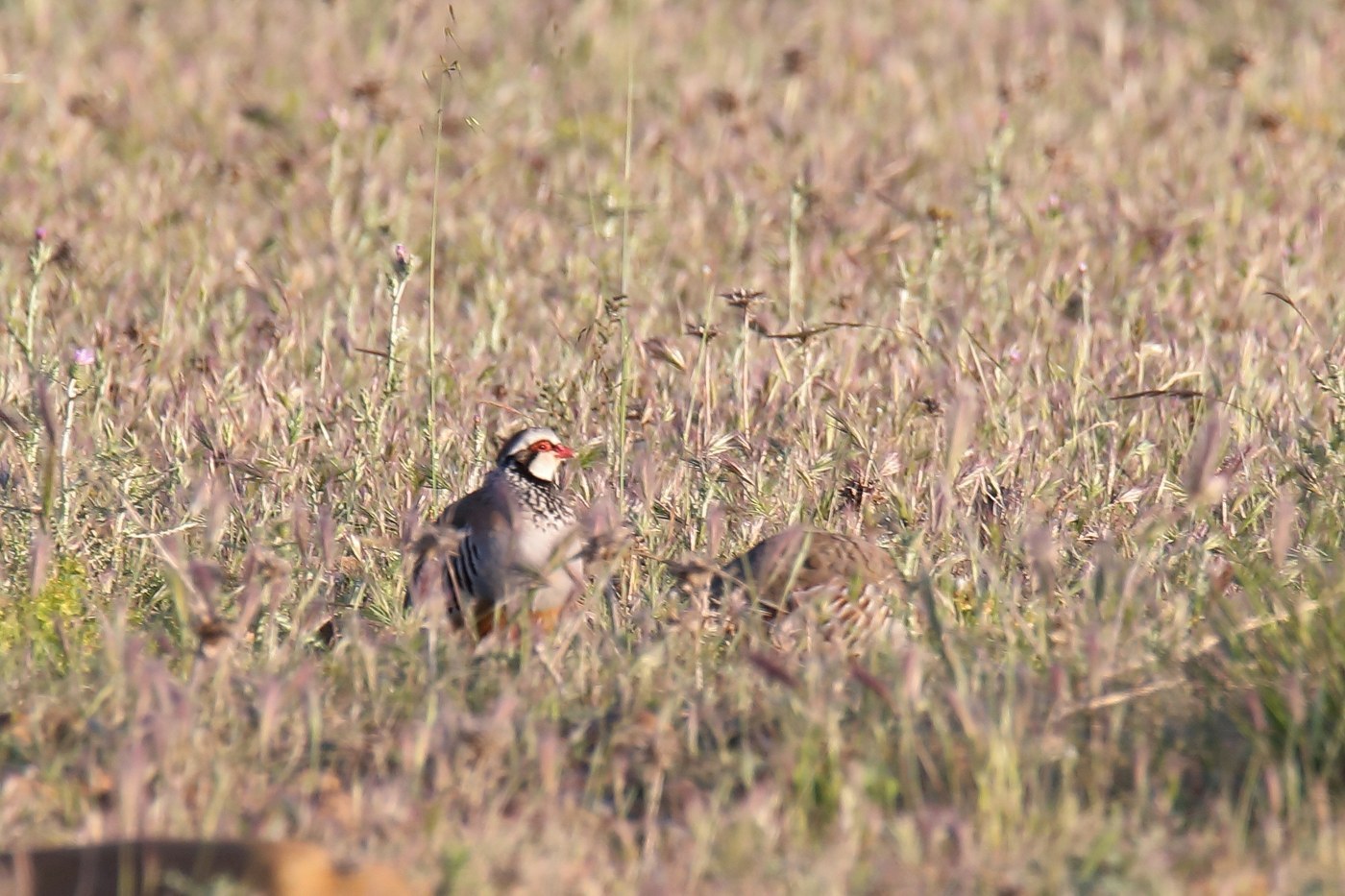
Key Field Marks
- Plump, rounded gamebird with a bright red bill and red legs — a strong, immediate clue not shared by most similar partridges
- Bold black-and-white and chestnut barring along the flanks, very conspicuous at rest and in flight
- A black band runs from the forehead through the eye and down around the throat, forming a distinctive black "necklace" or gorget bordered by white
- Buffy-orange face and throat framed by the black gorget, gray-brown crown and back
- Sexes look similar, though males average slightly larger with more prominent leg spurs
Similar Species
- Chukar: shows similar bold black-and-white flank barring and a red bill/legs, but lacks the black necklace gorget of Red-legged Partridge and has a plainer, more uniform buffy face; introduced range in North America (western US) does not naturally overlap with Red-legged Partridge.
- Grey Partridge: lacks red on the bill and legs entirely (bill is dark, legs grayish), has an orange face patch, and shows chestnut horseshoe marking on the belly rather than a black gorget.
- Hybrids with the introduced Chukar occur in parts of the Red-legged Partridge's range and can show intermediate features.
Habitat, Range & Season
- Native to southwestern Europe, including Spain, Portugal, and France, favoring dry open farmland, vineyards, scrubby hillsides, and stony ground
- Introduced and now well established in parts of the United Kingdom, particularly eastern and southern England
- Non-migratory resident, found in coveys outside the breeding season and in pairs during spring and summer
Voice
- Gives a harsh, repetitive "chuk-chuk-chukar" or "chuka-chuka" call, often repeated persistently from the ground or a low perch
- When flushed, prefers to run rather than fly, only bursting into a fast, whirring flight as a last resort
Frequently asked questions
What is the easiest way to identify Red-legged Partridge?
Look for a plump, boldly patterned partridge with a bright red bill and red legs, and a black necklace-like band bordering the throat.
How do I tell Red-legged Partridge from Chukar?
Red-legged Partridge has a distinct black gorget/necklace around the throat that Chukar lacks; their native ranges also don't naturally overlap.
Does Red-legged Partridge fly readily when disturbed?
No, it typically prefers to run for cover and only flies in a fast, whirring burst as a last resort.
Where is Red-legged Partridge found outside its native range?
It has been widely introduced and is now well established in parts of the United Kingdom, especially eastern and southern England.