
Red-eyed Vireo Identification Guide
The Red-eyed Vireo is a common but often unseen North American songbird famous for its incessant, question-and-answer song delivered from the leafy canopy all day long.
Read the full Red-eyed Vireo encyclopedia entry →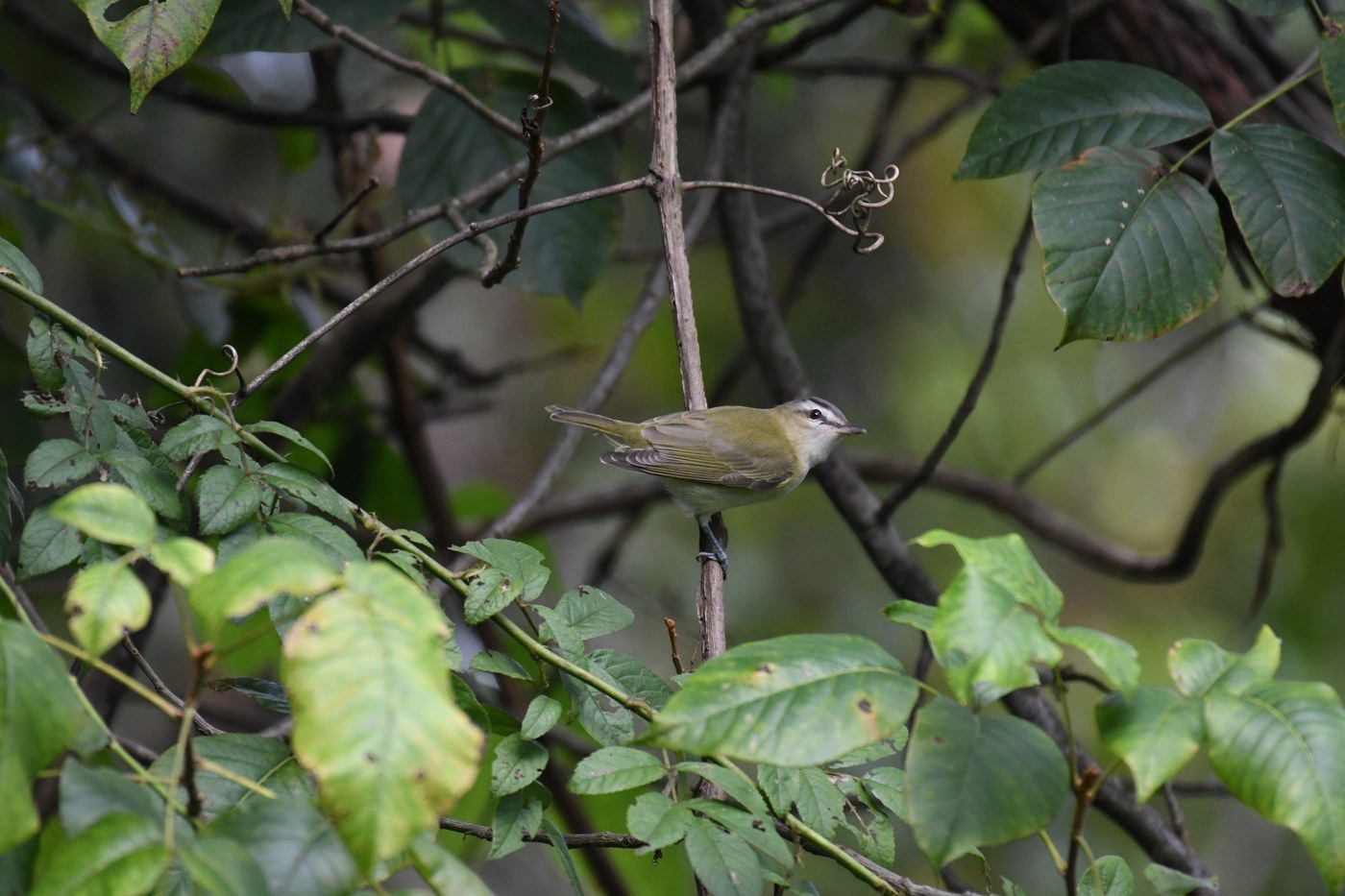
Key Field Marks
- Size & shape: Medium-sized vireo (12–14 cm), fairly stocky and thick-necked with a longish, somewhat heavy bill hooked slightly at the tip and a relatively short tail.
- Plumage: Olive-green upperparts, clean white underparts, with a distinctive head pattern: a gray crown bordered by a black lateral stripe, a bold white eyebrow stripe, and a black eyeline running through a striking red (or reddish-brown in immatures) eye. No wing bars.
- Bill: Fairly stout, gray, slightly hooked — typical vireo bill shape, heavier than a warbler's thin bill.
- Eye color: Adults show a distinctive ruby-red iris visible at close range or in good light — the source of the name — though eye color often appears dark at a distance or in poor light. Immatures/first-fall birds have dark brown eyes, not yet red.
- Behavior: Forages deliberately and somewhat sluggishly (compared to warblers) high in the leafy canopy, gleaning insects from foliage; famous for singing almost continuously through the day, even in the heat of midday when most other songbirds go quiet.
Separating It From Similar Species
- Vs. Warbling Vireo: Warbling Vireo lacks the bold black-bordered eyebrow and black eyeline of Red-eyed Vireo, showing a much plainer face with a faint pale eyebrow and no dark border; Warbling Vireo's song is a rapid, run-together warble rather than the Red-eyed's short, clearly separated phrases.
- Vs. Philadelphia Vireo: Philadelphia Vireo is smaller, shows a yellowish wash on the underparts (especially the throat/breast), and has a less contrasting, duskier eyeline than Red-eyed Vireo's crisp black-and-white head pattern.
- Vs. Black-whiskered Vireo (range overlap in Florida/Caribbean): Black-whiskered Vireo has a dark malar ("whisker") stripe below the bill that Red-eyed Vireo lacks.
Where & When To See It
Breeds across a huge swath of North American deciduous and mixed forest, from the eastern and central U.S. and southern Canada, favoring leafy canopy of broadleaf woodlands, forest edges, and even well-wooded suburban parks. One of the most abundant breeding songbirds in eastern North American forests despite being frequently heard far more than seen due to its canopy-dwelling habits. A long-distance migrant, wintering in the Amazon basin and other parts of northern and central South America; passes through in spring and fall migration across much of the continent.
Voice & Song Cues
The defining field mark for many birders: an endless series of short, robin-like phrases delivered in a deliberate "question and answer" rhythm — "Here I am. ... Look at me. ... Up here. ... In the tree." — repeated with brief pauses, often for hours on end, even during midday heat when other birds are silent. Call note is a nasal, whiny "chway" or "meow"-like note.
Frequently asked questions
Why is the Red-eyed Vireo called the 'preacher bird'?
Because of its habit of singing an endless series of short, choppy phrases almost non-stop through the day, even during midday heat — a nickname earned for its seemingly tireless sermonizing song.
How do I tell a Red-eyed Vireo from a Warbling Vireo by sight?
Look for a bold black-bordered white eyebrow and a dark eyeline through the eye on Red-eyed Vireo; Warbling Vireo has a much plainer, less contrasting face pattern without the black borders.
Do all Red-eyed Vireos actually have red eyes?
Adults show a red iris visible at close range in good light, but the color often looks dark from a distance; immature and first-fall birds have brown, not red, eyes.
Where do Red-eyed Vireos go in winter?
They are long-distance migrants that winter mainly in the Amazon basin and other parts of northern and central South America, returning to North American forests to breed each spring.