
Red-crowned Crane Identification Guide
The Red-crowned Crane is one of the world's largest and rarest cranes, a striking white bird with a bare red crown patch, prized as a symbol of longevity in East Asian culture.
Read the full Red-crowned Crane encyclopedia entry →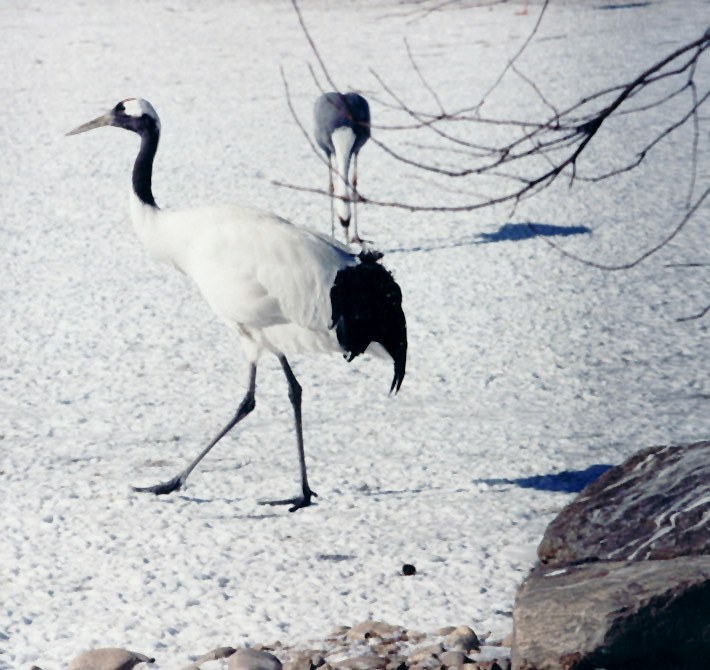
Key Field Marks
- Size & shape: Very large crane (140–150 cm tall, among the tallest and heaviest crane species), with a long neck, long dark legs, and a long straight bill — an unmistakable silhouette when standing in open wetland or field habitat.
- Plumage: Predominantly white body plumage with black secondaries and tertials that form a black "bustle" over the tail when the wings are folded (the tail itself is actually white; the black is drooping wing feathers). Head and much of the neck are black except for a white crown-surround and white patch on the cheek/throat area, with a small bare patch of red skin on the crown that brightens during display.
- Bill & legs: Bill long, straight, pale grayish-green to yellowish; legs long and blackish-gray.
- In flight: Neck and legs fully extended, black flight feathers contrasting with the white body — often flies in small family groups or pairs with slow, deep wingbeats.
- Behavior: Forms strong pair bonds reinforced by elaborate, synchronized unison calling and dancing displays involving bowing, leaping, and wing-flapping, especially in late winter.
Separating It From Similar Species
- Vs. Whooping Crane: No range overlap (Whooping Crane is North American only), but Whooping Crane also has a red crown patch and mostly white plumage with black wingtips; Red-crowned Crane differs in showing a fully black neck (Whooping Crane's neck is white with only a black facial area) and black secondaries forming a bustle rather than black primaries only visible in flight.
- Vs. White-naped Crane: White-naped Crane, which can co-occur in parts of East Asia, has a gray body (not white), a white nape stripe, and red skin around the eye extending further, quite different from Red-crowned Crane's white body and black neck.
- Vs. Siberian Crane: Siberian Crane is smaller-necked relative to body, entirely white except for black primaries, and has a red face/bill rather than Red-crowned's isolated red crown patch on an otherwise black head.
Where & When To See It
Two disjunct populations: a continental (migratory) population breeding in wetlands of far eastern Russia and northeastern China/Mongolia and wintering in the Korean DMZ area and coastal China, and a resident, non-migratory population on Hokkaido, Japan, centered on the Kushiro Marsh area, where birds can be observed year-round, including famous winter courtship-dancing gatherings at feeding stations. One of the rarest crane species in the world, with a total population in the low thousands, and a focus of significant conservation efforts in both Japan and mainland East Asia.
Voice & Song Cues
Extremely loud, far-carrying, trumpeting unison calls given by paired birds in a coordinated duet, with the male giving two notes for each single note of the female, produced using an elongated, coiled trachea that amplifies the sound — audible over long distances across open marsh and field habitat, especially during courtship displays.
Frequently asked questions
How can I tell a Red-crowned Crane from a Whooping Crane?
Ranges don't overlap, but plumage differs too: Red-crowned Crane has an entirely black neck, while Whooping Crane's neck is white with only a black face pattern; both show a red crown patch and mostly white body.
Where is the best place to see Red-crowned Cranes?
Hokkaido, Japan (especially around the Kushiro Marsh area) hosts a resident population viewable year-round, including famous winter dancing displays at feeding stations; the migratory mainland population breeds in far eastern Russia/northeast China and winters near the Korean DMZ and coastal China.
Why do Red-crowned Cranes have a red patch on the head?
It is a patch of bare, richly vascularized red skin on the crown (not feathers) that brightens and can be manipulated during courtship displays and social interactions.
Are Red-crowned Cranes endangered?
Yes, they are considered endangered, with a total wild population in the low thousands, making them one of the rarest crane species in the world.