
Red-breasted Sapsucker Identification Guide
The Red-breasted Sapsucker is a Pacific Coast woodpecker with an entirely red head and breast, best known for drilling neat rows of sap wells in tree bark.
Read the full Red-breasted Sapsucker encyclopedia entry →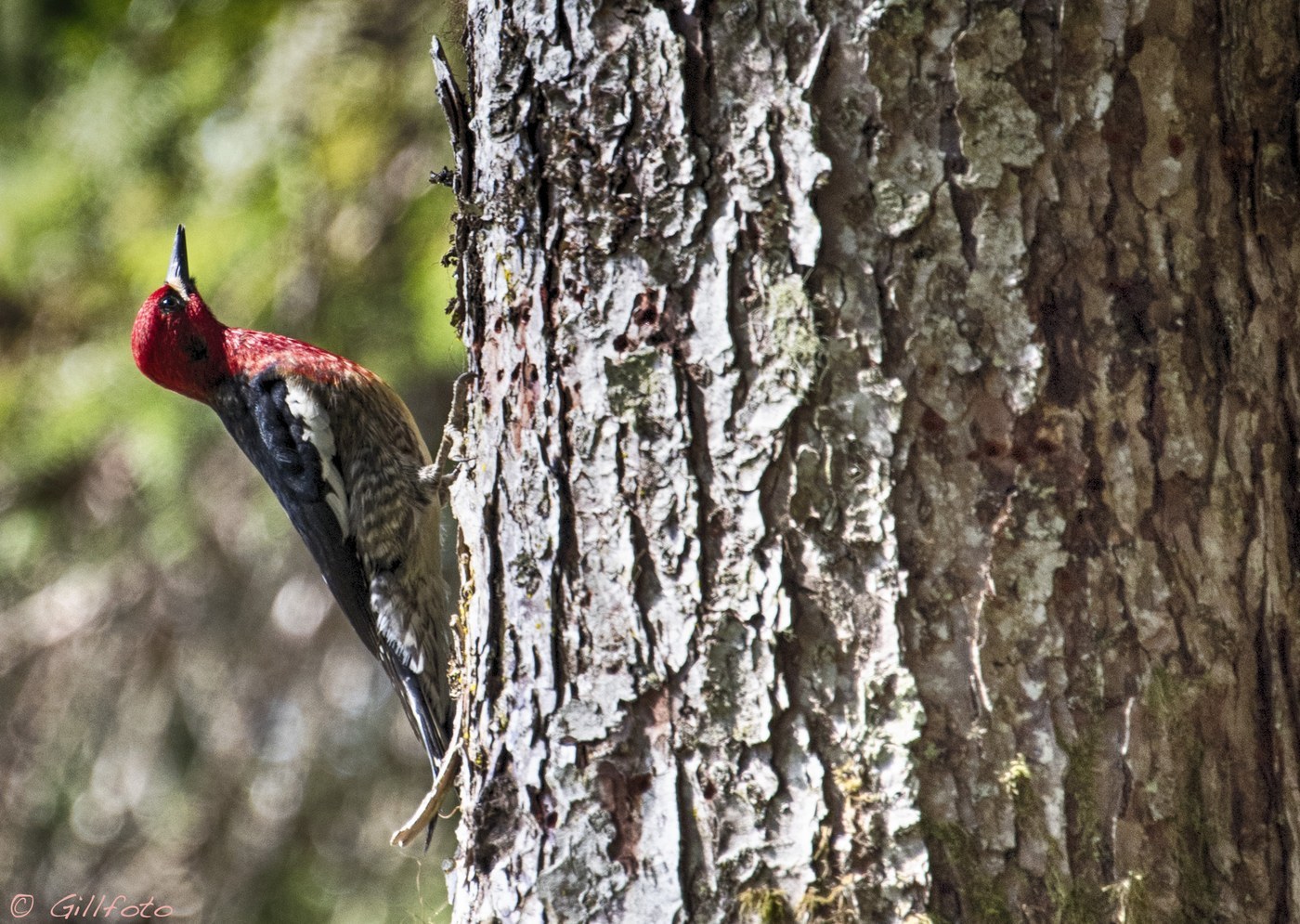
Key Field Marks
- Size & shape: Medium woodpecker (20–22 cm), similar in build to other sapsuckers — stocky body, stiff pointed tail used as a brace against tree trunks, and a straight chisel-like bill.
- Plumage: Entire head, nape, and breast are solid deep red (no white face stripes like other sapsuckers), contrasting with a black back mottled/barred with white and a bold white wing patch visible at rest and in flight. Belly pale yellowish.
- Bill: Straight, medium-length, chisel-tipped, blackish.
- Behavior: Drills neat horizontal rows of shallow sap wells in live tree bark (especially conifers and some deciduous trees) and returns repeatedly to drink sap and catch insects attracted to it — the "sapsucker" signature behavior shared by the whole genus. Often fairly quiet and easy to overlook while feeding.
Separating It From Similar Species
- Vs. Red-naped Sapsucker: Red-naped shows a black-and-white face pattern with only the crown, throat/chin patch, and nape red, plus a white stripe below the eye — Red-breasted lacks all facial white, with the red covering the whole head and breast solidly.
- Vs. Yellow-bellied Sapsucker: Yellow-bellied has a strongly patterned black-and-white face with only a red forecrown (and red throat in males), never the all-red hood of Red-breasted.
- Note on hybridization: Red-breasted, Red-naped, and Yellow-bellied Sapsuckers form a closely related complex and hybridize where ranges meet (interior valleys of the Pacific Northwest), so some individuals show intermediate face patterns with partial white markings.
- Vs. other red-headed woodpeckers: The neat horizontal rows of sap wells drilled in bark, visible on tree trunks, are a strong supporting clue unique to sapsuckers.
Where & When To See It
A Pacific Coast specialist, breeding in coniferous and mixed forests from southern Alaska south through coastal British Columbia, Washington, Oregon, and into California, including the Sierra Nevada and Cascades. Many populations are resident or short-distance migrants, with birds from northern and high-elevation areas moving to lower elevations or slightly south in winter. Look on trunks of conifers (and orchard/deciduous trees) for characteristic sap-well rows.
Voice & Song Cues
Gives a nasal, slightly squealing mewing call, and drums in an irregular, stuttering rhythm (slowing and speeding unevenly) rather than the steady roll of many other woodpeckers — a helpful clue even before the bird is seen.
Frequently asked questions
How can I recognize a Red-breasted Sapsucker versus other sapsuckers?
Look for a completely red head, nape, and breast with no white facial stripes — Red-naped and Yellow-bellied Sapsuckers both show black-and-white facial patterns with only partial red.
What are those neat rows of holes in tree bark?
Those are sap wells drilled by sapsuckers, including the Red-breasted Sapsucker, which returns repeatedly to feed on sap and insects attracted to it — a reliable sign the species is present even when the bird itself isn't visible.
Where in North America can I find a Red-breasted Sapsucker?
Along the Pacific Coast from southern Alaska through British Columbia, Washington, Oregon, and California, in coniferous and mixed forest, including mountain ranges like the Cascades and Sierra Nevada.
Do Red-breasted Sapsuckers hybridize with other sapsucker species?
Yes, they hybridize with Red-naped and Yellow-bellied Sapsuckers where their ranges overlap in the interior Pacific Northwest, sometimes producing birds with intermediate facial patterns.