
Red-breasted Merganser Identification Guide
The Red-breasted Merganser is a slim, fish-eating diving duck best known for its spiky double crest and thin serrated red bill.
Read the full Red-breasted Merganser encyclopedia entry →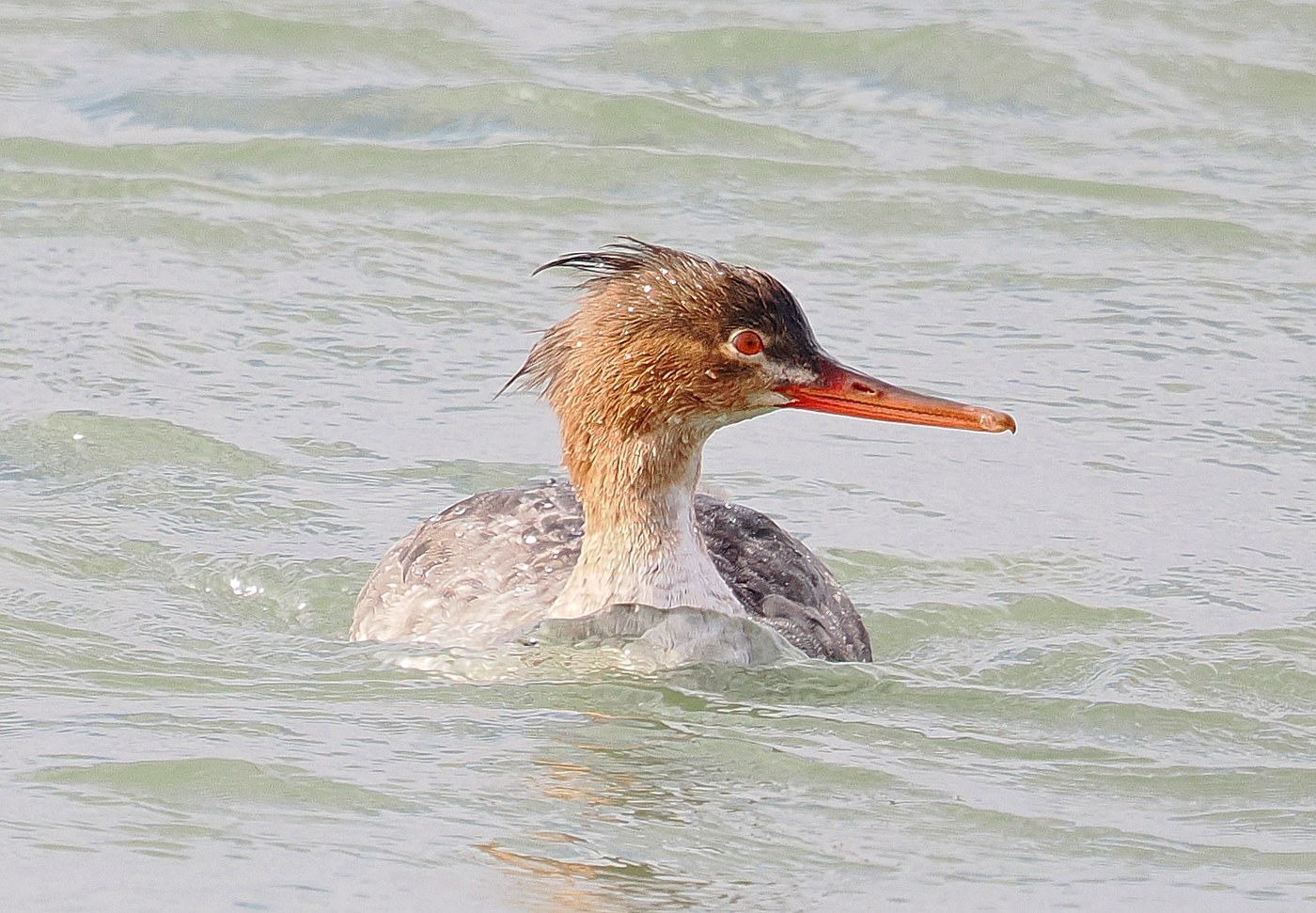
Key Field Marks
- Size & shape: Medium-large duck (52–58 cm) with a slender, low-riding body, long thin neck, and a shaggy, spiky double-pointed crest that sticks out behind the head.
- Bill: Long, thin, cylindrical, and serrated ("sawbill"), bright orange-red in both sexes — a key mark separating it from most other ducks.
- Male plumage: Breeding males have a dark, iridescent green head, white collar, rusty-orange streaked breast, black back, and grayish flanks with fine black-and-white vermiculations.
- Female/eclipse plumage: Grayish-brown body with a rufous-brown head and neck that blends gradually into a whitish throat and chin — no sharp border between head color and body/chest.
- In flight: Fast, direct flight low over water; white wing patches visible, body held flat with head, neck, and tail roughly in line.
- Behavior: Dives frequently and swims with body low in the water; often seen in loose groups on open water, sometimes cooperatively herding fish.
Separating It From Similar Species
- Vs. Common Merganser: Red-breasted has a shaggier, more disheveled double crest (vs. smoothly rounded head), a streaked rusty (not clean white) breast in males, and in females the rufous head blends gradually into the pale throat rather than showing a sharp, crisply demarcated border as in Common Merganser.
- Vs. Hooded Merganser: Hooded Merganser is smaller with a fan-shaped, boldly patterned white-and-black crest and a short dark bill, quite different from the Red-breasted's thin red-orange bill.
- Vs. scaup or other diving ducks: The thin serrated bill and shaggy crest immediately rule out scaup, which have short blue-gray bills and rounded heads.
Where & When To See It
Breeds across the boreal and subarctic zones of North America and Eurasia near lakes, rivers, and coastal tundra. Winters mainly in coastal marine waters, bays, estuaries, and large lakes farther south, often in small flocks. More tolerant of salt water and rougher, more exposed coastal conditions than Common Merganser, which favors freshwater more consistently in winter.
Voice & Song Cues
Generally quiet outside the breeding season. Displaying males give a odd, cat-like or purring "yeow-yeow" courtship call along with harsh croaks; females give a rough, low "krr-krr-krr" alarm/contact call when flushed or tending young.
Frequently asked questions
How do I tell a Red-breasted Merganser from a Common Merganser?
Check the head and breast: Red-breasted has a messier, spikier double crest and a streaked rusty breast in males, while Common Merganser has a smoother head and a clean white breast; females differ in that Red-breasted's rufous head blends gradually into the throat rather than ending sharply.
What does the bill look like on a Red-breasted Merganser?
A long, thin, cylindrical, serrated bill that is bright orange-red in both sexes — an easy field mark distinguishing it from ducks and geese with flatter, broader bills.
Where do Red-breasted Mergansers spend the winter?
Mostly along coastal marine waters, bays, and estuaries, though some also use large lakes; they tolerate saltier and rougher water than most other mergansers.
Do Red-breasted Mergansers dive for food?
Yes, they are pursuit divers that chase small fish underwater, often foraging cooperatively in loose groups that herd fish into shallow water.