
Red-billed Leiothrix Identification Guide
A small, brightly colored Asian babbler with a red bill, yellow-orange throat, and red-and-yellow wing patch, also known as the Pekin Robin and established as a feral species in parts of Hawaii and Europe.
Read the full Red-billed Leiothrix encyclopedia entry →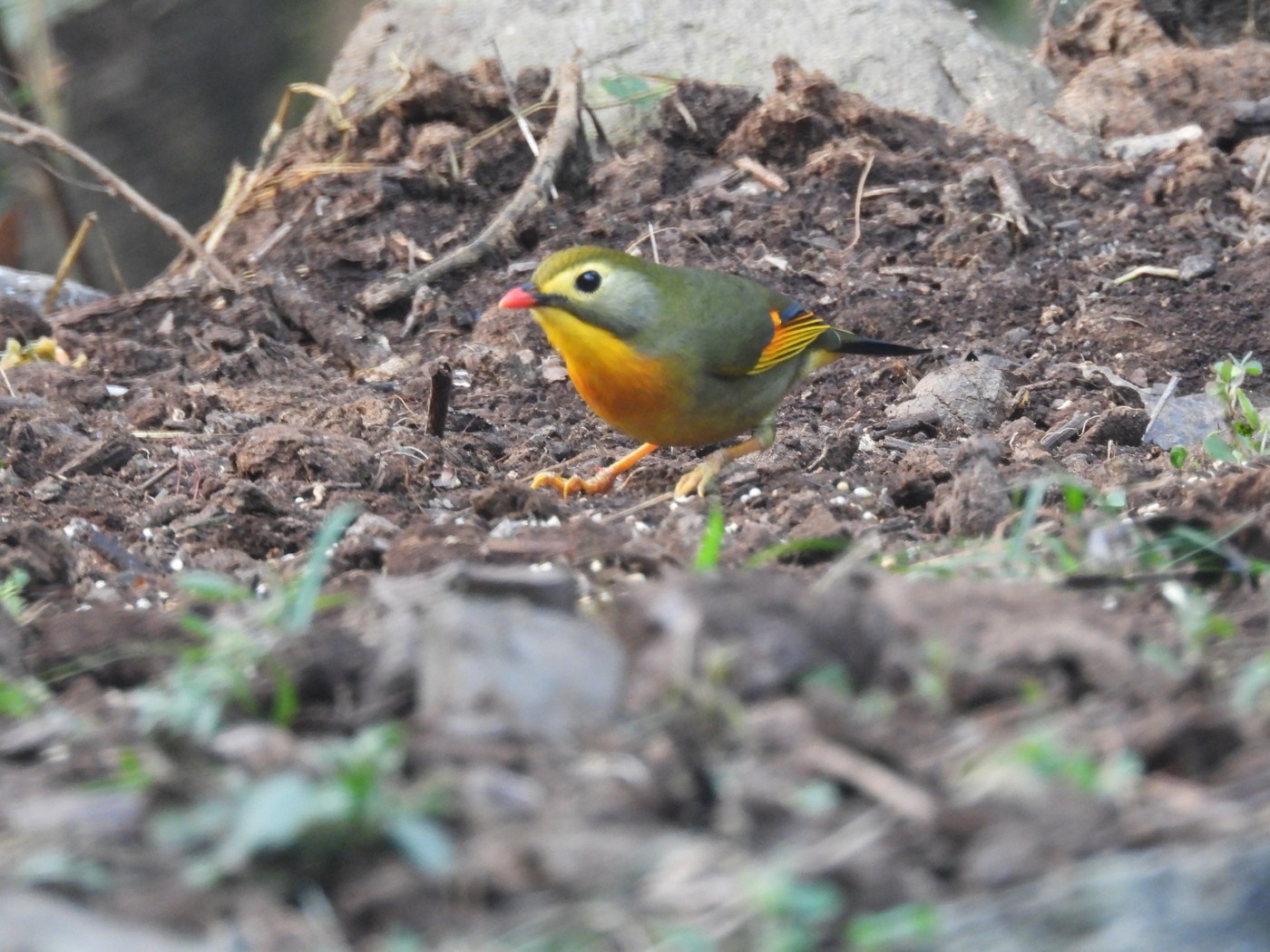
Key Field Marks
- Size & shape: A small, plump songbird about 13–15 cm long, with a fairly short, rounded tail and a rounded body typical of babblers.
- Head and upperparts: Olive-green crown and back, with a pale eyering giving a somewhat wide-eyed expression.
- Throat and breast: Bright yellow-orange throat blending into an orange-tinged breast, fading to olive-yellow underparts.
- Wing patch: A bright patch combining red and yellow (sometimes described as a "flame" panel) on the closed wing, formed by red and yellow edging on the flight feathers — a key diagnostic mark.
- Bill: Short, stout, and coral-red, contrasting with the olive head.
- Legs: Pale pinkish-flesh colored.
Separating It From Similar Species
- No other small songbird within its native or introduced range combines a red bill, yellow-orange throat, and red-and-yellow wing patch, making adults fairly straightforward to identify once seen well.
- Silvereyes and other small greenish passerines that may share habitat lack the red bill and the bright wing patch entirely.
- Juveniles are duller, with a less vivid throat and less contrastingly colored bill, but retain the diagnostic wing patch, which is the most reliable mark at any age.
Habitat, Range & Season
Native to the forested foothills and mid-elevation slopes of the Himalayas, southern China, and northern Southeast Asia, favoring dense shrubby undergrowth, forest edge, and bamboo thickets. Introduced and now established as a feral breeding species in Hawaii (particularly on Oahu and other islands) and in parts of Europe (including areas of Britain, France, and Italy) following escapes from the cage-bird trade. Largely resident, with some altitudinal movement in its native range during winter.
Behavior & Voice
Skulking and often more easily heard than seen, moving in small, loose flocks through dense low vegetation while foraging for insects, berries, and seeds close to the ground. Frequently flicks its wings and tail while perched. The song is a rich, varied, and melodious series of whistled phrases, considered one of the more musical songs among introduced babblers, and contact calls between flock members are soft chattering notes.
Frequently asked questions
What is the key field mark for the Red-billed Leiothrix?
A short, coral-red bill combined with a yellow-orange throat and a distinctive red-and-yellow patch on the closed wing are the most reliable identification features.
Is the Red-billed Leiothrix the same bird as the Pekin Robin?
Yes, Pekin Robin is a widely used common name for the same species, the Red-billed Leiothrix.
Where can I find Red-billed Leiothrix outside of Asia?
Feral, self-sustaining populations descended from escaped cage birds are established in parts of Hawaii and in scattered areas of Europe, including Britain, France, and Italy.
Why is the Red-billed Leiothrix often hard to spot despite its bright colors?
It is a skulking species that stays low in dense shrubby undergrowth and thickets, so it is frequently detected by its musical song before it is actually seen.