Red-bellied Woodpecker Identification Guide
A common eastern North American woodpecker with a zebra-striped black-and-white back and a red cap and nape, whose faint red belly wash is rarely the most visible feature.
Read the full Red-bellied Woodpecker encyclopedia entry →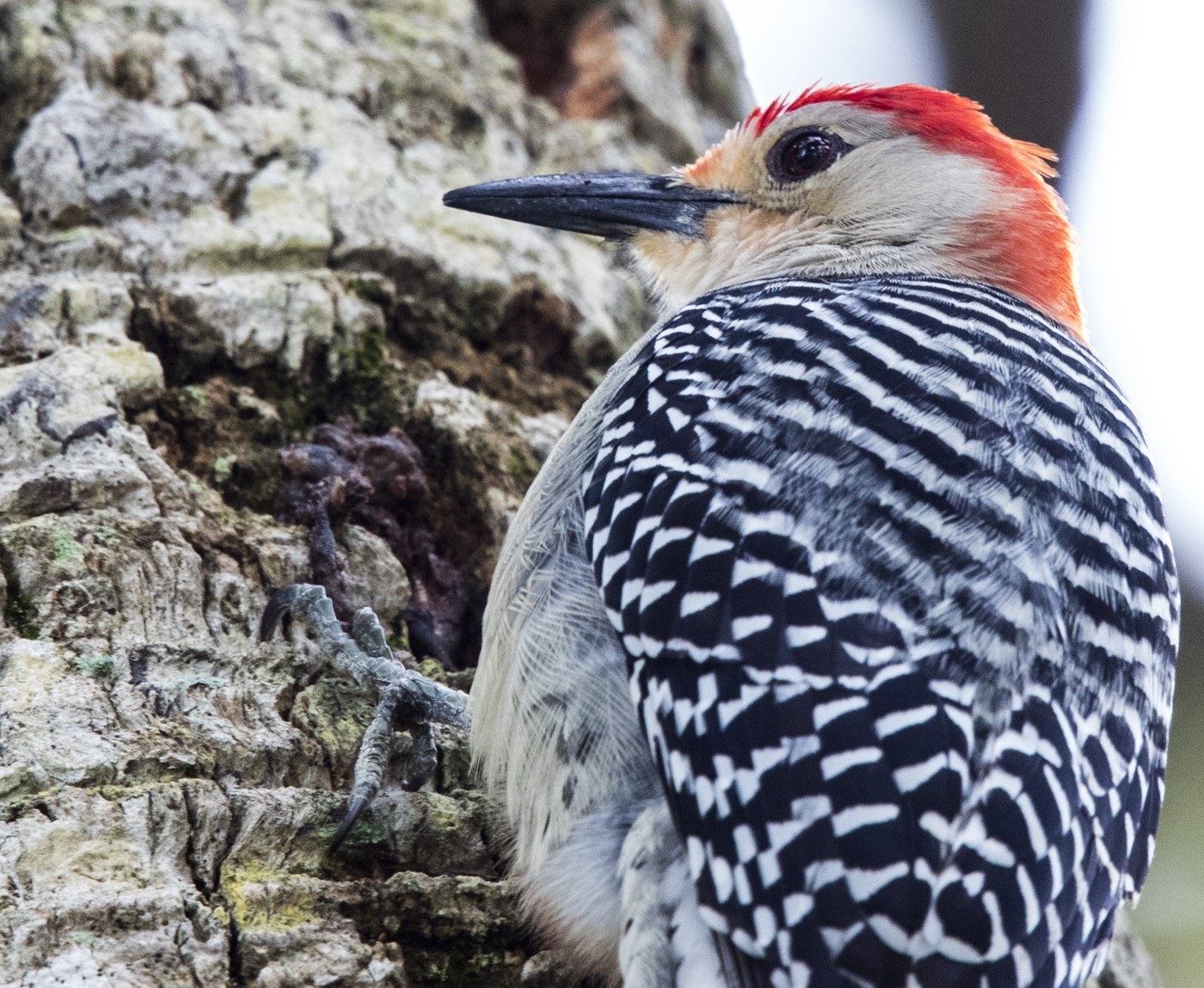
Key Field Marks
- Size & shape: A medium-sized woodpecker about 22–26 cm long, with a fairly long, chisel-tipped bill and a stiff, pointed tail used for bracing against tree trunks.
- Back and wings: Bold black-and-white horizontal barring across the back and wings gives a distinctive "zebra-backed" look.
- Head: Males show red from the bill all the way over the crown to the nape; females show red only on the nape, with a pale grey crown.
- Underparts: Pale grey-buff face and underparts, with a subtle, often hard-to-see reddish or orange-pink wash on the belly that gives the species its name but is rarely obvious in the field.
- Bill: Long, straight, and chisel-like, greyish-black.
Separating It From Similar Species
- Red-headed Woodpecker has a completely red head (not just crown/nape), a solid black back (no barring), and bold white wing patches, very different from the barred back of the Red-bellied Woodpecker.
- Golden-fronted Woodpecker, found further west and south, is very similar in pattern but shows an orange-yellow (not red) nasal tuft and a smaller red crown patch confined to males; ranges barely overlap.
- Yellow-bellied Sapsucker has a red forehead patch, black-and-white face striping, and a solid white wing stripe, quite different from the barred back and grey face of the Red-bellied Woodpecker.
- The barred black-and-white back combined with a plain grey-buff face is the quickest way to rule out confusion with other red-headed eastern woodpeckers.
Habitat, Range & Season
Widespread and common resident across the eastern United States, from the Great Lakes and southern New England south to Florida and west to the central Plains and Texas, with its range slowly expanding northward. Found in deciduous and mixed woodland, forest edge, parks, and suburban yards, readily visiting bird feeders for suet, seeds, and nuts. Non-migratory, present year-round throughout its range.
Behavior & Voice
Forages by climbing tree trunks and branches, gleaning and excavating for insects, and also eats acorns, nuts, seeds, and fruit; it caches food in bark crevices for later use. Frequently visits backyard feeders, especially for suet. The call is a rolling, churring "churr" or "chiv-chiv-chiv," along with a variety of chuckling and rattling notes; drumming is a fairly slow, steady roll on dead wood.
Frequently asked questions
Why is the Red-bellied Woodpecker's belly usually not red in photos?
The reddish wash on the belly is subtle and often obscured by feathers or the bird's posture, so the red crown and nape and the barred back are far more reliable field marks than the belly color the species is named for.
How do I tell a Red-bellied Woodpecker from a Red-headed Woodpecker?
The Red-headed Woodpecker has an entirely red head and a solid black back with bold white wing patches, while the Red-bellied Woodpecker has red only on the crown/nape and a black-and-white barred back.
How can I tell a male from a female Red-bellied Woodpecker?
Males show red extending from the bill over the entire crown to the nape, while females have a grey crown with red confined to the nape.
Where do Red-bellied Woodpeckers live?
They are year-round residents of deciduous and mixed woodlands, parks, and suburban yards across the eastern United States.
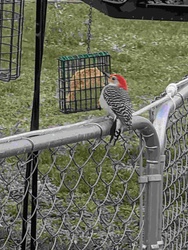
Red-bellied Woodpecker identified by the community
Recent Red-bellied Woodpecker sightings identified with Bird Identifier.