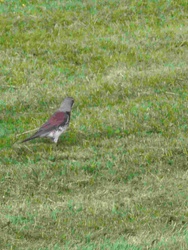
Red-backed Shrike Identification Guide
A migratory Eurasian shrike in which the male shows a grey head, chestnut back, and black highwayman's mask, hunting insects and small prey from prominent perches.
Read the full Red-backed Shrike encyclopedia entry →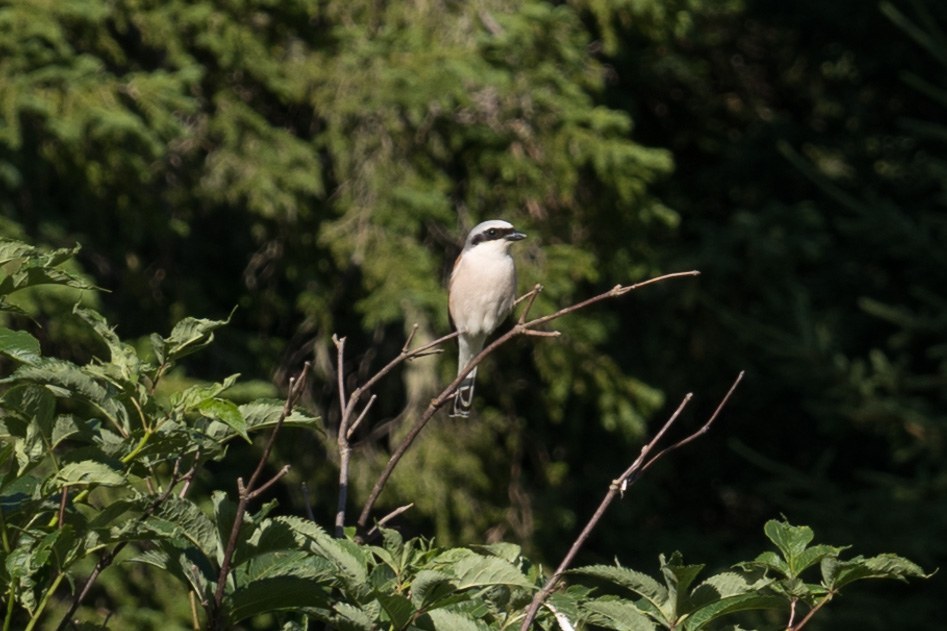
Key Field Marks
- Size & shape: A compact, thick-billed songbird about 16–18 cm long, with a fairly long tail and an upright posture typical of shrikes.
- Male: Blue-grey crown and nape, warm chestnut-brown back and wings, a bold black mask through the eye, pale pinkish-white underparts, and a black-and-white tail pattern visible in flight.
- Female: Duller, warm brown above with a faint mask, and finely scaled, crescent-shaped barring on buffy underparts — much less bold than the male.
- Bill: Stout, hook-tipped, blackish, typical of shrikes and used for grasping prey.
- Behavior in the field: Frequently perches conspicuously on wires, fence posts, or the tops of bushes, scanning for prey, then dropping down or sallying out to catch it.
Separating It From Similar Species
- Woodchat Shrike has a chestnut crown and nape (rather than grey) and a large white shoulder/scapular patch, quite different from the Red-backed Shrike's grey head and plain chestnut back.
- Great Grey Shrike is larger, entirely grey and white with black wings, and lacks the chestnut back of the Red-backed Shrike.
- Isabelline Shrike (a rarer vagrant in parts of the Red-backed Shrike's range) is paler and sandier overall, with a rufous tail contrasting against a duller, greyer-brown back.
- Females and juveniles are best separated from other brown shrikes by the combination of scaly underparts, a relatively short primary projection, and range/season.
Habitat, Range & Season
Breeds across much of Europe and temperate western Asia, favoring open country with scattered thorny bushes, hedgerows, and scrubby grassland where it can perch and hunt. A long-distance migrant, it winters in sub-Saharan Africa and passes through the Mediterranean and Middle East on migration, generally present on the breeding grounds from May to August/September.
Behavior & Voice
A classic "sit-and-wait" predator, watching from an exposed perch before dropping onto large insects, and occasionally small lizards, rodents, or nestling birds. Notably impales surplus prey on thorns or barbed wire to create a larder, a distinctive natural behavior of shrikes. The song is a subdued, scratchy warble that often incorporates mimicry of other bird species; the call is a harsh, chattering "shack-shack."
Frequently asked questions
What is the easiest way to identify a male Red-backed Shrike?
Look for a blue-grey head, chestnut-red back, a bold black mask through the eye, and pale pinkish underparts, typically seen perched prominently on a bush or wire.
How do you tell a Red-backed Shrike from a Woodchat Shrike?
The Red-backed Shrike has a grey crown and plain chestnut back with no white wing patch, while the Woodchat Shrike has a chestnut crown and a conspicuous white patch on the shoulder.
Why does the Red-backed Shrike impale prey on thorns?
It caches surplus food by skewering insects and small prey items on thorns or barbed wire, creating a 'larder' it can return to later — a well-known natural hunting behavior among shrikes.
When and where can I see a Red-backed Shrike?
It breeds in open, scrubby countryside across Europe and temperate Asia from roughly May to September, then migrates to spend the winter in sub-Saharan Africa.
Red-backed Shrike identified by the community
Recent Red-backed Shrike sightings identified with Bird Identifier.