
Red-backed Fairywren Identification Guide
A tiny Australian wren in which breeding males show a jet-black body with a fiery red-orange back, while females and non-breeding males are plain warm brown.
Read the full Red-backed Fairywren encyclopedia entry →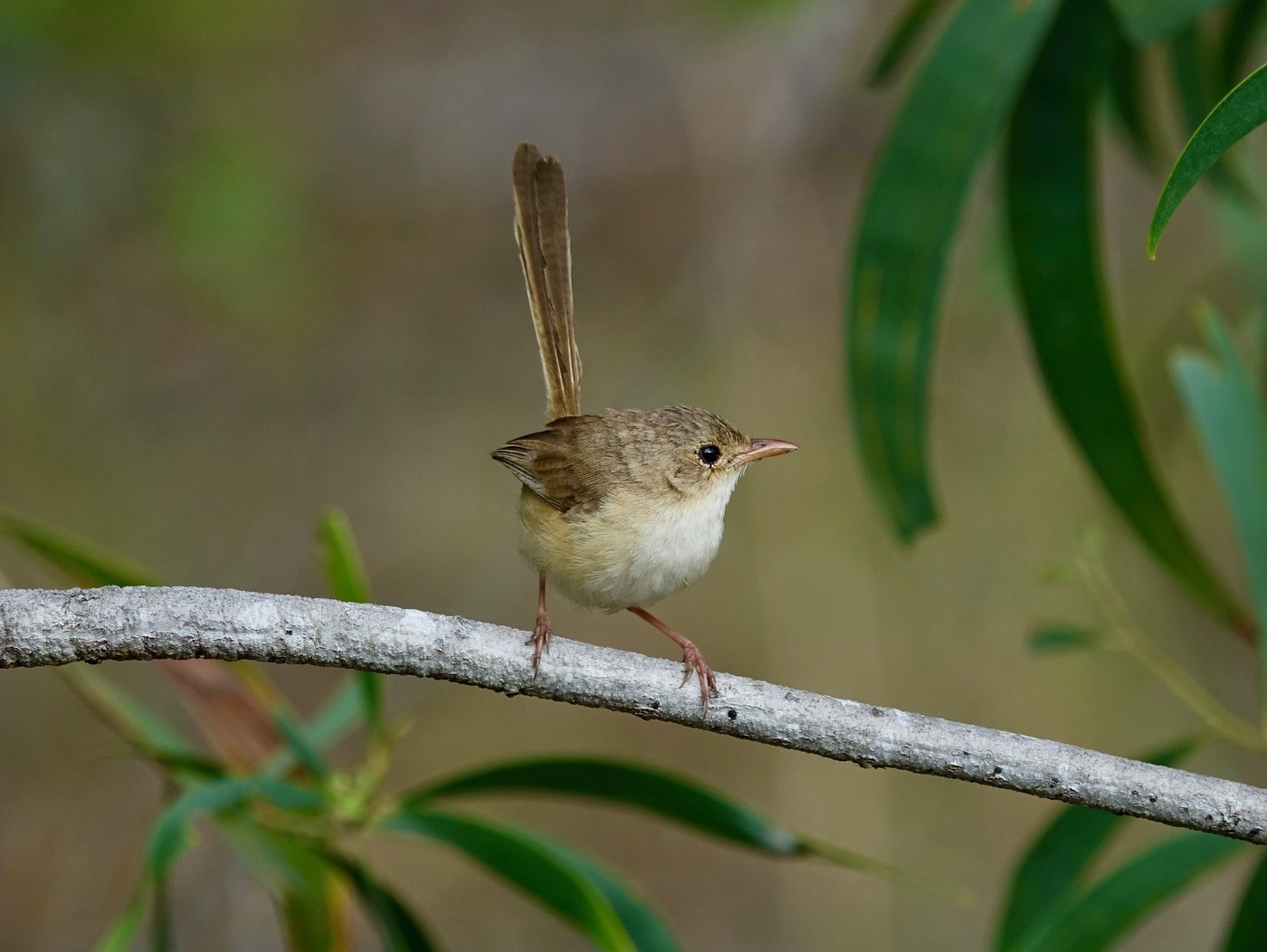
Key Field Marks
- Size & shape: A very small, long-tailed bird about 10–12 cm long, with the cocked, often-flicked tail typical of fairywrens.
- Breeding male: Glossy black overall, including the head, throat, and tail, with a vivid orange-red to scarlet patch across the back and shoulders — the defining feature of the species.
- Female and non-breeding male: Plain warm brown above, paler buffy-brown below, lacking any red, black, or blue tones; bill and legs are brownish-flesh colored, unlike the black bill of breeding males.
- Bill: Black in breeding males, dull horn-brown in females and non-breeding males.
Separating It From Similar Species
- Breeding males are unmistakable — no other fairywren shows a black body with a red back; other Australian fairywrens with red in the plumage (e.g., Red-winged Fairywren) show red on the shoulder/wing rather than the back, and have blue in the plumage rather than black.
- Females and dull males are trickier and closely resemble female Variegated or White-winged Fairywrens; range and habitat, along with the plain, unstreaked brown plumage lacking any blue tail tones, help confirm identity.
- Where ranges overlap with the Red-winged Fairywren in northwestern Australia, check whether the red patch is confined to the back (Red-backed) versus extending onto the folded wing (Red-winged).
Habitat, Range & Season
Found across northern and eastern Australia, from the Kimberley region east through the Top End and Cape York, south along the eastern coast to around central New South Wales. Inhabits grassy woodland, tall grass, sedges, cane fields, and shrubby understory, often near water. Resident year-round, with birds living in small family groups on defended territories.
Behavior & Voice
Lives in cooperative family groups, usually a dominant breeding pair assisted by helper birds from previous broods, foraging low in grass and shrubs for insects and other small invertebrates. Constantly on the move, hopping and flitting with the tail cocked and often flicked sideways. The song is a thin, high-pitched, reeling trill, and both sexes give sharp contact calls to keep the group in touch as they move through dense cover.
Frequently asked questions
How do I identify a male Red-backed Fairywren?
Look for an entirely black body with a bright orange-red patch across the back — no other Australian fairywren shows this exact combination.
How can I identify a female Red-backed Fairywren?
Females are plain warm brown above and buffy below with no red, black, or blue in the plumage; they are best told from similar female fairywrens by range, habitat, and the lack of any blue in the tail.
What is the difference between the Red-backed and Red-winged Fairywren?
In the Red-backed Fairywren the red patch is confined to the back, while in the Red-winged Fairywren red extends onto the folded wing (shoulder); their ranges also differ, with limited overlap in northwestern Australia.
What habitat should I search for Red-backed Fairywrens?
Look in tall grass, sedges, and shrubby understory, often near water, across northern and eastern Australia.