
Red-and-yellow Barbet Identification Guide
A boldly patterned East African barbet with a scarlet face, black-spotted golden upperparts, and a habit of nesting in termite mounds.
Read the full Red-and-yellow Barbet encyclopedia entry →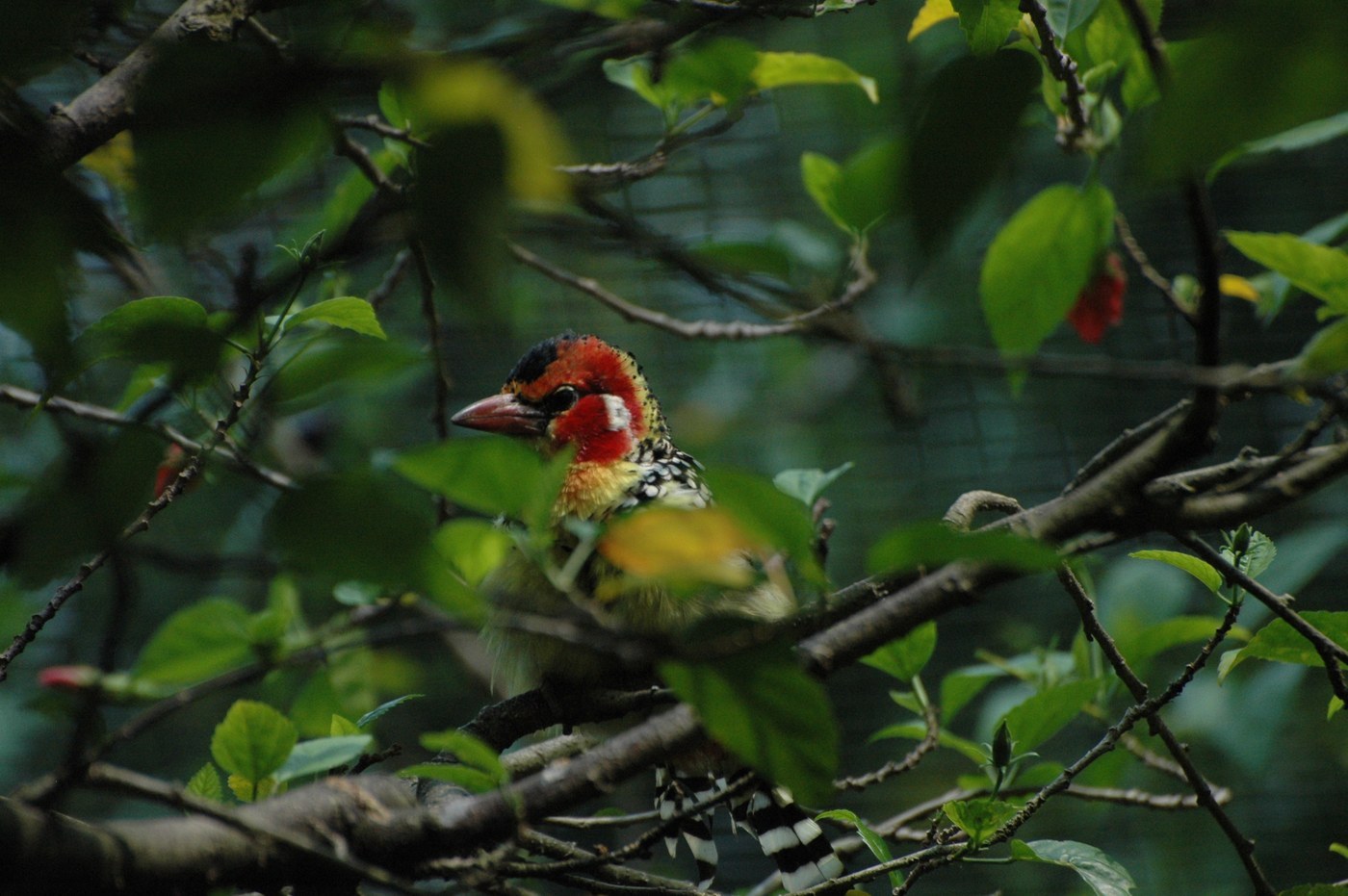
Key Field Marks
- Size & shape: A stocky, medium-sized barbet about 20–23 cm long, with a large head, short neck, and a stout, slightly downcurved black bill typical of barbets.
- Head: Bright red face, crown, and throat, with a small yellow patch behind the eye in many individuals.
- Upperparts: Black, densely spotted with bold yellow-white spots across the back, wings, and rump, giving a striking speckled look.
- Underparts: Golden-yellow breast and belly, crossed by an irregular black breast band that is often broken or spotted rather than solid.
- Bill and legs: Black, heavy bill; dark legs.
Separating It From Similar Species
- No other East African barbet combines a fully red face with heavily spotted black-and-yellow upperparts, making this species largely unmistakable within its range.
- D'Arnaud's Barbet, a close relative, lacks the red face entirely, instead showing a yellow-and-black spotted head, and has a different, more uniformly barred underpart pattern.
- Told from other similarly colorful African barbets (such as Yellow-breasted Barbet) by the extent of red on the head and the dense yellow spotting on the black back.
Habitat, Range & Season
Resident in dry bushland, thornscrub, and semi-arid savanna of East Africa, from southern Ethiopia and Somalia south through Kenya into northern Tanzania. Closely tied to termite mounds, which it excavates for nesting and roosting, and to areas of scattered acacia and thorn scrub. Non-migratory, present year-round, often in family groups defending a permanent territory.
Behavior & Voice
Highly social for a barbet, living in small family groups that cooperatively defend a territory centered on a termite mound used for nesting and roosting. Forages mostly on the ground and in low bushes for insects, seeds, and fruit. Known for loud, energetic duets and choruses between group members, involving synchronized calling accompanied by bowing, wing-flicking, and tail-fanning displays — one of the most vocal and demonstrative barbets in Africa.
Frequently asked questions
What is the most distinctive feature of the Red-and-yellow Barbet?
Its bright red face combined with black upperparts densely spotted in yellow is unique among East African barbets and makes it easy to identify.
How can I tell it apart from D'Arnaud's Barbet?
D'Arnaud's Barbet lacks the red face — its head is patterned in yellow and black rather than showing the solid red crown, throat, and face of the Red-and-yellow Barbet.
Where should I look for a Red-and-yellow Barbet?
Search dry thornscrub and savanna in East Africa, particularly near termite mounds in Kenya, southern Ethiopia, Somalia, and northern Tanzania.
Why does the Red-and-yellow Barbet nest in termite mounds?
Termite mounds provide a firm, weatherproof structure that the barbets excavate into nesting chambers, offering good protection for eggs and chicks in an open savanna habitat.