
Red-and-green Macaw Identification Guide
A huge, mostly crimson South American macaw with a broad green wing band and bare white facial skin finely lined with red feathers.
Read the full Red-and-green Macaw encyclopedia entry →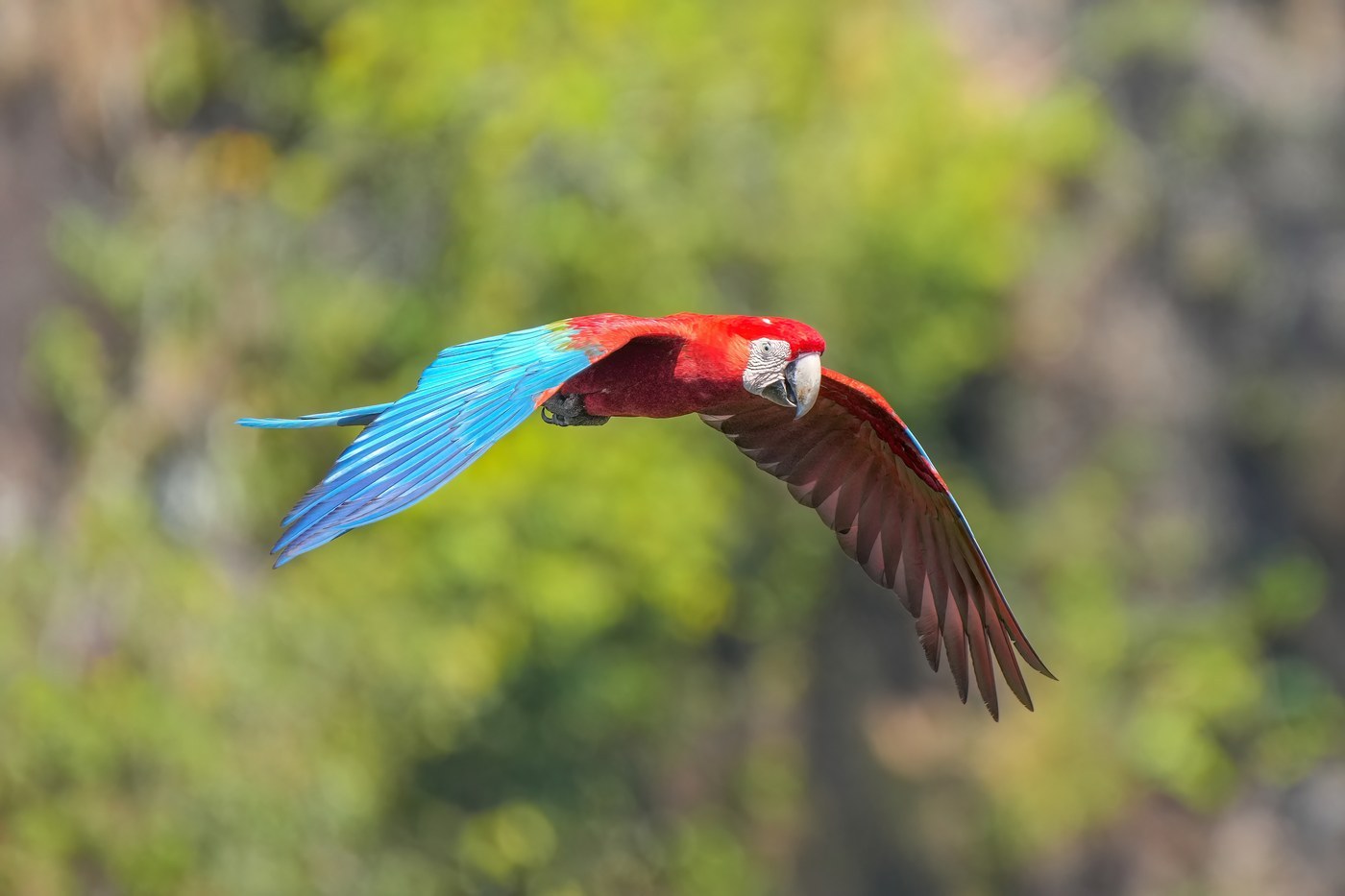
Key Field Marks
- Size & shape: One of the largest parrots in the world, 90–95 cm long including a very long, pointed tail, with a massive curved black bill and broad, powerful wings.
- Body color: Predominantly rich crimson-red over the head, neck, breast, and belly.
- Wings: A broad band of green across the wing coverts separates the red body from blue flight feathers and a blue lower back and rump — this green band is the key mark separating it from the similar Scarlet Macaw.
- Face: Bare white facial skin, but unlike the Scarlet Macaw's largely unmarked white face, this species shows fine lines of small red feathers crossing the white skin.
- Bill: Large, strongly hooked, mostly blackish-grey.
Separating It From Similar Species
- Scarlet Macaw is very similar in overall red-and-blue pattern but has a yellow (not green) band across the wing coverts and lacks the fine red feather lines on its bare white face.
- Military Macaw is mostly green rather than red, with a red forehead patch only, and is much smaller-billed and slimmer overall.
- Great Green Macaw is largely green with a reddish forehead and much paler, more pinkish bill base, lacking the extensive crimson body of this species.
- Size alone helps too — this is the second-largest macaw species after the Hyacinth Macaw, noticeably bulkier than the Scarlet Macaw.
Habitat, Range & Season
Resident across humid lowland and foothill forest of northern and central South America, including the Amazon Basin, parts of the Guianas, and eastward through Brazil, ranging locally into Panama in Central America. Favors tall forest, forest edge, and areas with cliffs or riverbanks containing exposed clay, where flocks and pairs gather to eat mineral-rich soil (a "clay lick"). Non-migratory, present year-round within its range.
Behavior & Voice
Usually seen in pairs or small family groups, occasionally gathering in larger numbers at clay licks and fruiting trees. Feeds on a wide variety of seeds, nuts, and fruit, using its powerful bill to crack open tough pods and nuts that few other animals can access. Flight is strong, direct, and unhurried, with slow, deep wingbeats and the long tail trailing behind. The voice is a loud, harsh, far-carrying squawk or screech, typically given in flight and when disturbed.
Frequently asked questions
How do I tell a Red-and-green Macaw from a Scarlet Macaw?
Check the wing coverts: the Red-and-green Macaw shows a green band, while the Scarlet Macaw shows a yellow band. The Red-and-green Macaw's bare facial skin also has fine red feather lines, which the Scarlet Macaw largely lacks.
How big is a Red-and-green Macaw?
It is one of the largest macaws, reaching about 90–95 cm in length, second in size only to the Hyacinth Macaw among all parrots.
Where do Red-and-green Macaws live?
They inhabit humid lowland and foothill forests across much of northern and central South America, including large parts of the Amazon Basin, with a small population reaching Panama.
Why do Red-and-green Macaws gather at clay licks?
They visit exposed riverbank or cliff clay deposits to eat mineral-rich soil, which is thought to help buffer toxins from the seeds and unripe fruit in their diet.