
Razorbill Identification Guide
A stocky black-and-white North Atlantic seabird best known for its thick, blade-like bill with a white vertical stripe and its upright, penguin-like posture on breeding cliffs.
Read the full Razorbill encyclopedia entry →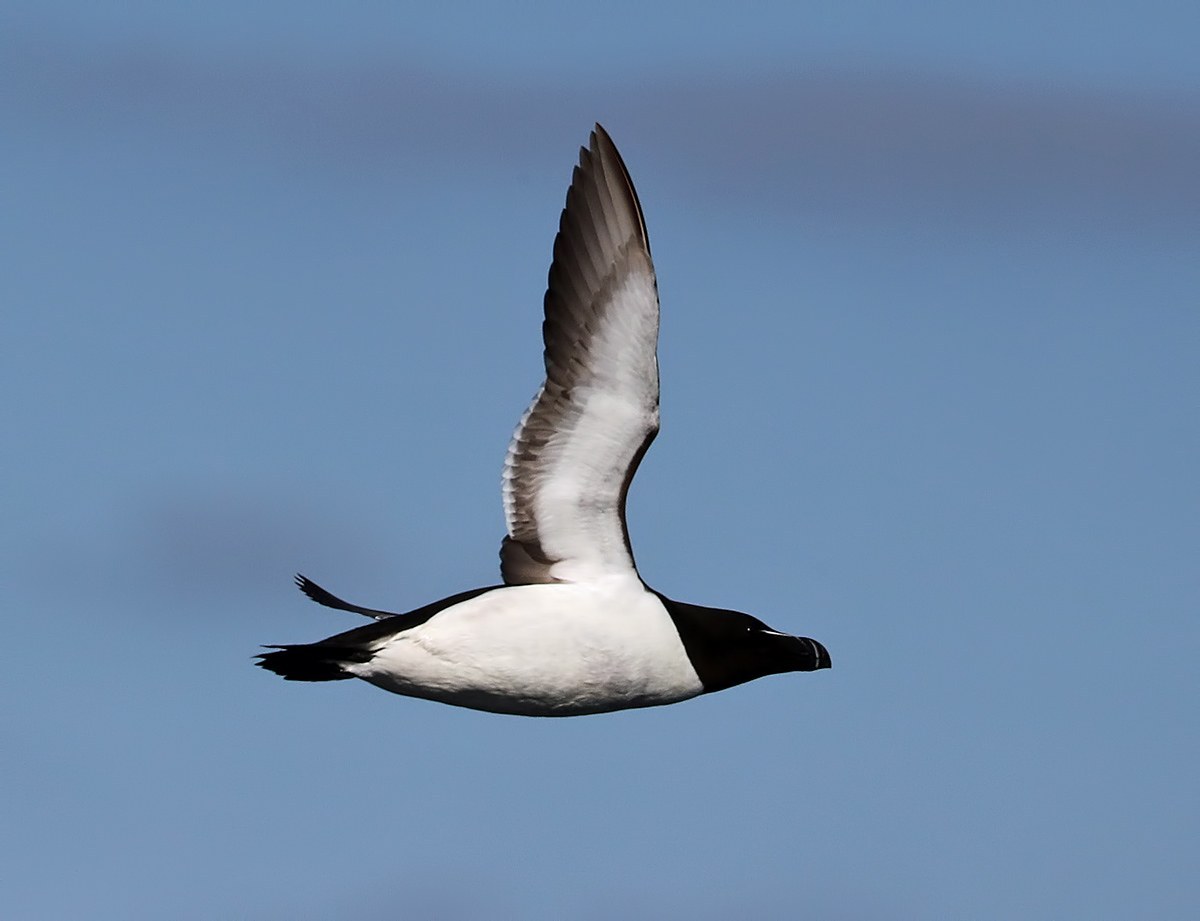
Key Field Marks
- Size & shape: A chunky, thick-necked auk about 38–43 cm long, with a large head and a pointed tail often cocked up, giving a distinctive silhouette both on the water and on cliff ledges.
- Bill: Deep, laterally flattened, and blunt-tipped, black with a bold white vertical line near the tip and a thin white line running from the bill base to the eye in breeding adults — the single best field mark.
- Plumage: Glossy black upperparts (head, neck, back) and crisp white underparts, with a sharp demarcation along the flanks; in non-breeding birds the face and throat become mottled white.
- Flight: Fast, low, and whirring over the water on short, rounded wings, typically flying in tight groups low over the sea.
- Posture: Stands upright on rock ledges, tail often raised, recalling a small penguin.
Separating It From Similar Species
- Common Murre (Common Guillemot) is more slender-necked with a thin, pointed, all-dark bill lacking any white markings, and lacks the Razorbill's blunt, laterally compressed bill shape.
- Thick-billed Murre has a shorter, thicker bill than the Common Murre but still lacks the Razorbill's flattened shape and white bill stripe; it shows a pale line along the gape instead.
- Black Guillemot is smaller, all-black in breeding plumage with a large white wing patch and bright red legs and feet, quite different from the Razorbill's bill and body pattern.
- At a distance on the water, the Razorbill's thicker head, longer cocked tail, and blockier bill profile separate it from the slimmer-billed murres.
Habitat, Range & Season
Breeds colonially on rocky sea cliffs, ledges, and boulder fields around the North Atlantic, from northeastern North America and Greenland to Iceland, the British Isles, and Scandinavia, often alongside murres and kittiwakes. Spends the rest of the year far out at sea, wintering across the North Atlantic and occasionally moving south to more temperate coasts in cold winters.
Behavior & Voice
An excellent diver, pursuing small schooling fish underwater using its wings for propulsion. Highly colonial when breeding, packing tightly onto ledges and laying a single, sharply pointed egg directly on bare rock. Largely silent at sea; at the colony it gives low, growling or grunting calls between mates and chicks.
Frequently asked questions
What is the single best field mark for a Razorbill?
Its thick, laterally flattened black bill with a bold white vertical band near the tip is the most reliable identification feature, distinguishing it from all similar auks.
How do I tell a Razorbill from a Common Murre?
The Razorbill has a deep, blunt, blade-like bill with a white stripe, a thicker neck, and a longer tail often held cocked up, while the Common Murre has a thin, pointed, all-dark bill and a slimmer profile.
Where and when can I see a Razorbill?
Look for breeding colonies on North Atlantic sea cliffs from spring through summer, or scan offshore waters in winter when Razorbills disperse widely across the open ocean.
Do Razorbills look different outside the breeding season?
Yes, in non-breeding (winter) plumage the white extends further up onto the face and throat, and the thin white line from the bill to the eye is lost, making the head pattern more mottled.