
Rainbow Lory Identification Guide
A colorful nectar-feeding parrot of Indonesia, New Guinea, and the Pacific islands, showing a blue head, red bill, and highly variable orange, yellow, or barred underparts depending on subspecies.
Read the full Rainbow Lory encyclopedia entry →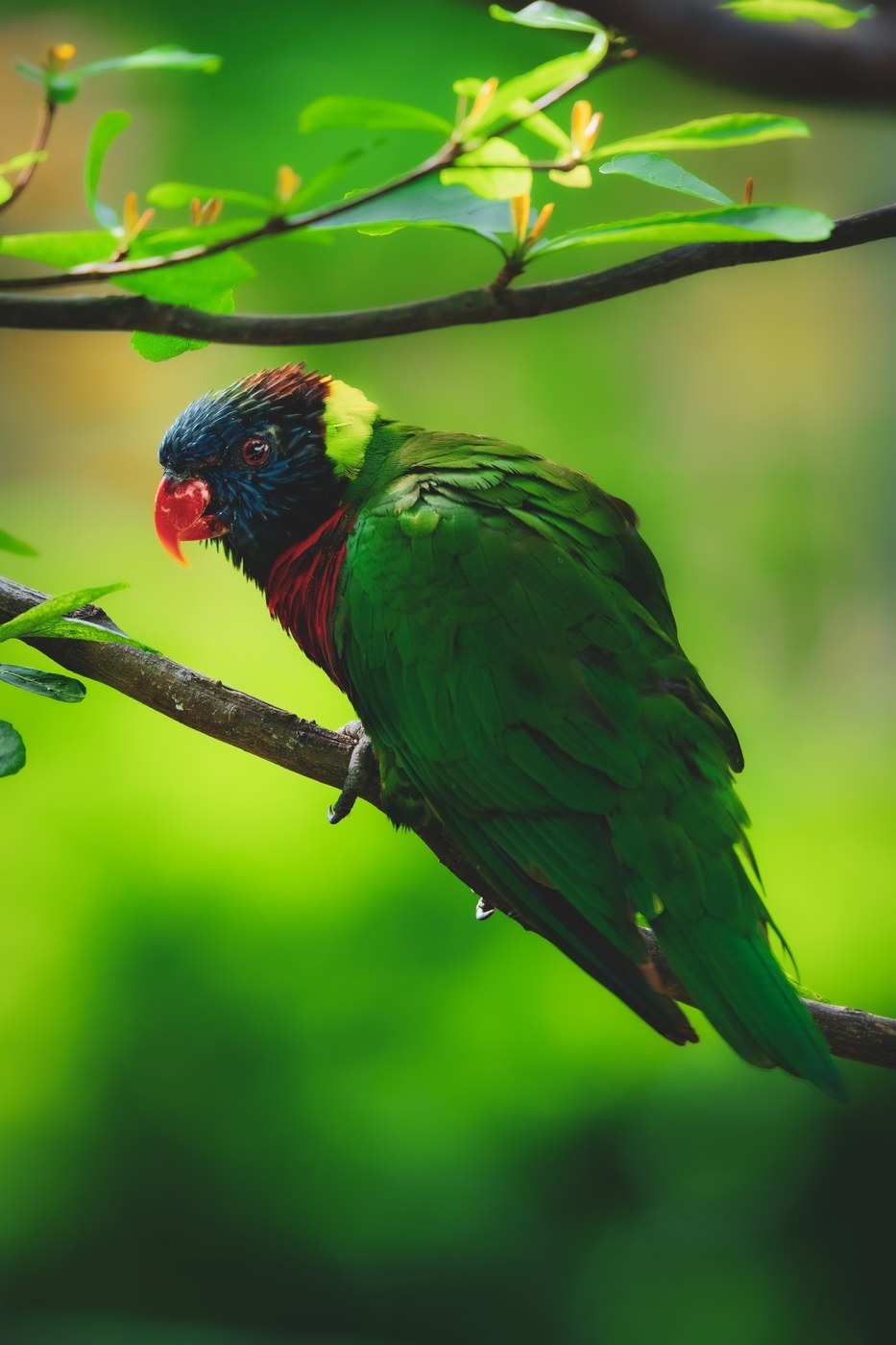
Key Field Marks
- Size & shape: A slender, medium-sized lorikeet around 25–30 cm, with pointed wings and a long, graduated tail, typical of the Trichoglossus lorikeets.
- Head: Rich blue with fine dark streaking, sharply set off from the body.
- Bill: Bright orange-red, strongly curved, suited to probing flowers for nectar and pollen.
- Underparts: Highly variable across its range — solid orange-red on some island populations, yellow-green barred or mottled on others — a reflection of the many subspecies within the wider species complex.
- Upperparts: Green back, wings, and tail, sometimes with a yellowish nape band.
- Eyes and legs: Orange to red eyes; grey legs.
Separating It From Similar Species
- Rainbow Lorikeet of mainland Australia is closely related and near-identical in head and back color but usually shows a cleaner, more uniform orange breast band and blue belly; the two are now often treated as separate species split along geographic lines.
- Coconut Lorikeet (New Guinea and northern Australia) is very similar but typically shows a darker, more solidly blackish-blue belly and a slightly different breast pattern.
- Regional subspecies of the Rainbow Lory complex can differ substantially in underpart color and pattern, so range is often the most reliable clue to which population you are seeing.
Habitat, Range & Season
Found across Wallacea, New Guinea, and parts of the western Pacific, in lowland and hill forest, forest edge, coconut plantations, mangroves, and gardens with flowering trees. Resident and largely sedentary, though flocks move locally to track flowering and fruiting trees.
Behavior & Voice
Gregarious and noisy, typically in pairs or small flocks that gather in larger numbers at good nectar sources. Feeds by clambering through blossoms, often hanging at odd angles, using a brush-tipped tongue to lap up nectar and pollen; also eats soft fruit and occasional insects. Flight is fast and direct with rapid wingbeats. Vocalizations are sharp, screeching, and chattering, given almost continuously in flight and while foraging.
Frequently asked questions
How do I identify a Rainbow Lory?
Look for a blue head, red curved bill, green back and wings, and underparts that range from solid orange to yellow-green barred depending on the population — combined with noisy, fast flight and constant screeching calls.
Is the Rainbow Lory a separate species from the Rainbow Lorikeet?
They are part of the same closely related species complex. Many taxonomists now split the Australian Rainbow Lorikeet from the more variable island populations often called Rainbow Lory, but the two look very similar and share the blue head and red bill.
Why do Rainbow Lories look different from island to island?
The species complex includes many subspecies across Indonesia, New Guinea, and the Pacific, and underpart color and pattern vary geographically, ranging from solid orange-red to barred yellow-green.
What habitat should I look in to find a Rainbow Lory?
Search flowering and fruiting trees in lowland forest, forest edge, coconut plantations, and gardens throughout its Indonesian, New Guinean, and Pacific island range.