
Rainbow Lorikeet Identification Guide
A brilliantly multicolored Australian parrot with a blue head, orange breast band, and green body, best known for its screeching flocks in eucalypt woodlands and city parks.
Read the full Rainbow Lorikeet encyclopedia entry →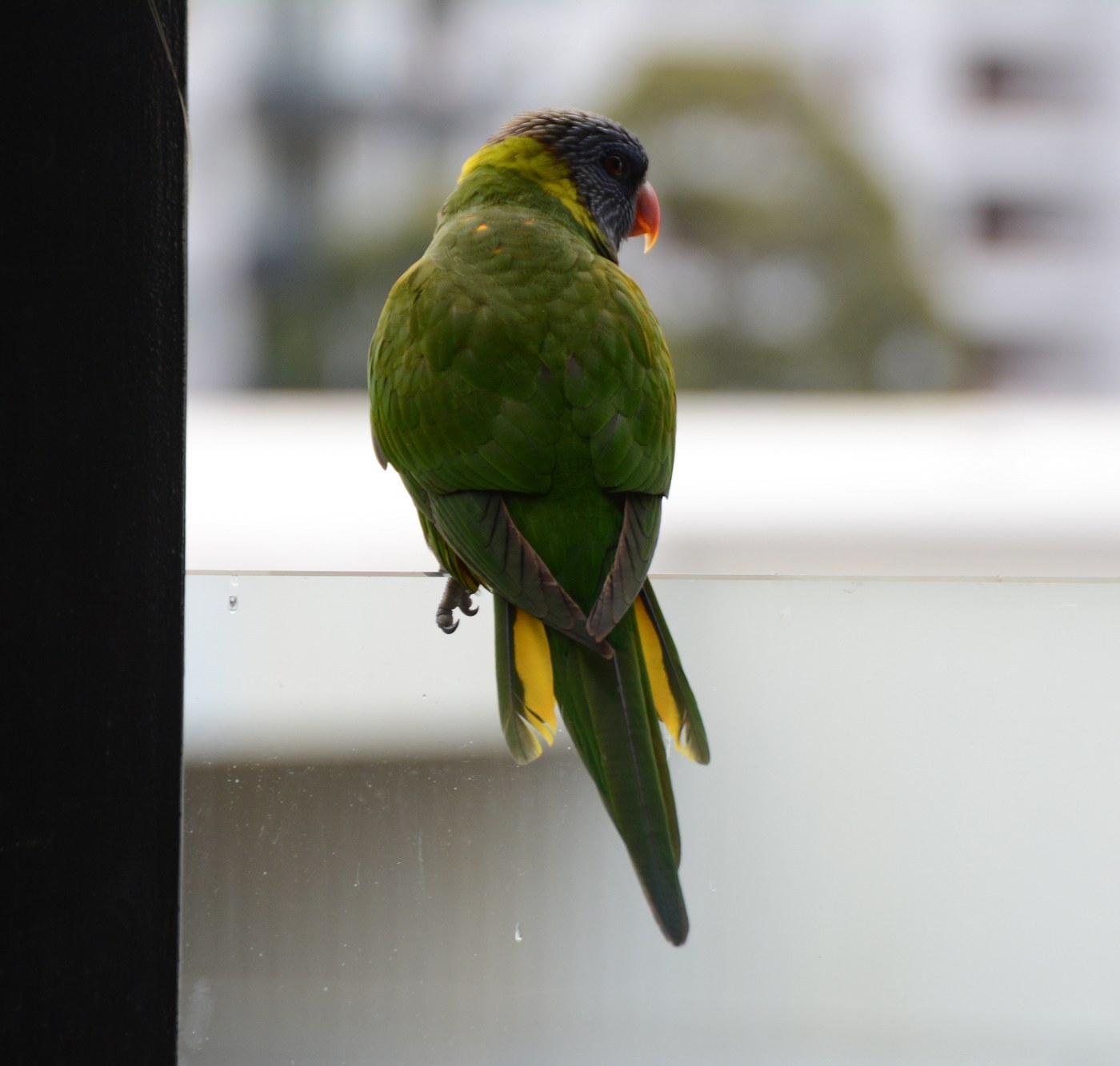
Key Field Marks
- Size & shape: A medium-sized parrot, 25–30 cm long, with a slender body, pointed wings, and a long, tapering tail — built for fast, direct flight.
- Head: Deep cobalt-blue to violet, finely streaked with darker blue, giving a scaly appearance up close.
- Bill: Bright coral-red to orange-red, adapted for prying open flowers; the tongue has a brush-like tip for lapping up nectar and pollen.
- Underparts: A vivid orange-yellow breast band separates the blue head from a deep blue belly.
- Upperparts: Bright grass-green back, wings, and tail, with a yellow-green wash on the nape and hindneck in some birds.
- Eyes and legs: Orange-red eyes; grey legs and feet.
Separating It From Similar Species
- Scaly-breasted Lorikeet lacks the blue head entirely — its head and underparts are green with fine yellow scaling, and it lacks the orange breast band.
- Musk Lorikeet is smaller, mostly green with a red forehead patch and blue crown patch, and lacks the blue head and orange chest band.
- Rainbow Lory (the broader species complex found through Wallacea and New Guinea) shares the blue head and red bill but often shows a more solid orange-red or barred underside depending on subspecies; Australian Rainbow Lorikeets are a distinct, geographically separate population now usually treated as its own species.
- Hybrids with Scaly-breasted Lorikeet occur where ranges overlap and can show intermediate, patchy chest coloration.
Habitat, Range & Season
Common and conspicuous across eastern and northern Australia, from Cape York south to South Australia, in eucalypt forest, woodland, coastal scrub, and — especially — suburban gardens, parks, and street trees with flowering natives. Non-migratory but locally nomadic, following flowering eucalypts, grevilleas, and bottlebrushes. Introduced, self-sustaining populations also occur in Perth, Auckland, and Hong Kong.
Behavior & Voice
Highly social, usually seen in noisy, fast-flying flocks that gather at dusk in communal roost trees, sometimes hundreds strong. Feeds acrobatically, often hanging upside-down, on nectar, pollen, soft fruit, and occasionally seeds or insects. Flight is swift, direct, and whirring, typically well above the canopy. The call is a shrill, screeching chatter given constantly in flight and while feeding — often the first clue to its presence before it is seen.
Frequently asked questions
What is the easiest way to identify a Rainbow Lorikeet?
Look for the combination of a solid blue head, bright orange-yellow breast band, and green back and wings, paired with a loud, screeching call and fast, direct flight.
Is the Rainbow Lory the same bird as the Rainbow Lorikeet?
They belong to the same species complex. The Australian population is now typically treated as the Rainbow Lorikeet (Trichoglossus moluccanus), while 'Rainbow Lory' commonly refers to related island populations across Indonesia and the Pacific with more variable underpart coloring.
How can I tell a Rainbow Lorikeet from a Scaly-breasted Lorikeet?
The Rainbow Lorikeet has a blue head and an orange chest band; the Scaly-breasted Lorikeet's head and underparts are green with fine yellow scalloping and no blue or orange.
Where is the best place to see Rainbow Lorikeets?
They are common and easy to see in flowering eucalypts, parks, and gardens throughout eastern and northern Australia, often visiting bird feeders and blossoming trees in suburban areas.
What time of day are Rainbow Lorikeets most active?
They are most conspicuous at dawn and dusk, when large flocks fly noisily to and from communal roost trees.