
Rainbow Bee-eater Identification Guide
Australia's only bee-eater, a slender, multicolored aerial hunter with a black downcurved bill, elongated central tail streamers, and a distinctive black eye stripe.
Read the full Rainbow Bee-eater encyclopedia entry →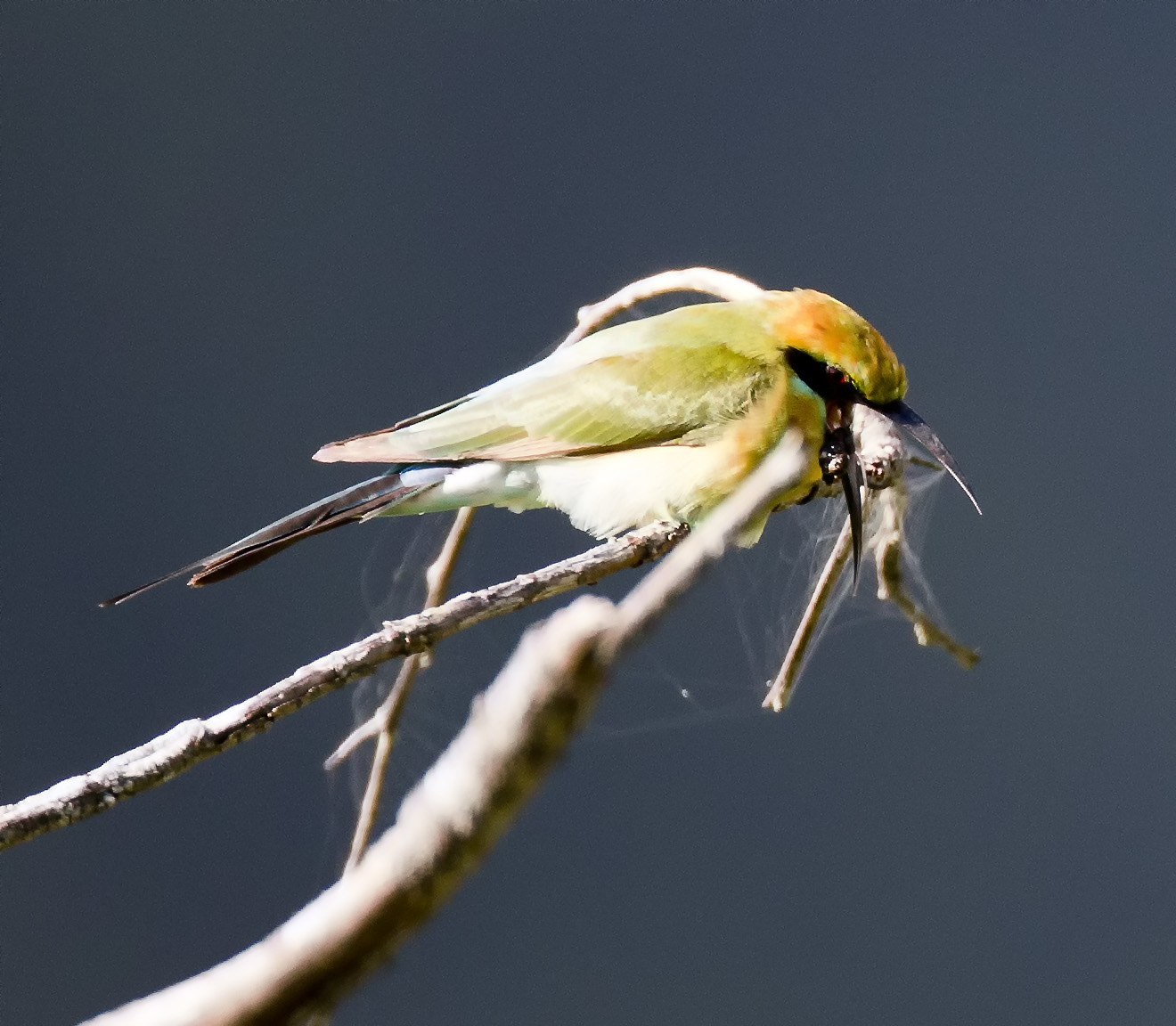
Key Field Marks
- Size & shape: Slender, streamlined bird (19–24 cm / 7.5–9.5 in including tail streamers), with long pointed wings, a short neck, and a long, thin, downcurved black bill adapted for catching flying insects.
- Plumage: Multicolored — turquoise-green body, a golden-orange crown and mantle, a black throat band bordered below by turquoise, black eye-stripe running through a red eye, and rich orange-chestnut on the underwing visible in flight.
- Tail: Central tail feathers are elongated into fine, wire-like streamers, longer and more pronounced in adults (especially males) than in juveniles, which lack or show only short streamers.
- Flight: Graceful, buoyant flight with frequent aerial sallies from an exposed perch (wires, dead branches) to catch flying insects, especially bees and wasps, on the wing.
- Behavior: Often perches in small groups on wires or bare branches between sallies, and may beat captured insects against the perch to remove stingers before swallowing.
Separating from Similar Species
- No other Australian bee-eater exists, so within Australia this species is essentially unmistakable once its rainbow coloring and downcurved bill are seen; silhouette (streamlined body, long tail streamers, pointed wings) alone is diagnostic even at a distance.
- Elsewhere in its wintering range (Indonesia, New Guinea, parts of Southeast Asia): Other Merops bee-eaters occur and require more careful comparison of throat color, tail streamer length, and underwing tone; Rainbow Bee-eater's combination of turquoise body with a distinct black throat band bordered by pale blue is a useful separator from similarly colored Old World bee-eaters.
Where & When to See It
- Habitat: Open woodland, farmland, riverbanks, and sandy or clay banks used for nesting burrows; frequently seen hawking insects over open areas, wetlands, and along roadsides.
- Range: Breeds throughout most of Australia (absent from the driest interior deserts and Tasmania as a breeder); northern Australian populations are largely resident, while southern populations migrate north to New Guinea, Indonesia, and parts of Southeast Asia for the austral winter.
- Season: In southern Australia, present as a breeding migrant roughly September–April; present year-round in northern Australia; wintering birds occur in Indonesia/New Guinea April–September.
Voice & Behavior Cues
- Gives a distinctive rolling, musical "prrp-prrp" or "trrrp" contact call, often given in flight, which frequently draws attention to the bird before it is seen.
- Nests colonially in burrows excavated into flat or sloping sandy/clay banks; look for clusters of small round burrow entrances as a sign of a breeding colony nearby.
Frequently asked questions
Is the Rainbow Bee-eater the only bee-eater in Australia?
Yes, it is the sole bee-eater species found in Australia, so its multicolored plumage, downcurved bill, and tail streamers make it unmistakable within the country.
How can I tell an adult from a juvenile Rainbow Bee-eater?
Adults, especially males, show long, fine wire-like central tail streamers, while juveniles have short or no streamers and slightly duller overall coloring.
Do Rainbow Bee-eaters migrate?
Southern Australian breeding populations migrate north to New Guinea, Indonesia, and parts of Southeast Asia for the austral winter (roughly April–September), while northern Australian populations tend to be more sedentary.
Where do Rainbow Bee-eaters nest?
They excavate nesting burrows colonially into flat or sloping sandy or clay banks, riverbanks, or even level ground, with clusters of round burrow entrances marking a colony.