
Quaker Parrot Identification Guide
Also known as the Monk Parakeet, a small bright-green parrot native to South America and now established as feral colonies in cities worldwide, recognizable by its gray forehead/breast and huge stick nests.
Read the full Quaker Parrot encyclopedia entry →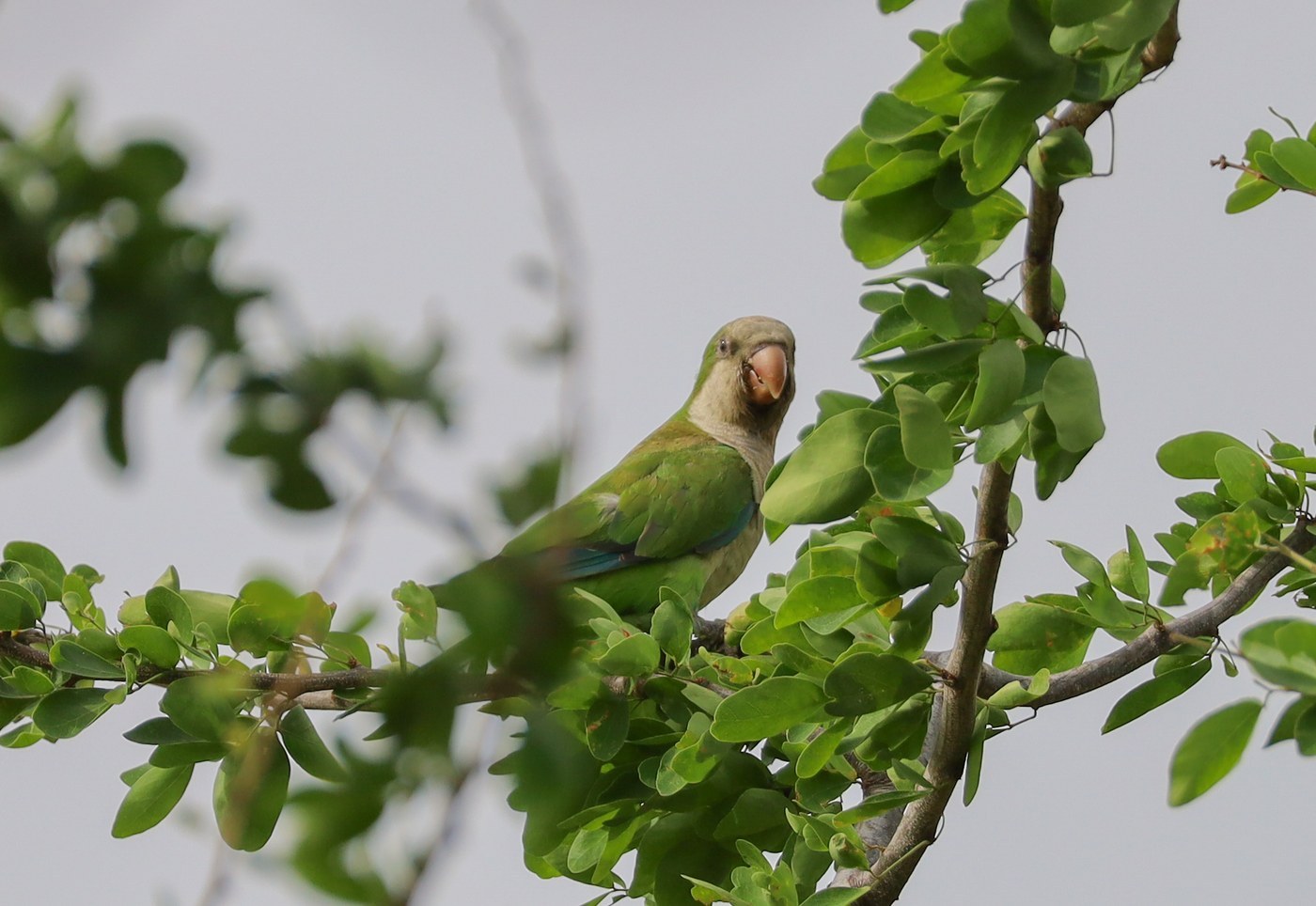
Key Field Marks
- Size & shape: Small parrot (about 29 cm / 11.5 in including a fairly long, pointed tail), with a stocky body and a proportionately large head for its size.
- Plumage: Bright green overall on the back, wings, and crown, with a pale gray forehead, face, throat, and breast scalloped with fine darker barring — the gray "monk-like" hood gives the species its alternate common name.
- Bill & underparts: Pale horn-colored bill; belly and undertail are yellowish-green; blue flight feathers are visible in the wing, especially in flight.
- Behavior: Highly social and noisy, living in large colonies; unlike almost all other parrots, it builds massive communal stick nests in trees or on utility structures rather than nesting in cavities.
Separating from Similar Species
- Other feral green parakeets (e.g., Rose-ringed Parakeet): Rose-ringed Parakeet has a very long, thin tail, an all-green head (males show a thin pink/black neck ring), and no gray breast — quite different from the Monk Parakeet's gray-fronted look.
- Escaped Amazon parrots: Amazons are bulkier, shorter-tailed, and lack the gray face/breast, usually appearing more uniformly green-bodied with colored head patches depending on species.
- Overall: The gray face/throat/breast combined with a stocky shape and huge communal stick nests is essentially unmistakable once learned.
Where & When to See It
- Habitat: Native to subtropical woodland, savanna, and palm groves of South America; introduced/feral populations thrive in urban and suburban parks, utility poles, and street trees in many temperate cities.
- Range: Native to central South America (Bolivia, Paraguay, Argentina, Uruguay, southern Brazil); naturalized feral populations established in parts of the United States (e.g., Florida, New York, Illinois, Texas), Europe, and elsewhere, often centered on utility poles and urban parks.
- Season: Non-migratory and present year-round wherever established, native or feral.
Voice & Behavior Cues
- Very loud, harsh, screeching calls and chattering, especially around the nest colony — among the noisiest small parrots encountered in urban settings.
- Look for enormous multi-chambered stick nests built in tree canopies or on top of utility poles/transformers, often used and expanded by multiple pairs over many years — a hallmark of the species found nowhere else among parrots.
Frequently asked questions
Is Quaker Parrot the same bird as the Monk Parakeet?
Yes — Quaker Parrot is simply the common pet-trade name for the Monk Parakeet (Myiopsitta monachus); both names refer to the same species.
How can I identify a Monk/Quaker Parakeet in the wild?
Look for a small, stocky green parrot with a pale gray forehead, face, and scalloped breast, blue in the flight feathers, and — most distinctively — huge communal stick nests in trees or on utility poles.
Why does this species build stick nests instead of using tree cavities?
Unlike nearly all other parrots, Monk Parakeets are not cavity nesters; they construct large, multi-chambered communal stick nests that multiple pairs share and reuse/expand over years, an unusual trait among parrots.
Where can feral Monk Parakeets be found outside South America?
Established feral colonies exist in numerous cities in the United States (including Florida, New York, Illinois, and Texas), Spain, and other parts of Europe, typically centered on urban parks and utility infrastructure.