
Purple-throated Fruitcrow Identification Guide
A glossy black cotinga of Amazonian and Central American rainforest canopy, named for the male's iridescent magenta-purple throat feathers that are usually held closed and hard to see.
Read the full Purple-throated Fruitcrow encyclopedia entry →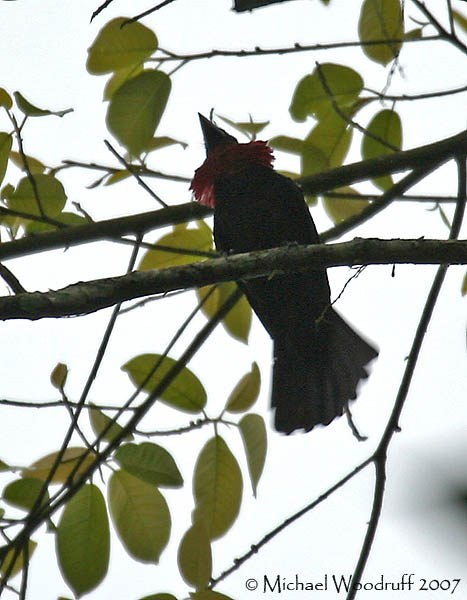
Key Field Marks
- Size & shape: Medium-large cotinga (about 27–30 cm / 11 in), crow-like in silhouette with a fairly long tail, broad wings, and a stout, slightly hooked black bill.
- Male plumage: Overall glossy black with a purplish-magenta sheen visible on the throat feathers only when fluffed or in direct light — often looks simply all-black at a distance or in poor light.
- Female plumage: Similar glossy black overall but typically lacks the extended, fluffable throat feathers, appearing more uniformly black-bodied.
- Behavior: Highly social, moving in noisy groups through the canopy and subcanopy; often perches conspicuously on bare branches, and forages for fruit and large insects.
Separating from Similar Species
- Other black cotingas/oropendolas: Purple-throated Fruitcrow is bulkier and blacker than most icterids in range, with a distinctly crow-like flight and shape; oropendolas are larger with long pointed bills and pale-tipped tails.
- American crows/jays (outside true range overlap): Not typically confused since ranges don't overlap with New World crows in the deep tropics, but body shape is superficially similar — fruitcrow has a shorter, broader tail and heavier build typical of cotingas.
- Black-headed/other fruitcrows: Range and the male's magenta throat (when visible) are the best distinguishing features from congeners with different throat colors or extents.
Where & When to See It
- Habitat: Canopy and mid-story of humid lowland rainforest, forest edge, and várzea (seasonally flooded) forest.
- Range: From southern Central America (Panama, Costa Rica) south through the Amazon Basin of South America, including Colombia, Ecuador, Peru, Brazil, and the Guianas.
- Season: Resident year-round; most conspicuous when groups are actively calling or feeding at fruiting trees.
Voice & Behavior Cues
- Gives loud, far-carrying, guttural growling or grunting calls, often described as a deep "graawrr," used in group communication and territory advertisement.
- Look and listen for noisy family groups of several birds moving together through the canopy, frequently visiting the same fruiting trees repeatedly.
Frequently asked questions
Why is it called the Purple-throated Fruitcrow if it looks all black?
The male's namesake iridescent purple-magenta throat feathers are elongated and can be fluffed out, but they are usually held flat and only catch color in good light or during display, so the bird often appears simply glossy black in the field.
Is the Purple-throated Fruitcrow a true crow?
No, despite the name and crow-like size and shape, it is a cotinga (family Cotingidae), not a member of the crow family Corvidae.
Where should I look for Purple-throated Fruitcrows?
Scan the canopy and subcanopy of humid lowland rainforest in Central and South America, particularly around fruiting trees, and listen for their deep growling group calls.
Do male and female Purple-throated Fruitcrows look different?
They are similar and both mostly glossy black, but only males have the elongated throat feathers capable of showing the purple sheen; females lack this extended throat plumage.