
Purple Swamphen Identification Guide
A large, chicken-sized rail of wetlands across the Old World and Australasia, unmistakable for its deep blue-purple plumage, oversized red bill and frontal shield, and long red legs.
Read the full Purple Swamphen encyclopedia entry →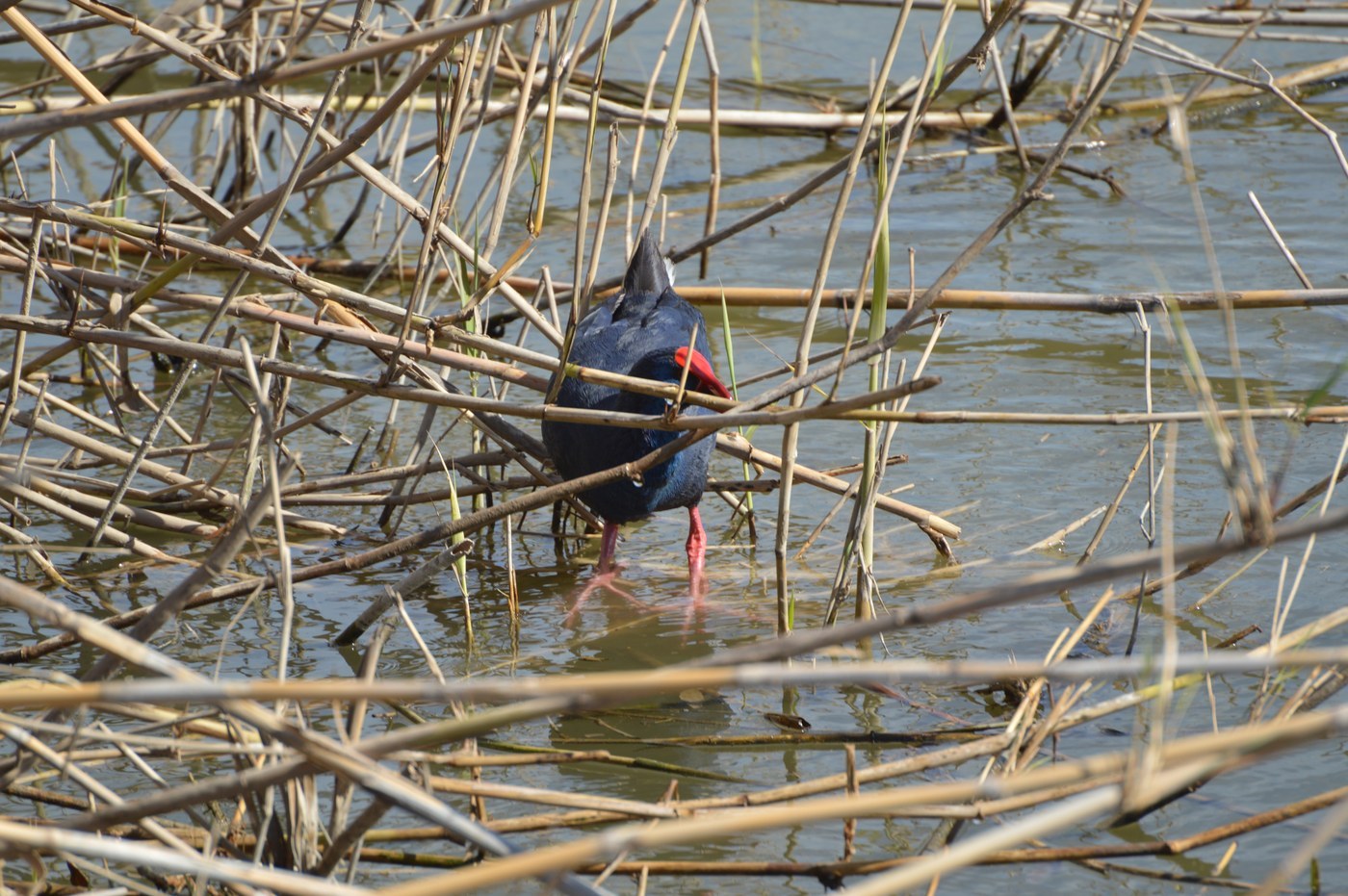
Key Field Marks
- Size & shape: Large for a rail (45–50 cm / 18–20 in body length), heavy-bodied with a short tail often flicked upward to reveal white undertail coverts.
- Plumage: Deep purple-blue overall, glossed with turquoise on the neck and breast in many populations, with blackish upperparts and wings; the white undertail flashes conspicuously when the tail is cocked.
- Bill & shield: Massive, thick, bright red bill continuing into a broad red frontal shield on the forehead — much larger and heavier than any other rail's bill.
- Legs: Long, thick, bright red-orange legs with very long toes for walking across floating vegetation.
- Behavior: Often seen clambering through reeds and using a foot to hold food while feeding, unlike most other rails; walks with a slow, deliberate gait and swims occasionally.
Separating from Similar Species
- Common Gallinule/Moorhen: Much smaller, with a slim red bill with a yellow tip (not a massive uniform red bill/shield) and less vivid blue-purple plumage.
- American Purple Gallinule (Central/South America and southeastern US, a separate but related species): Smaller and brighter, with a red-and-yellow-tipped bill and pale blue frontal shield rather than the swamphen's all-red, oversized bill and shield.
- Coots: Coots are uniformly slate-gray/black with a white (not red) bill and shield, and lack any purple-blue tones.
Where & When to See It
- Habitat: Dense freshwater marshes, reedbeds, swamps, and vegetated lake edges with tall emergent plants such as reeds, cattails, and rushes.
- Range: Extremely broad, spanning southern Europe, Africa, the Middle East, South and Southeast Asia, and Australasia (often now split by taxonomists into several regional species, e.g. African, Australasian, and Gray-headed Swamphens, but all share the same core field marks).
- Season: Largely resident year-round throughout its range, though local movements occur in response to water levels and drought.
Voice & Behavior Cues
- Gives loud, harsh, nasal honking, trumpeting, and cackling calls, often the first indication of its presence in dense reeds.
- Frequently seen perched conspicuously atop reed stems or feeding at the marsh edge in early morning and late afternoon, using its foot to grasp and manipulate vegetation while eating.
Frequently asked questions
What is the most distinctive feature of a Purple Swamphen?
Its massive, uniformly bright red bill fused into a broad red frontal shield, combined with deep purple-blue plumage and long red legs, is unmistakable and unlike any other rail.
How is Purple Swamphen different from a Common Moorhen/Gallinule?
Purple Swamphen is much larger and bulkier with an oversized all-red bill and shield, while Moorhen is smaller with a slender red bill tipped yellow and duller, mostly gray-brown-and-black plumage.
What habitat should I search for Purple Swamphens?
Dense freshwater marshes and reedbeds with tall emergent vegetation such as cattails and rushes; they rarely venture onto open water like ducks or coots.
Is the Purple Swamphen the same as the American Purple Gallinule?
No — they are related but distinct species. The American Purple Gallinule is smaller and brighter with a red-and-yellow bill and pale blue shield, while Purple Swamphen is larger with an entirely red, heavier bill and shield.