
Purple-rumped Sunbird Identification Guide
A tiny, common garden sunbird of South Asia, with males showing a glittering purple rump and throat patches and females a plain grayish-olive body with a whitish throat.
Read the full Purple-rumped Sunbird encyclopedia entry →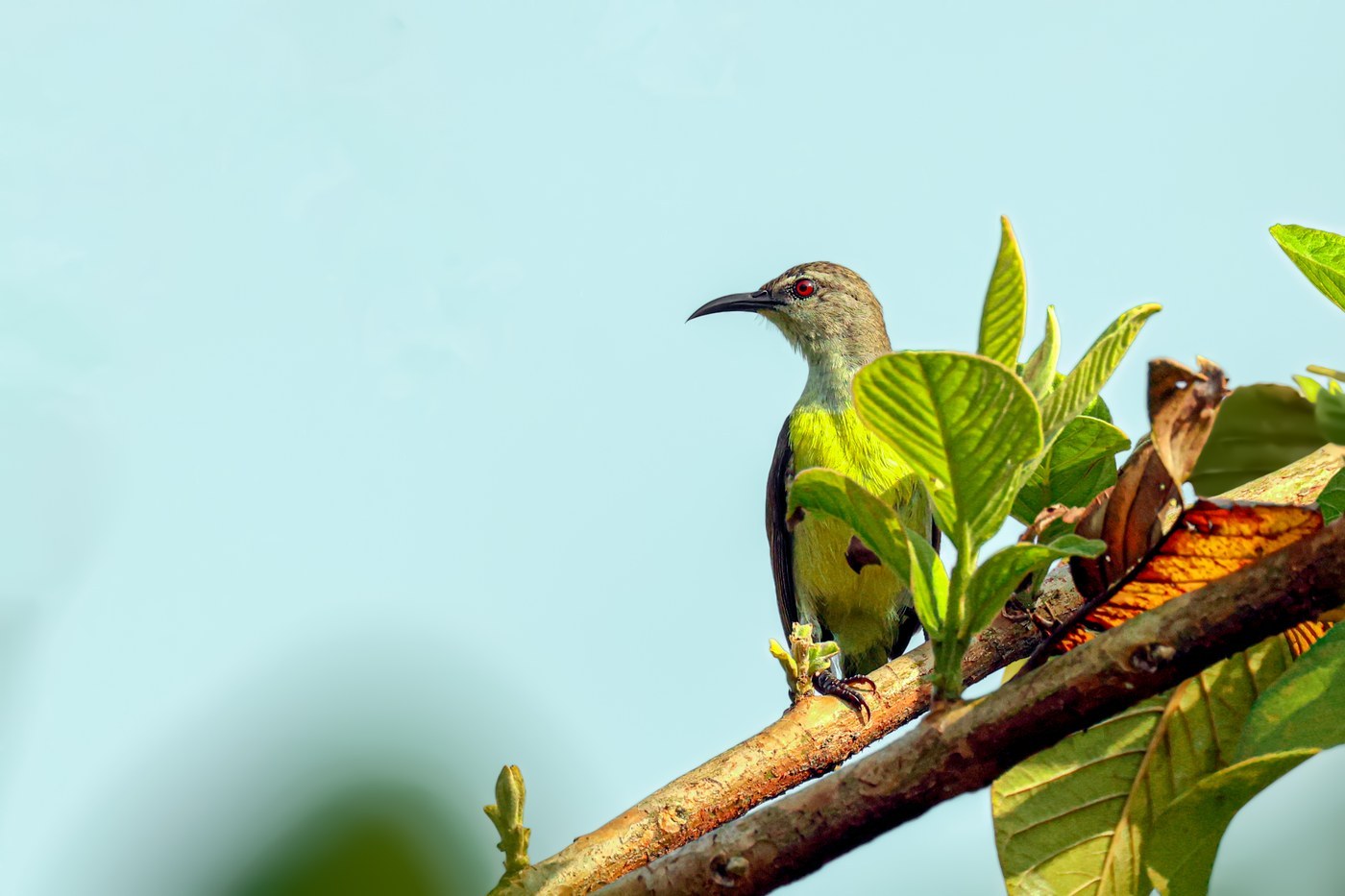
Key Field Marks
- Size & shape: Very small (8–9 cm / 3.5 in) with a thin, sharply decurved bill typical of sunbirds, used for probing tubular flowers.
- Male plumage: Maroon-and-metallic-green upper back, glittering purple rump (visible mainly in good light), dark maroon throat patch bordered below by a narrow yellow band, and grayish-white underparts with yellow wash on the flanks.
- Female plumage: Much plainer — olive-brown above, pale grayish-white below with a whitish throat, lacking the male's iridescent patches; best identified by small size, thin curved bill, and range.
- Behavior: Constantly active, flitting between flowers and hovering briefly at blossoms; often in pairs.
Separating from Similar Species
- Purple Sunbird: Breeding male Purple Sunbird is far more extensively glossy purple-black over the whole body (not just rump/throat); Purple-rumped Sunbird male retains a duller, maroon-toned back and grayish belly.
- Loten's Sunbird: Larger with a proportionately longer bill and a maroon breast band, lacking the yellow-bordered throat patch of Purple-rumped.
- Female sunbirds in general: Female Purple-rumped is best told by its small size, whitish (not yellow) throat contrasting with pale underparts, and characteristic decurved bill; range and habitat (gardens, scrub) help narrow choices further.
Where & When to See It
- Habitat: Extremely adaptable — gardens, parks, scrub, forest edge, and cultivated land, including dense urban areas with flowering plants.
- Range: Resident across peninsular India, Sri Lanka, and parts of Bangladesh; a familiar garden bird throughout its range.
- Season: Present year-round; breeding activity often peaks with local flowering seasons.
Voice & Behavior Cues
- Song is a fast, high-pitched twittering series of sharp notes, often delivered from an exposed perch.
- Builds a distinctive hanging, pear-shaped nest with a side entrance and a small overhanging "porch," often suspended from wires, eaves, or low branches — a useful clue even when the bird itself is not visible.
Frequently asked questions
How do I tell male and female Purple-rumped Sunbirds apart?
Males show iridescent purple/maroon patches on the rump, back, and throat with a yellow-bordered throat patch, while females are plain olive-brown above and pale below with a whitish throat and no iridescence.
What is the difference between Purple-rumped and Purple Sunbird?
Male Purple Sunbird in breeding plumage is glossy purple-black over nearly the entire body, whereas male Purple-rumped Sunbird has a duller maroon back, a more localized purple rump, and pale grayish underparts.
Where is the best place to see a Purple-rumped Sunbird?
It is one of the most common garden and park birds across peninsular India and Sri Lanka, readily found wherever flowering shrubs or trees are present, including in cities.
What does the nest of a Purple-rumped Sunbird look like?
A hanging, pear-shaped nest woven from plant fibers and spider webs with a side entrance hole and a small overhanging porch, often suspended from wires, eaves, or thin branches.