Purple Martin Identification Guide
North America's largest swallow, with glossy blue-black males and gray-bellied females/immatures, famous for nesting colonially in human-provided martin houses.
Read the full Purple Martin encyclopedia entry →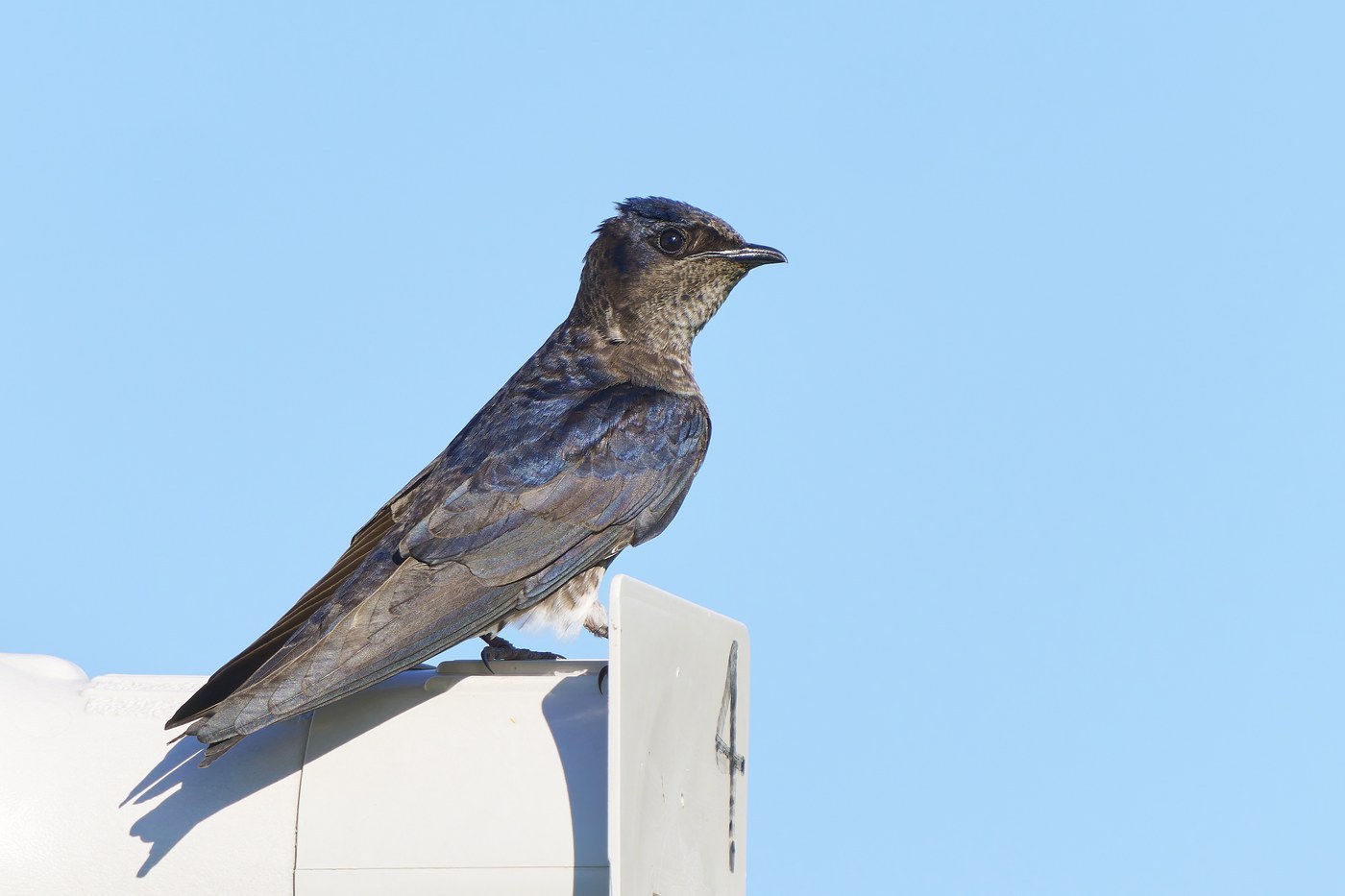
Key Field Marks
- Size & shape: Largest swallow in North America (19–20 cm / 7.5–8 in), with a robust body, broad-based triangular wings, and a slightly forked tail.
- Adult male: Entirely glossy blue-black/purple-black from head to belly, appearing all-dark at a distance — the only swallow in North America with a uniformly dark underside.
- Adult female & immatures: Duller, with a grayish-brown crown and back, dusky mottled breast, and pale, whitish-gray belly — much more like a typical swallow in contrast pattern than the male.
- Flight: Soars and glides more than most swallows, alternating flaps with long glides on slightly bowed wings; flight is powerful and often quite high.
- Behavior: Highly colonial, nesting almost exclusively in birdhouses ("martin houses") or hollow gourds in the eastern population, and in natural cavities/saguaros in the West.
Separating from Similar Species
- Tree Swallow: Much smaller with clean white underparts contrasting sharply against a glossy blue-green back; male Purple Martin lacks any white below.
- European Starling (in silhouette): Starlings can look superficially dark and glossy but have a shorter tail, different flight (direct, whirring wingbeats vs. martin's soaring glides), and a longer pointed bill.
- Female/immature vs. other swallows: The combination of large size, grayish (not white) belly, and dusky breast band-like mottling distinguishes female/immature Purple Martins from Tree or Barn Swallows.
Where & When to See It
- Habitat: Open country near water, agricultural fields, and increasingly suburban/urban areas with martin houses; in the western U.S., also nests in old woodpecker holes in dead trees and saguaro cacti.
- Range: Breeds across most of the eastern and central U.S. and scattered sites in the West and southern Canada; winters in the Amazon Basin of South America, especially Brazil.
- Season: Arrives on breeding grounds as early as late January–March in the South and April–May farther north; departs by late summer, with large pre-migratory roosts forming in July–September.
Voice & Behavior Cues
- Song is a rich, gurgling, liquid warble mixed with croaks, often described as "chortling," delivered from perches or in flight, especially at dawn.
- Eastern populations are almost entirely dependent on human-supplied housing, so scanning martin houses and gourd racks near open water or fields is the most reliable way to find them.
Frequently asked questions
How can I tell a male from a female Purple Martin?
Adult males are entirely glossy blue-black, including the belly, while females and immatures are duller above with a grayish, unmarked belly and mottled breast — the only truly all-dark-bellied swallow in North America is the adult male.
Where do Purple Martins nest?
In the eastern U.S., nearly the entire population nests in human-provided martin houses or hanging gourds; in the West, they still use natural cavities such as old woodpecker holes and saguaro cactus holes.
What is the easiest way to distinguish a Purple Martin from a Tree Swallow?
Purple Martin is noticeably larger and, in males, lacks any white on the underparts; Tree Swallow is smaller with crisp white underparts contrasting against a glossy blue-green back.
When do Purple Martins arrive in spring?
'Scouts' (typically older males) arrive first, as early as late January in the Deep South and progressively later moving north, with most of the population back on territory by April–May.
Purple Martin identified by the community
Recent Purple Martin sightings identified with Bird Identifier.