
Purple Gallinule Identification Guide
A jewel-toned marsh bird of the American tropics and Southeast, unmistakable with its deep purple-blue body, green back, and multicolored red-yellow bill topped by a pale blue frontal shield.
Read the full Purple Gallinule encyclopedia entry →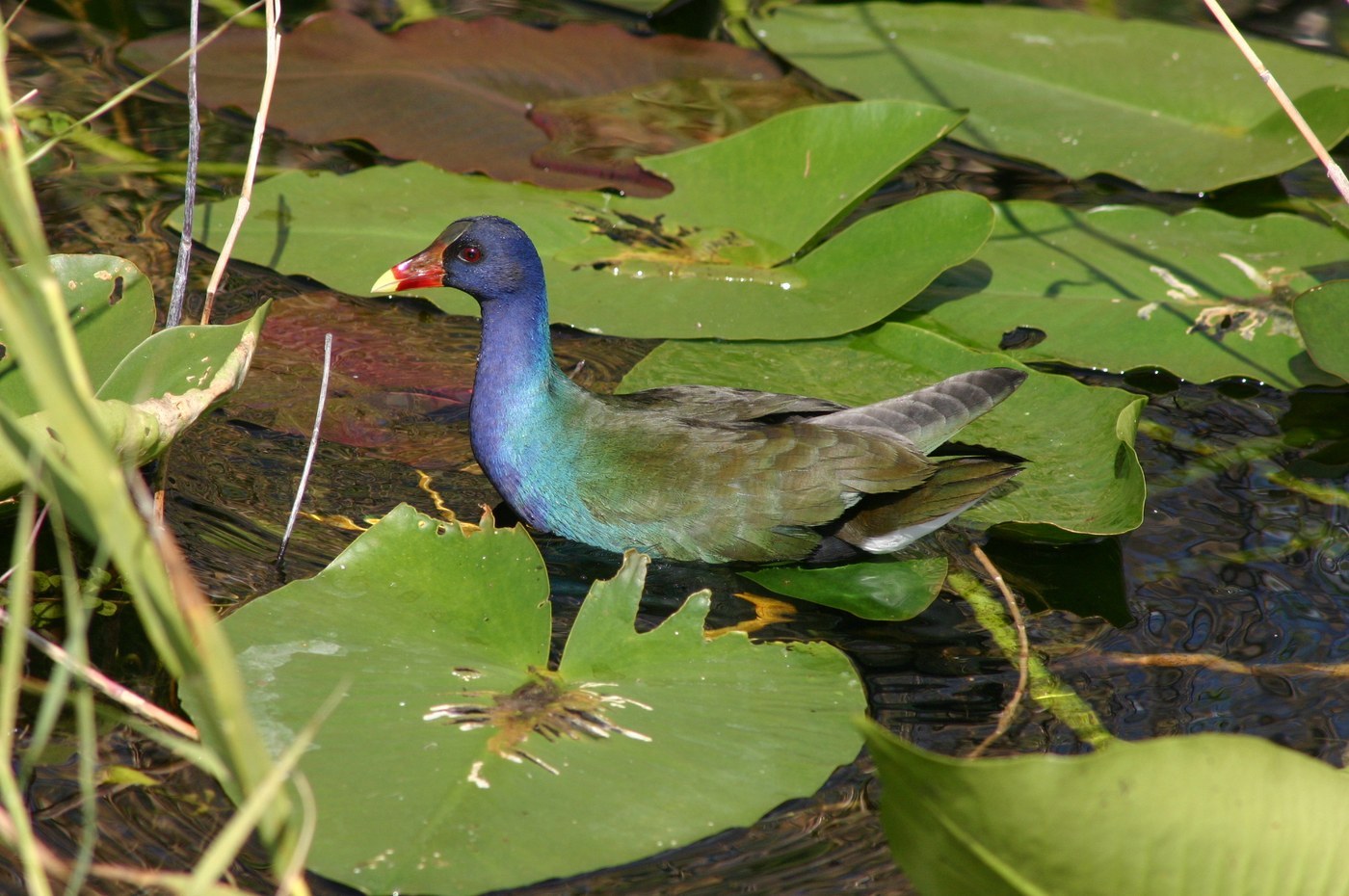
Key Field Marks
- Size & shape: A medium-sized rail relative, about 13 inches long, with very long toes adapted for walking across floating vegetation like lily pads, and a short, upturned tail.
- Plumage: Vivid purple-blue head, neck, and underparts contrasting with an iridescent green back and wings; undertail coverts bright white, flicked while walking.
- Bare parts — key mark: A striking bill that is red at the base shading to yellow at the tip, topped by a pale powder-blue frontal shield on the forehead; legs and long toes are bright yellow.
- Immatures: Duller buffy-brown overall with hints of green on the wings, lacking the adult's bright colors, and a duller bill — can be confused with young gallinules/moorhens until the blue and green adult colors emerge.
Separating It From Similar Species
- Common Gallinule (Moorhen): Overall dark gray-black with a red (not multicolored) bill and shield and a white flank stripe — lacks any purple or green iridescent coloring.
- American Coot: All slate-gray with a white bill, no purple/green plumage, and lobed (not long-toed) feet.
- Pukeko / Purple Swamphen (Old World): Much larger and darker purple-black with an all-red bill and shield and red legs (not yellow) — not found in the Americas, so range alone separates them.
Habitat, Range & Season
Found in freshwater marshes, swamps, and ponds with dense floating and emergent vegetation (water lilies, pickerelweed) across the southeastern United States, Central America, the Caribbean, and much of South America. Breeding range in the U.S. is centered on the Gulf Coast and Florida; northern populations are migratory, wintering farther south, while tropical populations are largely resident year-round.
Behavior
Walks confidently across lily pads and floating vegetation using its long toes to distribute weight, sometimes appearing to walk on water. Also swims and clambers through marsh vegetation, and will fly with legs dangling on short flights. Omnivorous, eating seeds, aquatic invertebrates, and occasionally eggs or small vertebrates.
Voice
A varied range of loud cackling, grunting, and clucking calls, including a sharp, hen-like "kek-kek-kek" series, typically given from dense marsh cover.
Frequently asked questions
What is the most distinctive feature of the Purple Gallinule's bill?
It is red at the base and yellow at the tip, topped by a pale powder-blue frontal shield — a unique combination that separates it from the all-red-billed Common Gallinule/Pukeko and the white-billed American Coot.
How can you tell a Purple Gallinule from a Common Gallinule (Moorhen)?
Purple Gallinule shows deep purple-blue underparts and an iridescent green back with a bicolored red-and-yellow bill, while Common Gallinule is uniformly dark gray-black with a solid red bill and shield.
Where does the Purple Gallinule live?
Freshwater marshes and ponds with floating vegetation across the southeastern United States (especially Florida and the Gulf Coast), Central America, the Caribbean, and much of South America.
Can Purple Gallinules really walk on water?
They appear to, thanks to extremely long toes that distribute their weight across lily pads and other floating vegetation, allowing them to walk over the surface without sinking.
Are Purple Gallinules migratory?
Populations in the northern part of the range, such as the southeastern U.S., are migratory and winter farther south, while tropical populations in Central and South America are generally year-round residents.