
Prairie Warbler Identification Guide
A small, tail-bobbing yellow warbler of scrubby second-growth habitat, marked by bold black side-streaking and a distinctive dark crescent below the eye.
Read the full Prairie Warbler encyclopedia entry →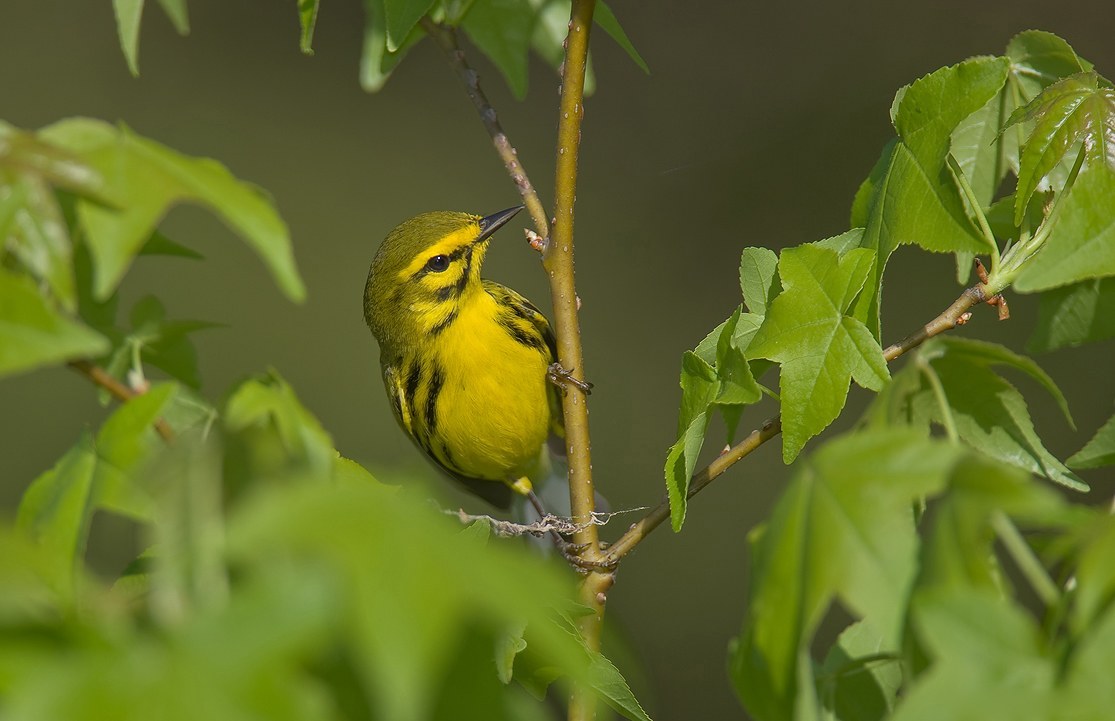
Key Field Marks
- Size & shape: A small warbler, about 4.5 inches, with a fairly long tail that it habitually bobs and pumps while foraging — one of the best behavioral clues.
- Plumage: Bright yellow underparts with bold black streaking concentrated along the flanks, forming a rough necklace-like pattern; back is olive-yellow with faint chestnut/rufous streaking, most visible on breeding males.
- Face: Yellow face set off by a dark eyeline and a distinctive dark crescent mark below the eye, plus yellow "spectacles" broken at the eyeline.
- Wings: Two faint yellowish-white wingbars on olive wings — subtler than in many other warblers.
Separating It From Similar Species
- Palm Warbler: Also bobs its tail, but is duller overall, browner above, has a rusty cap in breeding plumage, and lacks the bold black flank streaking; more of a ground/low-shrub forager.
- Magnolia Warbler: Shows a bold white tail band and gray head, quite different overall pattern despite yellow underparts.
- Pine Warbler: Lacks bold black streaking, has a plainer face without the under-eye crescent, and prefers pine canopy rather than scrub.
Habitat, Range & Season
Breeds in shrubby, early-successional habitat — regenerating clear-cuts, power-line cuts, sandy pine barrens, and coastal scrub — across the eastern United States, from the Great Lakes and New England south through the Southeast. In winter, it shifts almost entirely to mangrove forests in Florida and the Caribbean, making it one of the most mangrove-dependent North American warblers. Look for it on breeding grounds from late April through August, and in Florida/Caribbean mangroves in winter.
Behavior
Forages actively and low in dense shrubs and small trees, gleaning insects while constantly bobbing its tail — a habit shared with few other warblers, making it a useful diagnostic behavior even at a distance.
Voice
An ascending, buzzy series of notes that speeds up and rises in pitch, often rendered as "zee-zee-zee-zee-zee-zeeee," one of the more distinctive and easily learned warbler songs of scrubby habitat.
Frequently asked questions
Why is it called the Prairie Warbler if it doesn't live on prairies?
The name is a historical misnomer from early descriptions of birds in open scrubby habitat; the species actually favors shrubby second growth, pine barrens, and mangroves, not open grassland prairie.
How do you tell a Prairie Warbler from a Palm Warbler?
Both bob their tails, but Prairie Warbler has bold black flank streaking and a brighter yellow face with a dark eye crescent, while Palm Warbler is duller, browner, and shows a rusty cap in breeding plumage.
Where do Prairie Warblers spend the winter?
The large majority winter in mangrove forests in Florida and across the Caribbean, making them unusually dependent on mangrove habitat for a North American warbler.
What does the Prairie Warbler's song sound like?
A buzzy series of notes that rises in pitch and speeds up, often described as 'zee-zee-zee-zee-zeeee.'