
Prairie Falcon Identification Guide
A pale, sandy-brown falcon of open western landscapes, best identified in flight by the dark patches under its wingpits (axillaries) that contrast with otherwise pale underwings.
Read the full Prairie Falcon encyclopedia entry →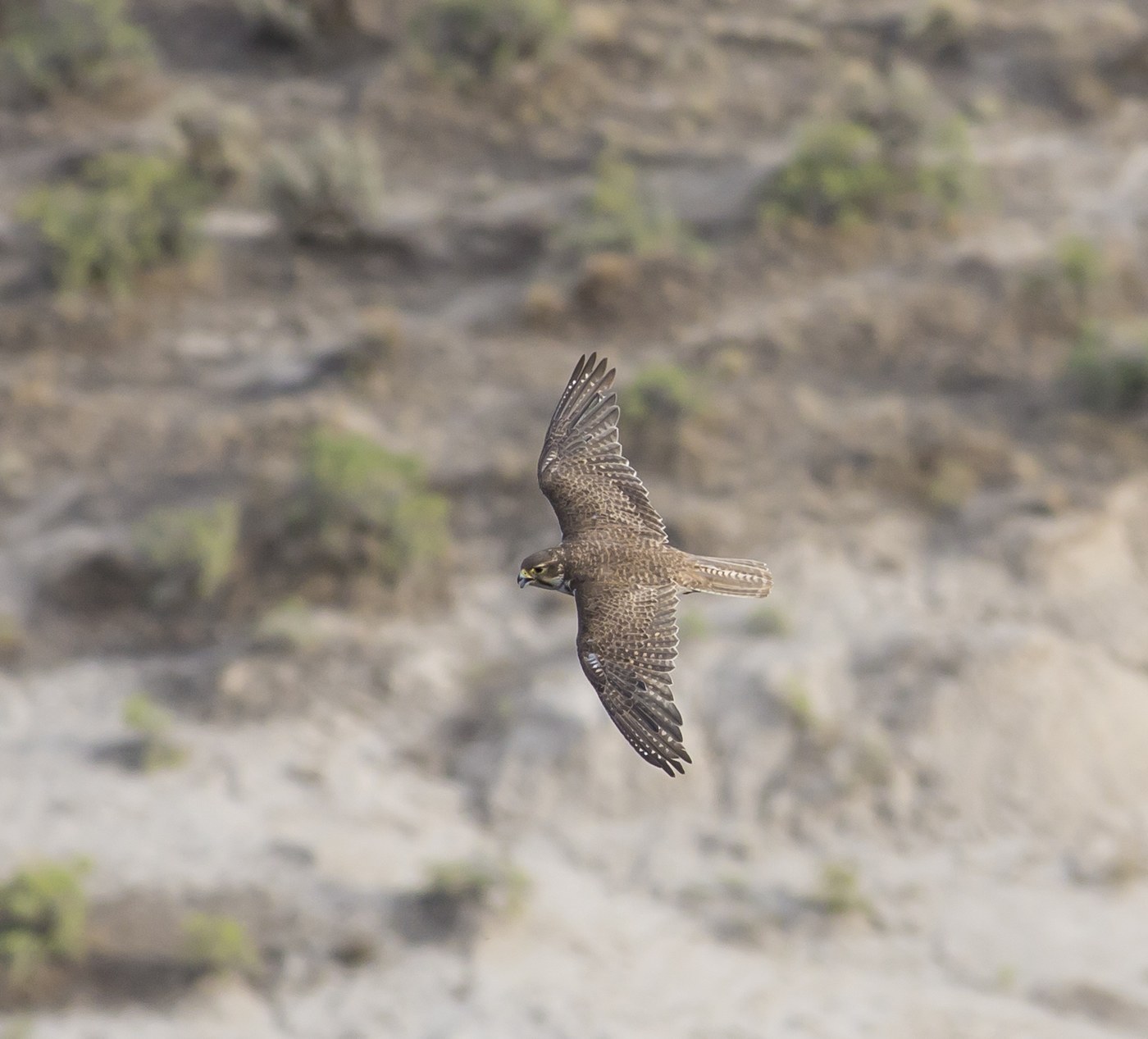
Key Field Marks
- Size & shape: A medium-large falcon, 15–19 inches long, with long pointed wings and a long tail, similar in structure to Peregrine Falcon but proportionally slimmer and longer-tailed.
- Plumage: Pale sandy or grayish-brown above, matching arid rangeland; underparts whitish to buff with brown streaking and spotting, heavier on the flanks.
- Face: A relatively thin, narrow dark mustache mark against a pale face, less bold than a Peregrine's.
- In flight — the key mark: Dark brown "wingpit" patches (axillaries and underwing coverts) contrast sharply with the pale flight feathers and body — visible at a distance and diagnostic among North American falcons.
- Eyes: Brown, not the blackish eyes/hood look of a Peregrine.
Separating It From Similar Species
- Peregrine Falcon: Darker slate-gray above, bold black hood and thick mustache, underwings evenly dark-barred rather than showing isolated dark wingpits.
- Merlin: Much smaller and stockier, with a less bold or absent mustache and a banded (not solidly dark) tail.
- American Kestrel: Smaller, more colorful (rufous back, blue-gray wings on males), with a more buoyant, hovering flight style.
Habitat, Range & Season
A bird of the arid and semi-arid West — shortgrass prairie, sagebrush steppe, desert grassland, and canyon country — from southern Canada through the western United States into northern Mexico. It nests on cliff ledges overlooking open hunting ground and is largely a year-round resident across much of its range, though northern and high-elevation breeders move to lower elevations or south in winter.
Behavior
Hunts low and fast over open ground, often flushing prey (ground squirrels, small birds) with a low contour-hugging flight before stooping. Frequently perches on cliffs, utility poles, or fence posts scanning open terrain.
Voice
A harsh, repeated kree-kree-kree or kik-kik-kik alarm call near the nest cliff, similar in tone to other large falcons but generally higher-pitched and less deep than a Peregrine's.
Frequently asked questions
What is the best field mark for identifying a Prairie Falcon in flight?
Look for dark brown patches in the 'wingpits' (axillaries and underwing coverts) that contrast with the paler underwing and body — this is the single most reliable mark.
How do you tell a Prairie Falcon from a Peregrine Falcon?
Prairie Falcon is paler sandy-brown overall with a thinner mustache mark and dark wingpit patches, while Peregrine is darker slate-gray with a bold black hood and evenly barred underwings.
Where do Prairie Falcons nest?
On cliff ledges overlooking open rangeland, grassland, or desert, typically across the arid western United States, southern Canada, and northern Mexico.
Are Prairie Falcons migratory?
Most are year-round residents, though birds breeding at high elevation or in the north may move to lower elevations or southward in winter.