
Powerful Owl Identification Guide
Australia's largest owl, a massive, long-tailed forest predator identified by its heavily barred underparts, staring yellow eyes, and lack of ear tufts.
Read the full Powerful Owl encyclopedia entry →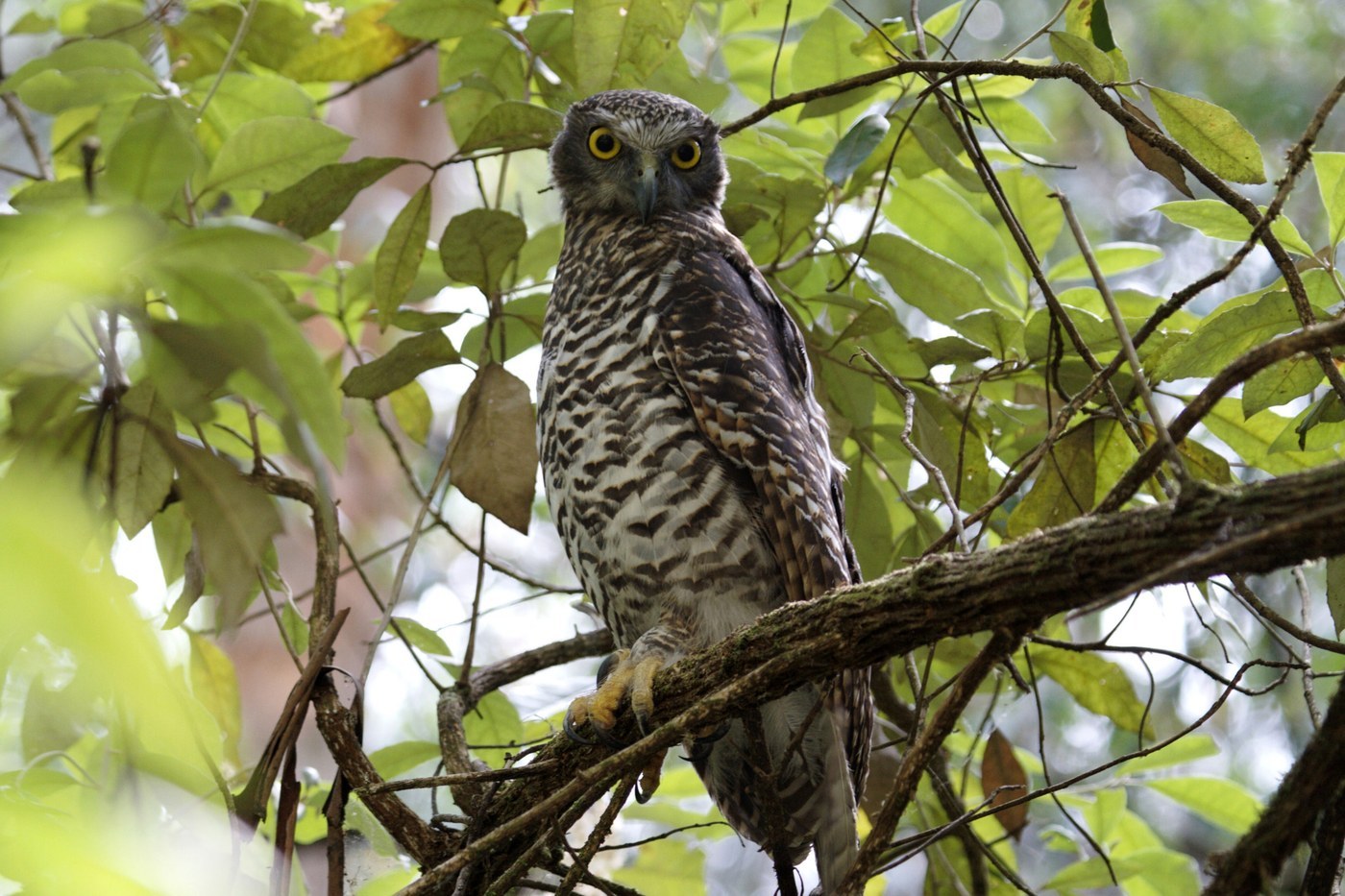
Key Field Marks
- Size & shape: A huge owl, 20–26 inches long, with a proportionally small, rounded head (no ear tufts), a long tail, and a bulky, powerful body — Australia's largest owl species.
- Plumage: Grayish-brown to dark brown above densely marked with white spots and bars; underparts white to pale buff with heavy, chevron-shaped dark brown barring running the length of the belly.
- Eyes: Deep-set, relatively small, dark yellow eyes that give a fierce, unblinking stare, set beneath a plain facial area rather than a defined facial disc.
- Feet: Massive, powerfully built feet and talons — an adaptation for taking arboreal mammal prey such as possums and gliders.
Separating It From Similar Species
- Barking Owl: Smaller and paler, with bold vertical streaking (not chevron barring) on the underparts and proportionally larger yellow eyes.
- Sooty Owl: Much paler, silvery-gray overall with a distinct heart-shaped facial disc and fine dark spotting rather than barring.
- Rufous Owl (northern Australia/New Guinea): Similar shape but warmer rufous-brown tones and finer barring; ranges barely overlap.
Habitat, Range & Season
A resident, non-migratory species of tall, wet eucalypt forest, woodland, and increasingly leafy suburban parkland along the eastern Australian seaboard, from far north Queensland to Victoria and into South Australia. Pairs hold large permanent territories and are present year-round; roost sites are often reused for years.
Behavior
Strictly nocturnal, roosting by day in dense canopy foliage — often given away by a pile of fresh possum or glider fur and bones on the ground below, or by mobbing calls from small birds. Hunts arboreal mammals almost exclusively, taking them from branches in flight.
Voice
A deep, far-carrying, resonant double hoot, "whoo-hoo," with the second note lower — one of the most recognizable owl calls in Australia, often heard well before the bird is seen, typically at dusk and through the night.
Frequently asked questions
How can you tell a Powerful Owl from a Barking Owl?
Powerful Owl is much larger with chevron-shaped barring on the underparts, while Barking Owl is smaller, paler, and shows bold vertical streaking instead of barring.
Does the Powerful Owl have ear tufts?
No, it has a rounded, tuftless head, unlike many owls that show prominent ear tufts.
What does a Powerful Owl's call sound like?
A deep, resonant double hoot, 'whoo-hoo,' with the second note pitched lower than the first, carrying long distances at night.
Where in Australia can you find a Powerful Owl?
In tall eucalypt forest and increasingly in leafy urban parks along the eastern coast, from Queensland through New South Wales and Victoria to South Australia, year-round.
What is a telltale sign a Powerful Owl is roosting nearby?
A pile of fresh fur, bones, or possum/glider remains on the ground beneath a dense canopy tree, along with mobbing calls from small birds during the day.