
Pompadour Cotinga Identification Guide
A striking Amazonian canopy bird whose male combines deep magenta-purple plumage with brilliant white wing patches, visible from a great distance in flight.
Read the full Pompadour Cotinga encyclopedia entry →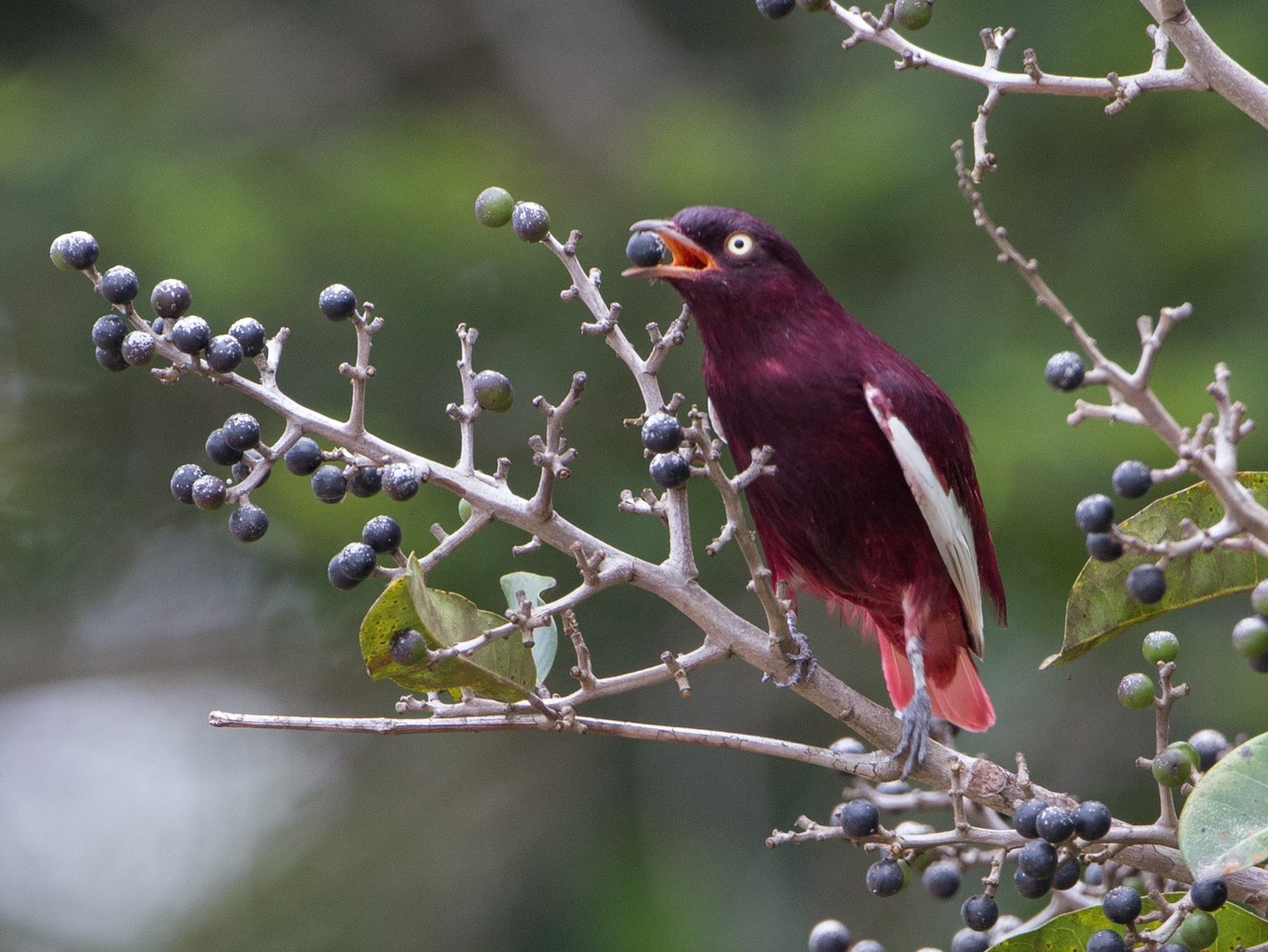
Key Field Marks
- Size & shape: A stocky, short-tailed, large-headed cotinga about 7.5–8 inches long, with a short, slightly hooked bill.
- Male plumage: Rich, deep magenta-purple ("pompadour purple") body plumage that can look almost black in poor light, contrasting sharply with bold white wing coverts and flight-feather patches.
- Bare parts: Pale bluish-white bill and a pale, whitish eye that stands out on the dark head.
- Female plumage: Overall gray, somewhat paler and scalloped on the underparts, with duller whitish-gray wing markings echoing the male's pattern — far less contrasting than the male.
- In flight: The white wing patches flash conspicuously against the dark body, often the first clue observers get as a bird crosses a canopy gap.
Separating It From Similar Species
- Male Pompadour Cotinga is essentially unmistakable within its range — no other cotinga combines a solid purple body with white wings.
- Female/immature birds can be confused with female fruiteaters or other gray cotingas; look for the pale wing markings and stocky, big-headed cotinga silhouette, and try to locate an accompanying male.
- Spangled Cotinga and other blue cotingas show turquoise-and-black scaled or mottled patterns, not the solid purple-and-white block pattern of Pompadour.
Habitat, Range & Season
Found in the canopy and emergent trees of humid lowland and terra firme forest in northern South America — the Amazon Basin, the Guianas, southern Venezuela, and adjacent Brazil and Colombia. It is a resident, non-migratory species, present year-round, though individuals wander locally in search of fruiting trees.
Behavior
A quiet, fruit-eating canopy specialist that perches upright and motionless for long periods on exposed dead branches or emergent treetops — a classic cotinga "sit-and-wait" posture — before sallying out to pluck fruit. Often located by scanning bare canopy perches rather than by call.
Voice
Largely silent; it lacks a loud song and is rarely detected by ear. Occasional soft, low grunting or nasal notes have been reported near display perches, but visual detection from canopy towers or clearings is the reliable method.
Frequently asked questions
What color is a male Pompadour Cotinga?
A deep magenta-purple body with bold, contrasting white patches on the wings — a combination no other cotinga in its range shows.
How do you identify a female Pompadour Cotinga?
Females are plain gray with paler, less contrasting whitish-gray wing markings; they're best confirmed by looking for an accompanying purple male or by the stocky cotinga shape.
Where do Pompadour Cotingas live?
They inhabit the canopy of humid lowland forest across the northern Amazon Basin, the Guianas, and parts of Venezuela, Colombia, and Brazil, year-round.
How do birders usually find a Pompadour Cotinga?
By scanning exposed, bare branches in the emergent canopy or from canopy towers, since the species is largely silent and easiest to detect by its striking plumage.