
Plumbeous Vireo Identification Guide
A gray-and-white vireo of Rocky Mountain and southwestern pine forests, told from its close relatives by its plain slate-gray back and bold white spectacles.
Read the full Plumbeous Vireo encyclopedia entry →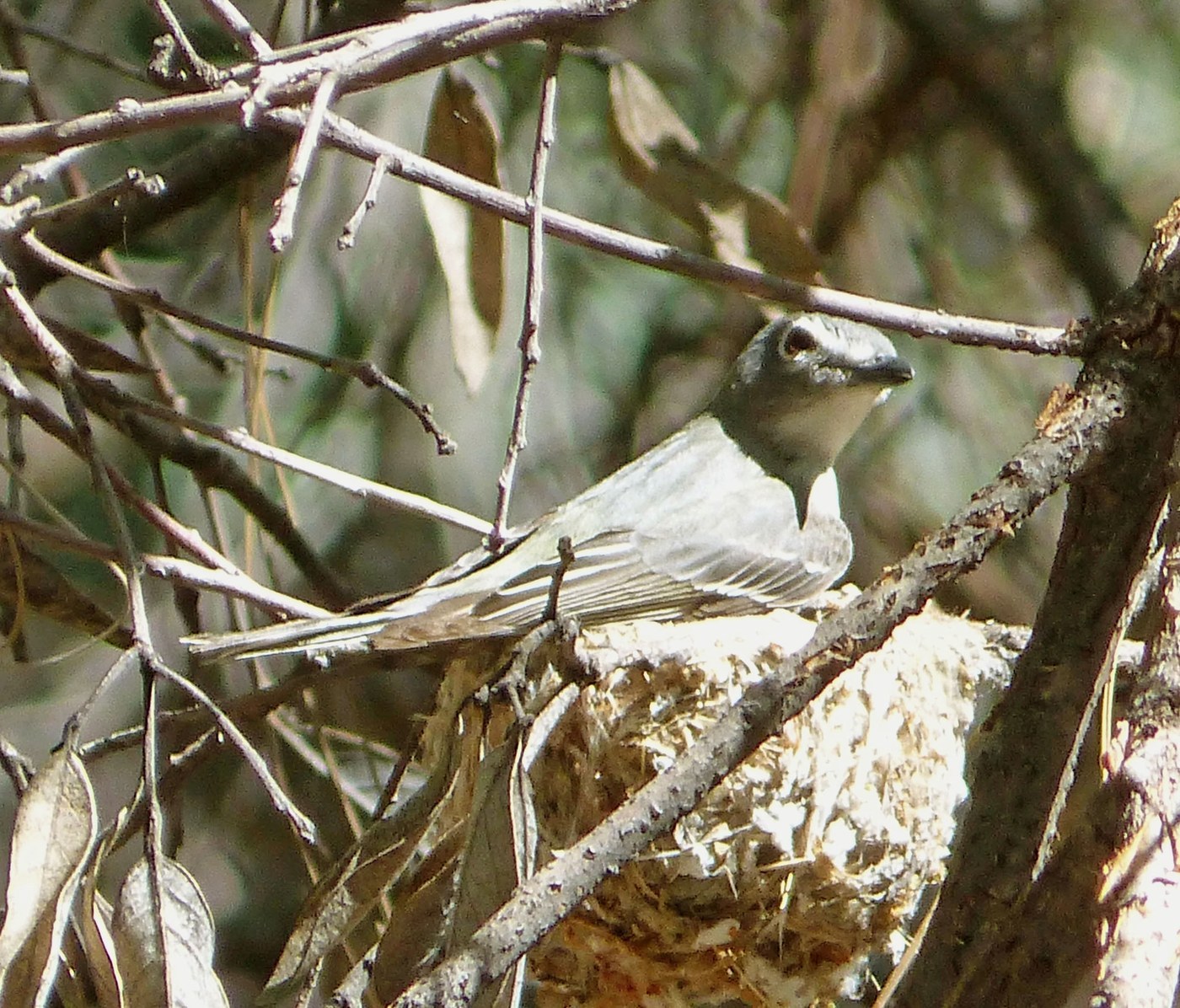
Key Field Marks
- Size & shape: A stocky, big-headed vireo about 5–5.5 inches long, with a thick, slightly hooked bill typical of the genus.
- Plumage: Overall gray above and off-white below, with no green or yellow tones anywhere in adult plumage — this is the single most useful mark.
- Face: Bold white "spectacles" (broken eye-ring plus lores) on a gray face.
- Wings: Two crisp white wingbars on dark gray wing coverts; flight feathers narrowly edged whitish.
- Underparts: Whitish throat and belly with only a faint gray wash on the flanks — never washed yellow.
Separating It From Similar Species
- Cassin's Vireo: Shows a subtle olive-green cast to the back and pale yellow tinge on the flanks; Plumbeous is uniformly gray with no green or yellow.
- Blue-headed Vireo: Has a much bluer-gray hood contrasting with a bright olive-green back and clean yellow flanks; Plumbeous lacks any green or yellow.
- Gray Vireo: Smaller, thinner-billed, plainer-faced (weak or absent spectacles), usually shows only one faint wingbar or none, and habitually pumps its tail — Plumbeous does not.
Habitat, Range & Season
Plumbeous Vireo breeds in dry montane forest, especially ponderosa pine, pinyon-juniper, and pine-oak woodlands across the Rocky Mountains and the interior Southwest (Colorado, Utah, Arizona, New Mexico, west Texas) south into the Mexican highlands. It is a short-to-medium-distance migrant, wintering mainly in Mexico and northern Central America. Look for it from May through August on breeding territory, foraging deliberately in the mid- and upper canopy.
Behavior
Like other vireos, it moves slowly and methodically through foliage, gleaning insects and caterpillars, and pauses often — a much more sedate forager than the warblers it shares habitat with.
Voice
The song is a series of slow, deliberate, robin-like burry phrases separated by pauses: "see-you … see-it … see-here" — husky and unhurried, distinguishable from the faster, sweeter phrasing of Red-eyed Vireo.
Frequently asked questions
What is the easiest way to tell a Plumbeous Vireo from a Cassin's or Blue-headed Vireo?
Check for any hint of green or yellow. Plumbeous Vireo is essentially gray and white with no green back or yellow flanks, while Cassin's shows a faint olive wash and Blue-headed shows bold green and yellow.
Where is the best place to find a Plumbeous Vireo?
Dry pine and pinyon-juniper woodlands in the Rocky Mountains and southwestern US, such as ponderosa pine forest in Colorado, Arizona, and New Mexico, during the breeding season (May–August).
Does the Plumbeous Vireo have wingbars?
Yes, it shows two clean white wingbars, which helps separate it from the plainer-winged Gray Vireo.
Is the Plumbeous Vireo's song different from other vireos?
It sings slow, husky, robin-like phrases with distinct pauses between them, similar in cadence to other solitary vireos but huskier than Red-eyed Vireo's continuous chatter.