
Plum-headed Parakeet Identification Guide
A slender Indian parakeet with a long pointed tail, green body, and — in males — a plum-purple head set off by a black chin stripe and thin turquoise nape band.
Read the full Plum-headed Parakeet encyclopedia entry →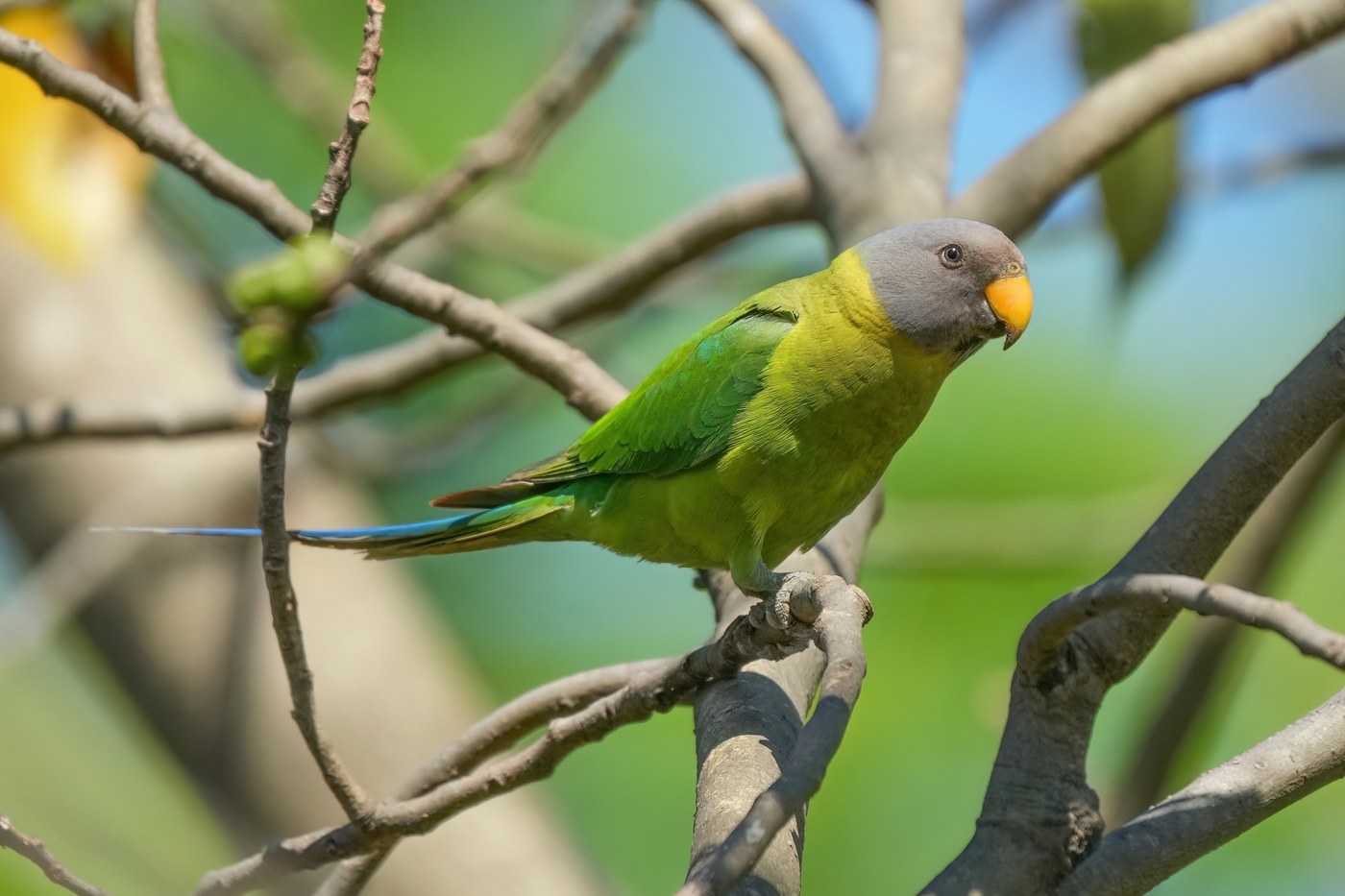
Key Field Marks
- Size & shape: A medium-sized parakeet around 33–36 cm (13–14 in) including its long, tapering, pointed tail, with a slim body typical of the Psittacula parakeets.
- Adult male: A rich plum to pinkish-purple head, a narrow black chin stripe running from the lower mandible, and a thin black ring around the neck bordered above by a slim turquoise-blue band on the nape.
- Adult female: A duller grey-blue to grey head lacking the black neck ring, often with a pale yellowish collar instead; overall softer and less contrasty than the male.
- Bill: Male's upper mandible is yellow to orange-yellow with a darker tip; female's bill is mostly dark, sometimes with a yellowish tip.
- Body: Green overall on both sexes, with a maroon-red patch on the shoulder (lesser wing coverts) often visible at rest and more so in flight.
How to Tell It From Similar Species
- Blossom-headed Parakeet: Very similar but with a paler, more pinkish-lilac (less deep purple) head, more whitish-grey around the eye, and red confined mostly to the upper mandible; ranges are largely separate, with Blossom-headed found further east (Nepal, northeastern India, and into Southeast Asia) while Plum-headed occupies most of peninsular India, Sri Lanka, Pakistan, and Bangladesh.
- Rose-ringed Parakeet: Considerably larger, entirely green-bodied with no purple or grey head, and shows a rose-pink and black neck ring on males rather than a purple head.
- Female Plum-headed vs. female Blossom-headed: Very similar and best separated by range, since female plumages of the two species overlap greatly.
Habitat & Range
Widespread across the Indian subcontinent, including India, Sri Lanka, Nepal, Bangladesh, and parts of Pakistan. It favors open deciduous and dry forest, cultivated land, orchards, and gardens, generally avoiding dense evergreen forest.
Behavior
Usually seen in small, fast-flying flocks that move directly between feeding and roosting sites, often calling continuously in flight. Feeds on seeds, fruit, blossoms, and grain, sometimes visiting cultivated fields and orchards in numbers.
Voice
A shrill, high-pitched screeching call, often likened to a small toy trumpet — higher-pitched and less harsh than the calls of the larger Rose-ringed Parakeet, typically given in bursts as flocks fly overhead.
Frequently asked questions
How do you tell a male from a female Plum-headed Parakeet?
Males have a plum-purple head with a black chin stripe and a thin turquoise nape band plus a partly yellow bill; females have a duller grey-blue head with no black neck ring, sometimes a pale yellowish collar, and a mostly dark bill.
How is Plum-headed Parakeet different from Blossom-headed Parakeet?
Blossom-headed Parakeet has a paler, more pinkish-lilac head with more whitish-grey around the eye and less extensive red on the bill; the two species also largely replace each other geographically, with Blossom-headed found further east into Southeast Asia.
Where is the Plum-headed Parakeet found?
Across the Indian subcontinent — India, Sri Lanka, Nepal, Bangladesh, and parts of Pakistan — in open forest, farmland, orchards, and gardens.
What does a Plum-headed Parakeet sound like?
A shrill, high-pitched screeching call often compared to a small toy trumpet, higher and less harsh than the calls of the larger Rose-ringed Parakeet.