
Pink-footed Goose Identification Guide
A medium grey-brown goose with a dark head and neck, pink legs, and a short bill banded pink in the middle with black at the base and tip.
Read the full Pink-footed Goose encyclopedia entry →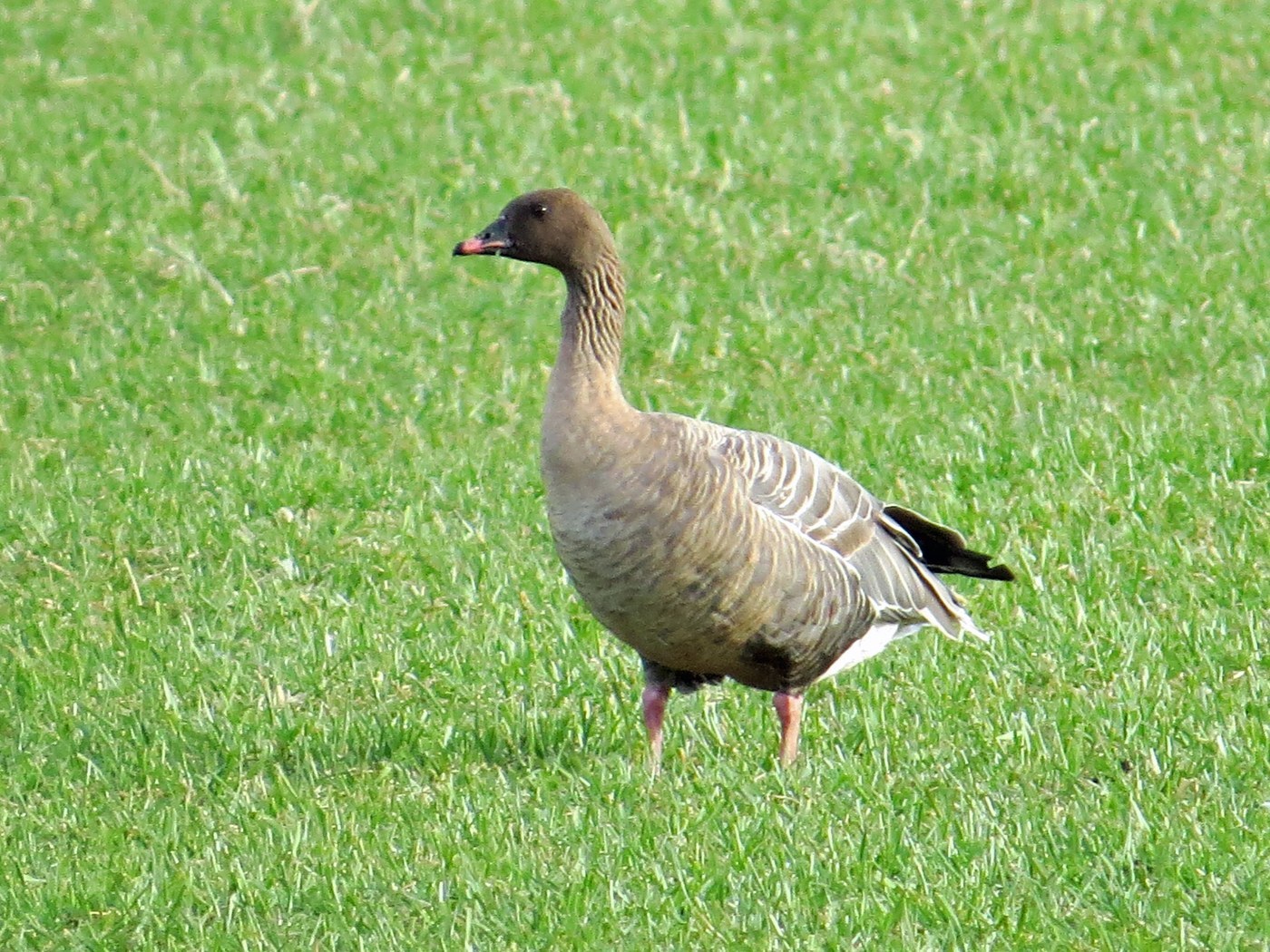
Key Field Marks
- Size: A medium-sized "grey goose," smaller than a Greylag Goose but similar in size to or slightly larger than a Bean Goose.
- Body: Grey-brown overall with a noticeably darker chocolate-brown head and neck that contrasts with the paler grey-brown body — a key mark visible even at a distance.
- Bill: Short and stubby, with a distinctive pattern: black at the base and tip with a pink band across the middle — quite different from the more extensively orange or all-pink bills of similar species.
- Legs: Bright pink, giving the species its name.
- In flight: Shows a pale blue-grey forewing panel typical of "grey geese," and flocks travel in noisy skeins, often in classic V or line formation.
How to Tell It From Similar Species
- Bean Goose (Taiga and Tundra): Has orange legs (not pink) and a mostly orange or orange-yellow bill with a black tip, lacking the Pink-footed's pink leg and pink-banded bill combination.
- Greylag Goose: Larger and paler grey overall, with an all-pink or orange bill lacking strong black at the base and tip, and orange (not pink) legs.
- White-fronted Goose: Shows a white patch at the base of the bill and dark belly barring, both absent in Pink-footed Goose.
Habitat & Range
Pink-footed Geese breed in the high Arctic on Greenland, Iceland, and Svalbard, then migrate to winter in milder areas — chiefly Britain (especially Scotland and England), the Netherlands, Denmark, and Belgium. In winter they favor farmland, stubble fields, grasslands, and estuaries, feeding in large flocks on waste grain, potatoes, and grass, and roosting communally on estuaries, lochs, or reservoirs.
Voice
A high-pitched, nasal, somewhat musical "wink-wink" or "ang-ang" call, higher and more clipped than the deeper honking of a Greylag Goose, often heard well before large skeins come into view overhead.
Frequently asked questions
How do you tell a Pink-footed Goose from a Bean Goose?
Check the legs and bill: Pink-footed Goose has pink legs and a bill that is black at the base and tip with a pink central band, while Bean Goose has orange legs and a mostly orange bill with only a black tip.
Where do Pink-footed Geese spend the winter?
Large numbers winter in Britain (particularly Scotland and eastern England), as well as the Netherlands, Denmark, and Belgium, feeding on farmland and roosting on estuaries and lakes.
Where do Pink-footed Geese breed?
They breed in the Arctic, mainly on Greenland, Iceland, and the Svalbard archipelago.
What does a Pink-footed Goose sound like?
A high-pitched, nasal "wink-wink" or "ang-ang" call, higher-pitched and more clipped than the deeper honk of a Greylag Goose.