
Pine Grosbeak Identification Guide
A large, tame boreal finch — rosy-red in males, golden-olive in females — with a stubby dark bill, long tail, and two white wingbars.
Read the full Pine Grosbeak encyclopedia entry →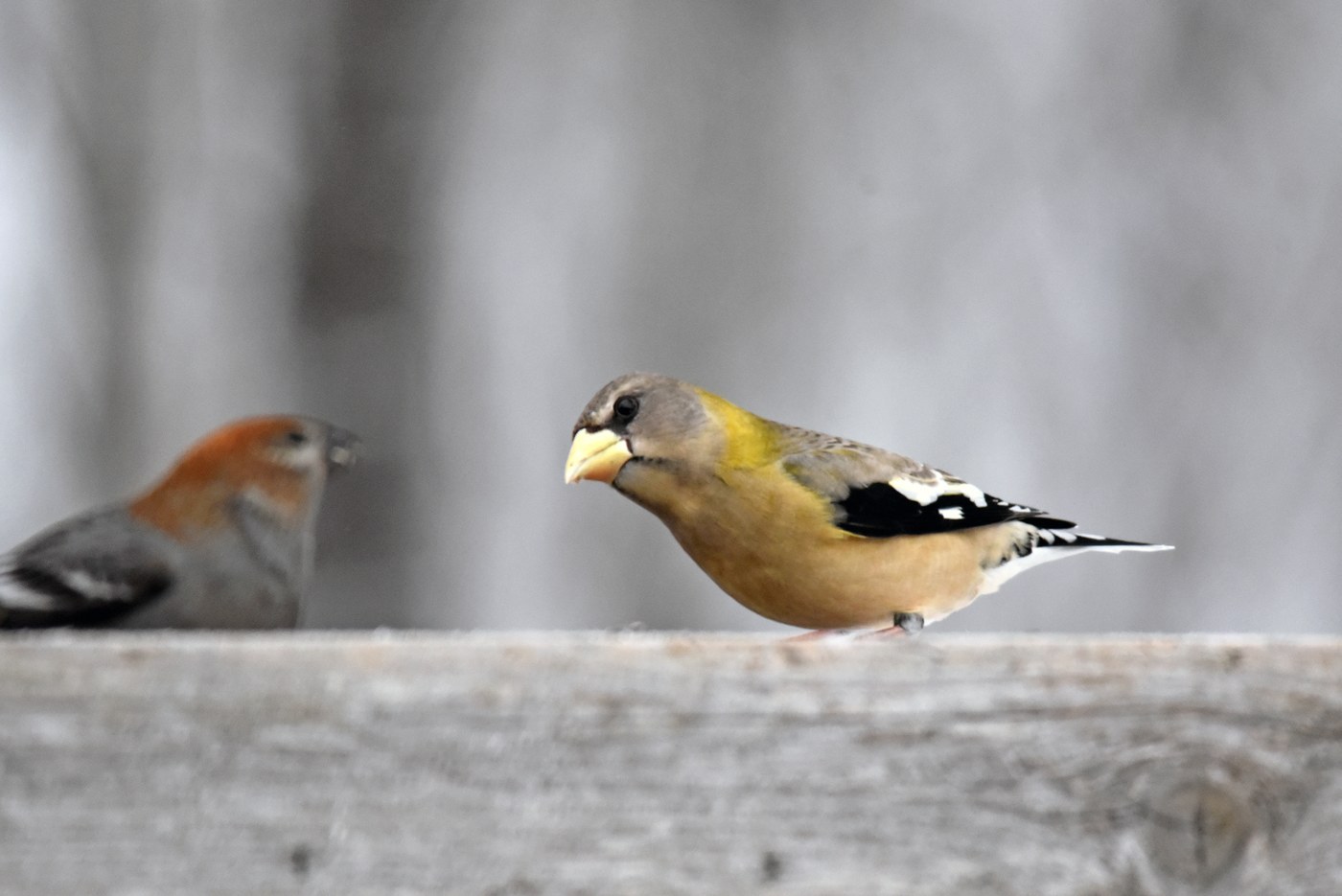
Key Field Marks
- Size & shape: A big, chunky finch, 20–25 cm (8–10 in) long, distinctly larger than most other finches, with a long tail and a short, stout, strongly curved conical bill.
- Adult male: Rosy-red to raspberry-pink over the head, breast, and rump, with grey flanks and belly and blackish wings crossed by two clean white wingbars.
- Adult female / immature: Olive-yellow to golden-tan on the head and rump with a grey body, showing the same white double wingbars as the male.
- Bill: Short, deep, and strongly hooked at the tip — much stubbier than a typical finch bill, adapted for crushing buds and seeds.
- Behavior: Notably tame and slow-moving, often allowing close approach; feeds deliberately on buds, seeds, and berries, frequently in small flocks.
How to Tell It From Similar Species
- Purple Finch / House Finch: Both are much smaller with slimmer, more pointed bills and lack the Pine Grosbeak's bulk and double white wingbars.
- White-winged Crossbill: Smaller, with crossed bill tips (visible at close range) rather than a simple conical bill, and a more streaky, less uniformly colored body.
- Red Crossbill: Also smaller with crossed mandibles and lacks the bold white wingbars typical of Pine Grosbeak.
- Female/immature vs. female Purple Finch: Pine Grosbeak is considerably larger and bulkier, with a stubbier bill and cleaner double wingbars.
Habitat & Range
Pine Grosbeaks breed across the boreal and subalpine coniferous forests of Canada, Alaska, and the mountainous western United States, as well as across northern Eurasia. In winter they can irrupt southward in variable numbers depending on cone and berry crops, sometimes appearing at feeders well south of their normal range, favoring crabapple and mountain-ash berries.
Voice
The flight call is a soft, whistled, three-note "pui-pui-pui," clear and musical. The song is a rich, warbling series reminiscent of a Purple Finch's song but slower and more fluty.
Frequently asked questions
What color is a male Pine Grosbeak?
Adult males are rosy-red to raspberry-pink on the head, breast, and rump, with grey flanks and blackish wings marked by two white wingbars.
How do you tell a Pine Grosbeak from a crossbill?
Pine Grosbeak is noticeably larger and bulkier with a simple, stubby conical bill and bold white wingbars, whereas crossbills are smaller with visibly crossed bill tips.
Why do Pine Grosbeaks suddenly show up at feeders far south of their range?
They are irruptive — in years when boreal conifer seed and berry crops fail, flocks move south in search of food, sometimes turning up well outside their usual range.
Are Pine Grosbeaks tame around people?
Yes, they are known for being unusually approachable and slow-moving compared to most finches, often allowing close observation while feeding.