
Pileated Woodpecker Identification Guide
North America's largest common woodpecker, unmistakable with its crow-sized black body, flaming red crest, and loud, ringing calls echoing through mature forest.
Read the full Pileated Woodpecker encyclopedia entry →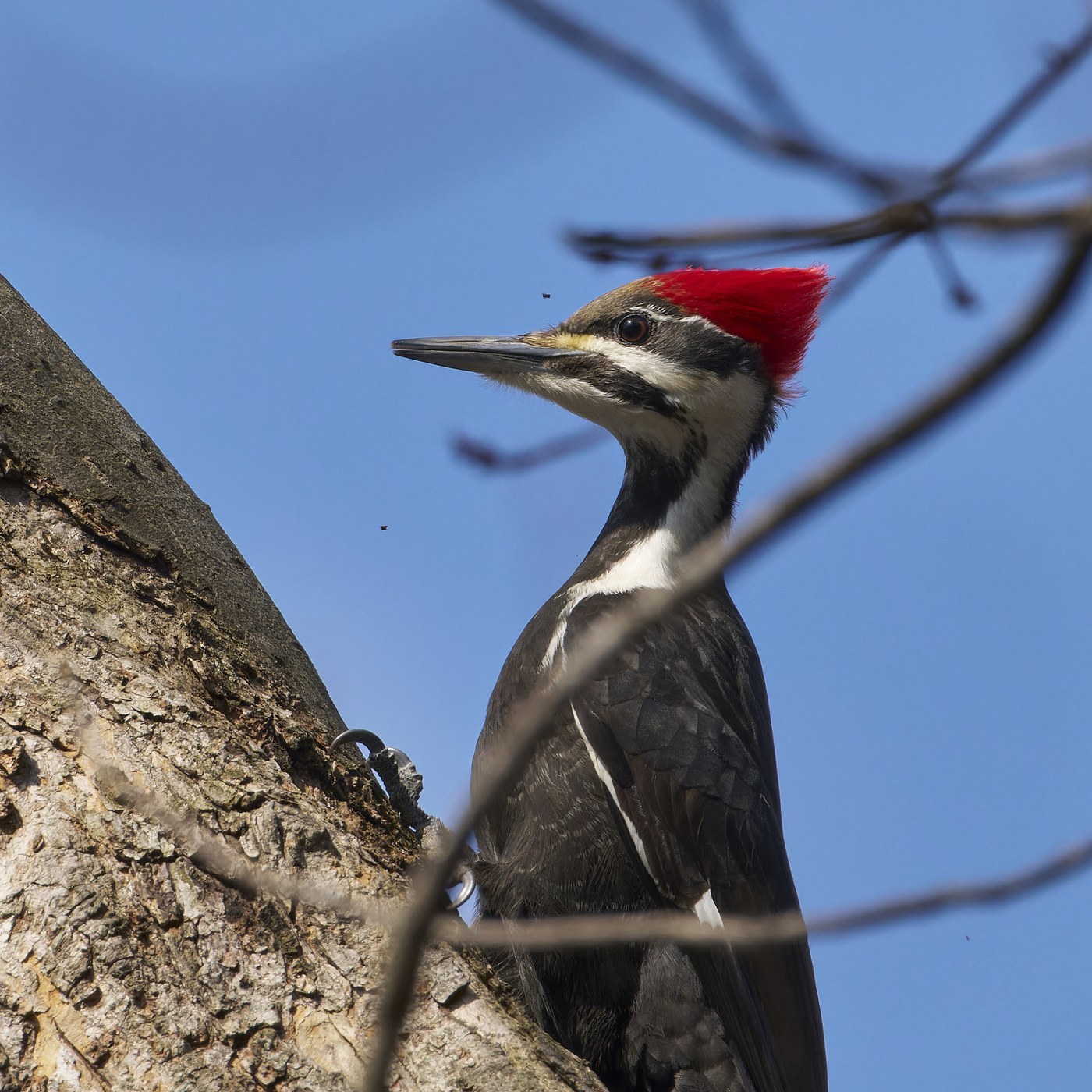
Key Field Marks
- Size: Roughly crow-sized, about 40–49 cm (16–19 in) long with a wingspan near 70 cm (28 in) — by far the largest regularly seen woodpecker in most of North America.
- Plumage: Mostly black body with bold white stripes running down the neck and onto the face; a prominent, pointed flaming-red crest tops the head.
- Sex differences: Males show a red "mustache" (malar) stripe extending from the bill and a red forehead; females have a black malar stripe and a black forecrown, with red confined to the rear crest.
- Bill: Long, chisel-shaped, blackish-grey — well suited to excavating deep into dead wood.
- In flight: Slow, deep, crow-like wingbeats with an undulating flight path; large white patches at the base of the primaries flash conspicuously on both the upper and lower wing surfaces.
Behavior & Sign
Pileated Woodpeckers excavate large, distinctive rectangular or oval holes in dead trees and snags while digging for carpenter ants and wood-boring beetle larvae, leaving piles of coarse wood chips at the base of the tree. They also drum loudly and are usually detected first by sound — either their calls or thunderous, resonant drumming — before being seen.
How to Tell It From Similar Species
- Northern Flicker: Much smaller and browner overall, with a spotted breast and no all-black body or red crest; flicker calls are similar in cadence but higher and thinner.
- Red-headed Woodpecker: Smaller, with a fully red head (not just a crest) and bold white wing patches on an otherwise black-and-white (not all-black) body.
- Ivory-billed Woodpecker (historically, now believed extinct or exceedingly rare): Slightly larger with more extensive white on the trailing edge of the folded wing and a different bill color (pale ivory vs. the Pileated's dark bill); any claimed sighting needs extreme scrutiny given how similar the two species are in silhouette.
Habitat & Range
Found year-round across most of the eastern United States and Canada, the Pacific Northwest, and parts of California, wherever there is mature forest — coniferous, deciduous, or mixed — with enough large dead or dying trees to supply nest cavities and insect prey. It is generally absent from the treeless Great Plains and arid Southwest.
Voice
A loud, irregular, ringing series of "kuk-kuk-kuk-kuk" or "wuk-wuk-wuk" calls, deeper, louder, and less evenly paced than the similar call of a Northern Flicker. Drumming is loud, deep, and resonant, often trailing off slightly in volume at the end of the roll.
Frequently asked questions
How big is a Pileated Woodpecker compared to other woodpeckers?
It is roughly crow-sized, about 40–49 cm long, making it the largest widespread woodpecker in North America — noticeably bigger than the similar-looking but much smaller Northern Flicker.
How can I tell a male from a female Pileated Woodpecker?
Males have a red malar (mustache) stripe and a red forehead; females have a black malar stripe and black forecrown, with red limited to the crest.
What kind of holes does a Pileated Woodpecker make?
Large, distinctly rectangular or oblong excavations in dead wood, often quite deep, made while foraging for carpenter ants and beetle larvae — much larger and more angular than holes made by smaller woodpeckers.
Is the Pileated Woodpecker the same as the Ivory-billed Woodpecker?
No, they are different species, though similar in size and pattern. Ivory-billed Woodpecker has more white on the trailing wing edge and a pale bill, and is considered extinct or exceptionally rare, unlike the fairly common Pileated.
What does a Pileated Woodpecker sound like?
A loud, irregular series of ringing "kuk-kuk-kuk" calls, deeper and less evenly spaced than a Northern Flicker's similar call, plus loud, resonant drumming.