
Pigeon Guillemot Identification Guide
A sooty-black Pacific seabird with a bold white wing patch crossed by a black wedge, bright red legs, and a red gape flashed during noisy cliffside displays.
Read the full Pigeon Guillemot encyclopedia entry →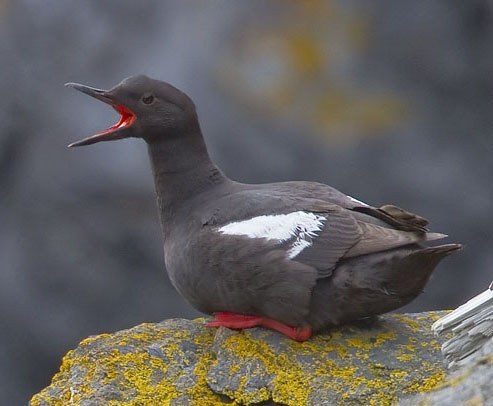
Key Field Marks
- Size & shape: A medium-sized alcid roughly 34 cm (13 in) long, with a plump body, thin dark bill, and rounded head — smaller and slimmer than a murre.
- Breeding plumage: Overall sooty black with a large white patch on the upperwing coverts that is distinctively crossed by a dark wedge or bar — this bisected wing patch is the key mark separating it from its Atlantic relative.
- Bare parts: Bright coral-red legs and feet, and a red mouth lining (visible when the bird calls or gapes during display) contrasting sharply with the black plumage.
- Non-breeding/winter plumage: Mottled grey and white above, whitish below, with the white wing patch still visible but the bird overall much paler and less uniformly dark than in summer.
- In flight: Shows white underwing linings along with the white patch on the upperwing; whirring, direct flight low over the water on rapidly beating wings, typical of alcids.
How to Tell It From Similar Species
- Black Guillemot: The Atlantic counterpart looks nearly identical but has a solid, unbroken white wing patch with no dark wedge through it, and the two species do not normally overlap in range (Black Guillemot is Atlantic/Arctic, Pigeon Guillemot is Pacific).
- Murres and murrelets: Murres are larger with slimmer, dagger-like bills and no white wing patch; marbled and other murrelets are much smaller and lack the bold white wing panel entirely.
Habitat & Range
Pigeon Guillemots are found along the Pacific coast of North America from Alaska south to central California, rarely straying far from shore. They nest in crevices, burrows, or under boulders on rocky cliffs and islands, and forage for small fish and invertebrates in shallow nearshore waters, often diving right off the rocks where they roost.
Voice
They give thin, high-pitched whistling and hissing notes, especially during pair displays at the breeding colony, when birds face off, open their bright red mouths, and trill at one another.
Frequently asked questions
How do you tell a Pigeon Guillemot from a Black Guillemot?
Look at the white wing patch: Pigeon Guillemot has a dark wedge or bar crossing through it, while Black Guillemot's patch is solid white. Range also separates them — Pigeon Guillemot is a Pacific species, Black Guillemot an Atlantic/Arctic one.
What color are a Pigeon Guillemot's legs?
Bright coral to red, matching the red lining of its mouth — both are conspicuous against the black plumage.
Where do Pigeon Guillemots nest?
In crevices, burrows, or under rocks and boulders on rocky sea cliffs and islands along the Pacific coast, usually close to the water.
Do Pigeon Guillemots look different in winter?
Yes — winter birds molt into a mottled grey-and-white plumage that is much paler than the sooty black breeding plumage, though the white wing patch remains visible.