
Pied-billed Grebe Identification Guide
A small, chunky, secretive brown grebe of freshwater ponds, best known for its stout pale bill with a black ring and its loud, unexpected whooping call.
Read the full Pied-billed Grebe encyclopedia entry →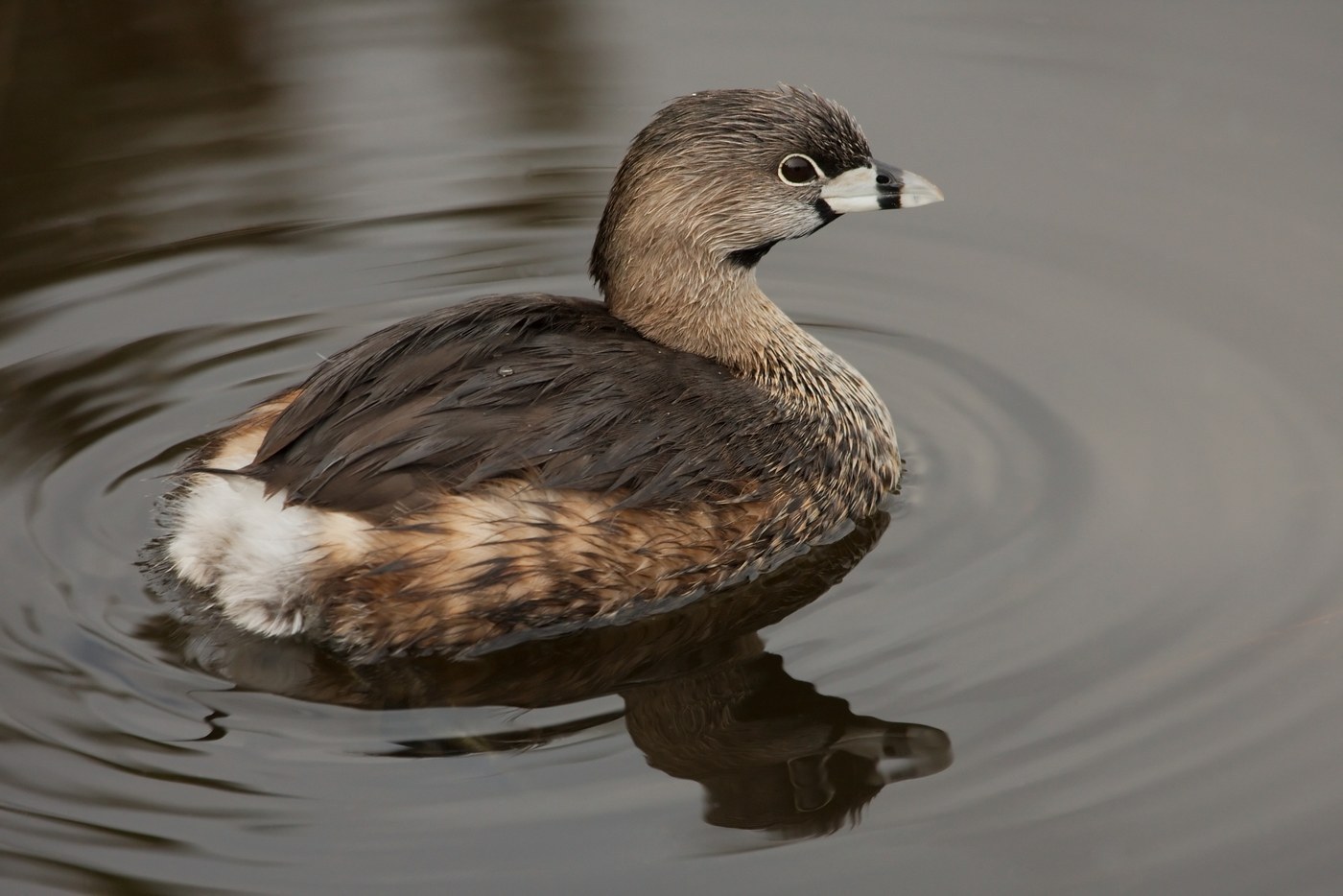
Key Field Marks
- Size and shape: A small, stocky, short-necked grebe with a distinctively thick, chicken-like bill unlike the thinner, pointed bills of most other grebes.
- Plumage (breeding): Plain brown body with a blackish throat patch and a whitish bill crossed by a bold black band — the source of its "pied-billed" name.
- Plumage (nonbreeding): Plainer brown overall, pale throat, and a bill lacking the black band.
- Tail: A small, fluffy white tail tuft is often visible, flicked when alert.
Separating It From Similar Species
- Least Grebe: Smaller and daintier with a thin bill and a bright yellow eye, quite different from the Pied-billed's stout pale bill and dark eye.
- Horned and Eared Grebes: Both have thinner, more pointed bills and, in breeding plumage, ornate head plumes that the plain-headed Pied-billed Grebe never shows.
- The thick, stubby, chicken-like bill is the most reliable mark separating Pied-billed Grebe from every other grebe in its range.
Where and When to See It
Widespread across freshwater ponds, marshes, and lakes with dense emergent vegetation throughout the Americas, from Canada south through the United States, Central America, and much of South America. Northern populations move south in winter, while many southern populations are resident year-round.
Behavior
Notoriously secretive, often slowly sinking its body underwater to hide (rather than diving abruptly) when disturbed, and skulking among reeds and cattails. Dives for small fish, crustaceans, and aquatic insects, and rarely takes flight, preferring to swim or dive away from danger.
Voice
A loud, far-carrying, whooping series often rendered as "kuk-kuk-kuk-cow-cow-cowp-cowp-cowp," surprisingly loud and cackling for such a small, plain, and secretive bird — frequently the first sign of its presence.
Frequently asked questions
What is the best field mark for a Pied-billed Grebe?
Its thick, stubby, chicken-like bill, which in breeding season is pale with a bold black ring around it.
Why is the Pied-billed Grebe hard to see even when present?
It is highly secretive, often sinking slowly underwater to hide among vegetation rather than flying or diving conspicuously when disturbed.
What does a Pied-billed Grebe sound like?
A loud, far-carrying whooping and cackling series, quite unexpected from such a small, plain-looking bird.
Does the Pied-billed Grebe fly often?
Rarely — it strongly prefers to escape danger by diving or swimming away rather than taking flight.