
Pectoral Sandpiper Identification Guide
A migratory shorebird known for its sharply defined, densely streaked breast band that stops abruptly against a clean white belly.
Read the full Pectoral Sandpiper encyclopedia entry →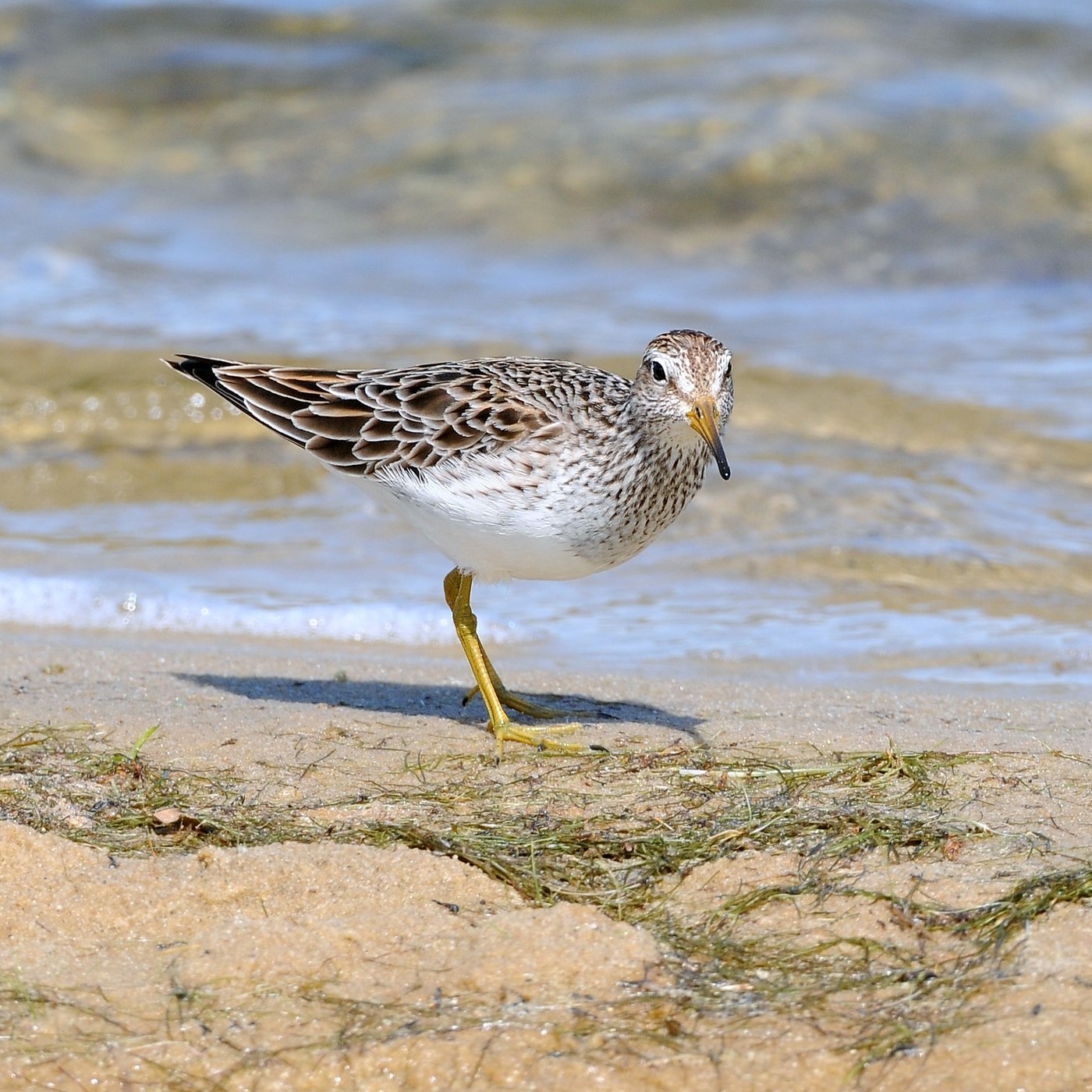
Key Field Marks
- Size & shape: A medium-sized sandpiper, roughly 19–23 cm long, with a moderately long neck, giving it a slightly more upright posture than smaller "peep" sandpipers.
- Breast pattern (key mark): Dense brown streaking covers the breast and ends in a sharp, clean line against the bright white belly, like a distinct bib — the single best field mark for this species.
- Upperparts: Brownish overall with dark feather centers and pale buffy-white fringes, giving a somewhat scaly appearance.
- Bare parts: Bill is fairly straight to very slightly drooped near the tip, dark with a paler base; legs are dull yellowish-green.
- Behavior: Forages methodically by walking through grass and mud with a steady, deliberate gait, picking at the surface rather than probing deeply; often somewhat furtive, crouching low in vegetation when alarmed.
Separating It from Similar Species
- Sharp-tailed Sandpiper: Breast streaking is finer and blends more gradually into the belly rather than stopping abruptly; often shows a more rufous-toned cap.
- Baird's Sandpiper: Smaller, with a buffier, more uniformly scaled breast lacking the sharp demarcation, and a shorter, straighter bill.
- Least Sandpiper: Much smaller, with yellowish legs but lacking the sharply defined breast band and generally streaked more diffusely across the whole underside.
- Ruff (juvenile/female): Larger and structurally different, with a more pot-bellied shape and different leg color; lacks the sharp pectoral demarcation.
Where & When to See It
- Breeding range: Arctic tundra of Siberia and northern North America (Alaska and northern Canada).
- Migration & winter range: Long-distance migrant wintering mainly in South America (especially Argentina) and, in smaller numbers, Australia and New Zealand; regularly seen on migration across the interior of North America.
- Habitat: Prefers wet grasslands, flooded fields, marsh edges, and short-grass wetlands rather than open mudflats or beaches favored by many other shorebirds.
- Season: Passes through temperate regions mainly in spring (April–May) and fall (August–October) migration windows.
Voice
Flight call is a low, hoarse, reedy "trrp" or "krrk," quite different from the higher, thinner calls of many small sandpipers. During courtship, males inflate an air sac in the breast and give a deep, resonant hooting display over tundra breeding grounds.
Frequently asked questions
What is the single best field mark for a Pectoral Sandpiper?
The sharply demarcated, heavily streaked breast band that ends abruptly against a clean white belly, resembling a distinct bib.
How do I separate Pectoral Sandpiper from Sharp-tailed Sandpiper?
Pectoral Sandpiper's breast streaking stops abruptly at a sharp line, while Sharp-tailed Sandpiper's streaking is finer and fades more gradually into the belly.
What habitat should I search for Pectoral Sandpipers?
Wet grasslands, flooded fields, and marshy edges rather than open mudflats or sandy beaches favored by many other sandpipers.
When is the best time to see Pectoral Sandpipers on migration?
Spring migration in April–May and fall migration from August through October, depending on region.