
Paradise Shelduck Identification Guide
A large New Zealand endemic duck with striking sexual dimorphism — a white-headed chestnut female paired with a black-headed, dark-bodied male.
Read the full Paradise Shelduck encyclopedia entry →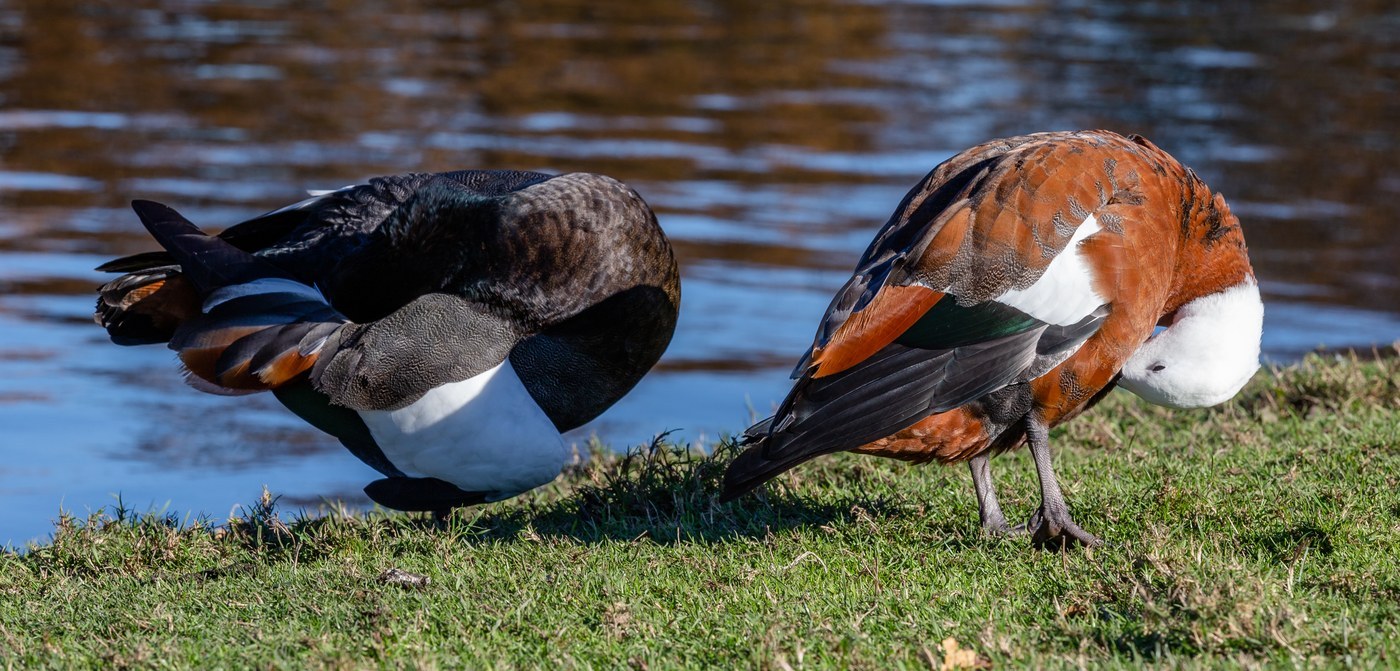
Key Field Marks
- Size & shape: A big, goose-like duck around 63 cm long, with a fairly upright stance and strong direct flight typical of shelducks.
- Male: Black head and neck, dark gray to blackish body finely barred with black, and a chestnut-tinged back; overall looks dark at a distance.
- Female: Strikingly different — pure white head contrasting with a rich chestnut-orange body, making pairs easy to sex even at range.
- In flight: Both sexes show large white wing patches (upperwing coverts) contrasting with black flight feathers and a green speculum.
- Behavior: Usually seen in pairs, which mate for life, or in larger post-breeding flocks; grazes on pasture grasses as readily as it feeds in water, often far from wetlands.
Separating It from Similar Species
- Australian Shelduck: Similar shape and some chestnut coloring, but males lack the black head/chestnut back combination and females lack the pure white head of a female Paradise Shelduck; ranges are largely separate (Australian Shelduck is mainly in Australia).
- No other New Zealand waterfowl shows the combination of a white-headed female paired with a black-headed male, making the species essentially unmistakable within its range.
Where & When to See It
- Range: Endemic to New Zealand, found throughout both the North and South Islands.
- Habitat: Farmland pastures, rivers, lakes, and wetlands; highly adaptable and now common in agricultural landscapes, sometimes considered a pest of pasture due to grazing flocks.
- Season: Resident year-round; forms large flocks outside the breeding season, sometimes numbering in the hundreds at favored molting or feeding sites.
Voice
Sexes have different calls — the male gives a hoarse, wheezy honk, while the female's call is a loud, clear, repeated "zonk-zonk" or "zink-zink," often given in flight.
Frequently asked questions
How do you tell a male and female Paradise Shelduck apart?
The female has a pure white head with a chestnut body, while the male has an all-black head with a darker, barred body — one of the most obvious sexual dimorphisms among ducks.
Is the Paradise Shelduck found outside New Zealand?
No, it is endemic to New Zealand and not naturally found anywhere else.
Do Paradise Shelducks need to be near water?
Not always — they graze extensively on pasture grasses and can be found well away from wetlands in farmland.
What call does a female Paradise Shelduck make?
A loud, clear repeated 'zonk-zonk' call, distinct from the hoarser honking of the male.